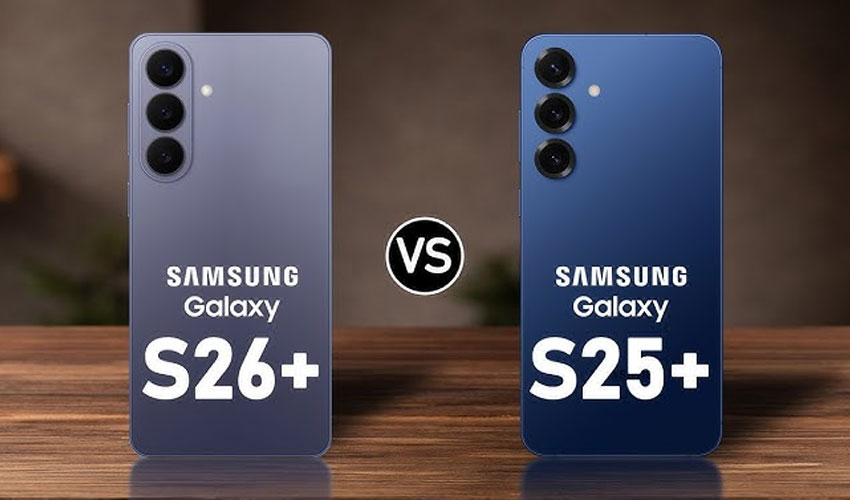
Just over a year after the Galaxy S25 series launch, Samsung has unveiled its new Galaxy S26 lineup. The 2026 flagship family includes the Galaxy S26, S26 Plus and S26 Ultra, sticking to the familiar formula.
But how different is the standard Galaxy S26 compared to last year’s Galaxy S25 — and should you consider upgrading?
The Samsung Galaxy S26 starts at £849, making it more expensive than its predecessor at launch.
In comparison, the Samsung Galaxy S25 debuted at £799/$799. As it’s now a year old, it’s easier to find at discounted prices, and further price drops are expected in the coming weeks.
While the S26 is the most affordable model in the 2026 lineup, it still represents a price increase year-on-year.
Exynos 2600 vs Snapdragon 8 Elite for Galaxy
One of the biggest changes lies under the hood.
Unlike the S25 series — which largely ran on Qualcomm’s Snapdragon 8 Elite for Galaxy chip — the Galaxy S26 and S26 Plus now use Samsung’s own Exynos 2600 processor. Meanwhile, the S26 Ultra runs on the newer Snapdragon 8 Elite Gen 5 for Galaxy. In the US, however, the entire S26 lineup uses Qualcomm’s chip.
Samsung claims the Exynos 2600 delivers up to:
-
39% improvement in NPU performance
-
24% improvement in GPU
-
19% improvement in CPU
While real-world testing is still pending, the Galaxy S25 previously impressed with smooth everyday performance and minimal lag, despite occasional warmth during use. The Snapdragon 8 Elite for Galaxy remains a highly capable chipset for most users.
Slightly bigger battery
Battery capacity has seen a modest bump.
The Galaxy S26 now houses a 4300mAh battery, compared to the Galaxy S25’s 4000mAh cell. While this doesn’t compete with some rivals offering 7000mAh batteries, it’s still a welcome improvement.
The S25 comfortably lasted a full day in regular use, so users can expect similar or slightly better endurance from the S26.
Storage upgrade as standard
A notable change comes in storage options.
The Galaxy S25 was available in 128GB, 256GB and 512GB variants, all paired with 12GB RAM. The Galaxy S26 also retains 12GB RAM across models but drops the 128GB option entirely.
The base Galaxy S26 now starts at 256GB, with a maximum capacity of 512GB. This is a practical upgrade, especially as modern apps and games require increasingly more storage space.
No camera hardware changes
In terms of cameras, there are no major upgrades.
Both the Galaxy S26 and S25 feature the same triple rear camera setup:
-
50MP main sensor
-
12MP ultra-wide
-
10MP telephoto
-
12MP front camera
Samsung’s flagship phones have long been regarded as strong camera performers. However, critics noted that the Galaxy S25’s setup was beginning to fall slightly behind competitors in 2025. The lack of hardware upgrades in the S26 may disappoint users hoping for a significant leap.
Galaxy AI gets smarter
Artificial intelligence remains central to Samsung’s flagship experience.
Both devices support Galaxy AI features such as Circle to Search, Gemini integration and photo editing tools. However, the Galaxy S26 introduces refinements and new capabilities.
Updates to Now Bar and Now Brief provide more personalised and adaptive recommendations. Circle to Search can now identify multiple elements in a single section.
A new feature called “Now Nudge” delivers real-time suggestions based on on-screen activity. For example, if someone messages you requesting specific photos, Now Nudge offers a shortcut to quickly access and share them.
Early verdict: Is it worth upgrading?
The Galaxy S26 brings incremental improvements rather than a major overhaul.
With a slightly larger battery, more base storage and enhanced Galaxy AI features, it’s a refined upgrade. However, the lack of camera changes and the processor split may leave some users hesitant.
For Galaxy S25 or even S24 owners, there may not be a compelling reason to upgrade just yet. A full review will ultimately determine whether the S26 can compete among the best Android smartphones of 2026.






.jpg)