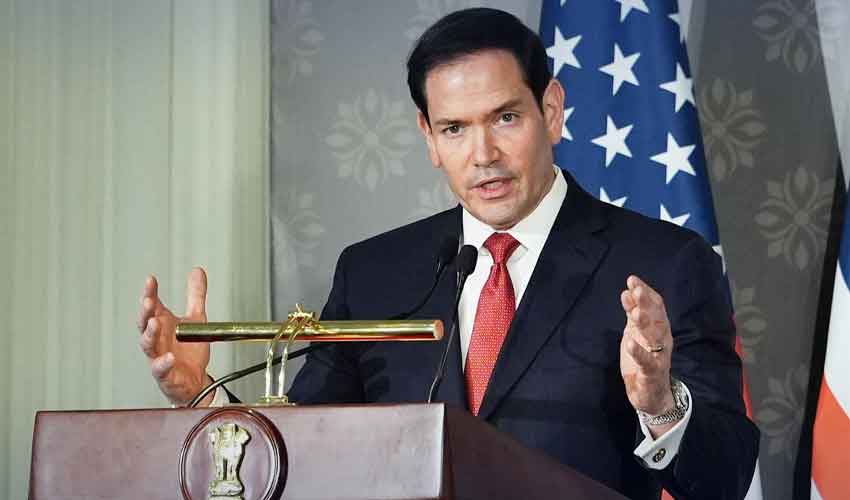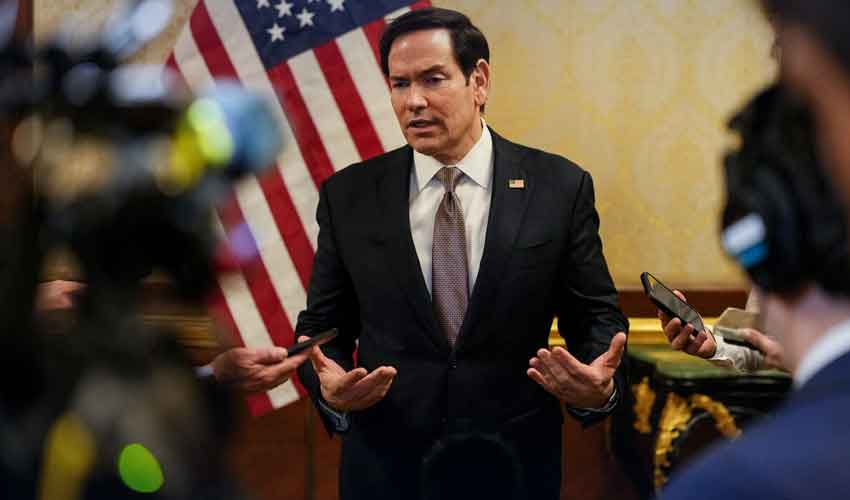
US Secretary of State Marco Rubio has assured Gulf allies that any future agreement with Iran will take their interests into account and will not undermine the security or prosperity of Washington’s longstanding partners in the region.
Speaking at a meeting of Gulf Arab foreign ministers and officials in Bahrain on Thursday, Rubio said the United States is ready for lasting peace in the region but remains committed to protecting its allies.
Rubio said the Strait of Hormuz is an international waterway and no country has the right to impose tolls or fees on vessels passing through it.
“The reality of it is that no country on Earth has the right to charge for the use of international waterways,” Rubio said. “And that will never be an acceptable condition of any deal.”
He added that President Donald Trump had been “fundamentally clear” on the issue.
Bahrain’s Foreign Minister Abdullatif bin Rashid Al Zayani, who chaired the meeting, welcomed Oman’s announcement of a corridor for the safe passage of vessels through the strait.
US seeks lasting peace with Iran
Rubio said President Trump is committed to completing the peace process and moving the region toward stability.
“The United States is ready for lasting peace in the region,” he said. He added that Washington is entering a new phase and hoped it would lead to peace.
Rubio said the United States would ensure that all decisions made during negotiations remain in the interest of the region and allied countries.
Gulf allies assured on security
Rubio’s three-day Gulf tour is the first high-level diplomatic mission since the US-Iran framework agreement was reached last week to end the conflict.
The war began on February 28 with US-Israeli strikes on Iran, after which Tehran targeted several Gulf states and took effective control of the Strait of Hormuz, disrupting oil flows and shaking global energy markets.
At previous stops in the United Arab Emirates and Kuwait, Rubio sought to reassure regional leaders that Washington would not accept any arrangement that was overly favourable to Iran.
“We’re not going to do anything that undermines the security of our allies, our longstanding allies in the region,” Rubio told reporters in Kuwait.
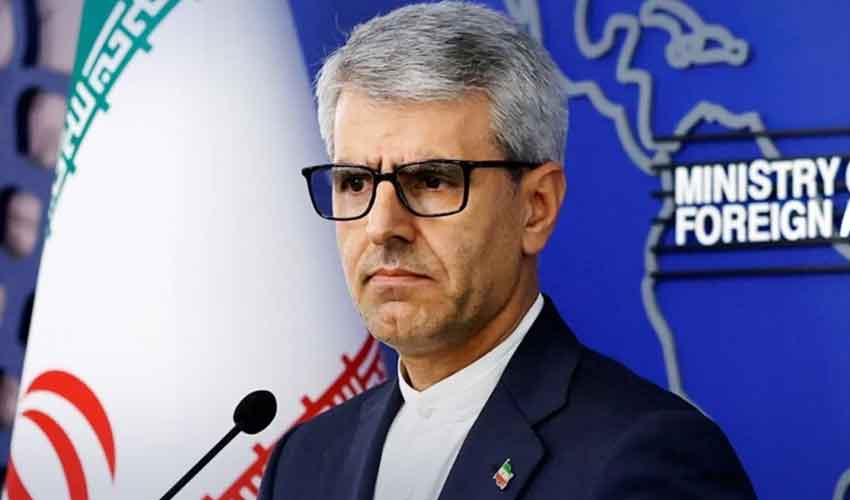
Also Read: Iran warns US against changing terms of post-war MoU
Rubio said the purpose of his Middle East visit was to thank Gulf countries for their help, friendship, cooperation and unity during a difficult period.
All six Gulf Cooperation Council states — Saudi Arabia, Qatar, Oman, the United Arab Emirates, Bahrain and Kuwait — are strategic US allies and provided varying levels of logistical support to Washington during the war.
However, they were also affected by Iranian airstrikes during the conflict, increasing concerns over any deal that could strengthen Tehran.
Iran nuclear issue remains central
Rubio said Iran cannot be allowed to possess nuclear weapons. His remarks came amid continuing uncertainty over the exact terms of the preliminary US-Iran accord.
President Trump said on Tuesday that Iran had agreed to nuclear inspections “into infinity,” while Tehran denied making such a concession, raising fresh questions about the fragile peace process.
Conflicting accounts over deal terms
The United States and Iran have also offered conflicting accounts about financial incentives for Tehran, control of the Strait of Hormuz and Israel’s parallel war in Lebanon.
Rubio has acknowledged the sensitivity of his mission as Gulf Arab leaders remain wary that excessive concessions could alter the regional security balance and affect oil flows.
Also Read: US-Iran technical talks to resume in Switzerland next week: Rubio
The draft US-Iran agreement includes no limits on Iran’s ballistic missiles, a proposed $300 billion reconstruction fund and provisions that could expand Tehran’s regional influence and control over critical oil shipping lanes.
Rubio has said he would not ask Gulf allies to contribute to the reconstruction fund during the trip, even though the memorandum suggests regional countries could be partially responsible for financing it.
Lebanon-Israel talks also discussed
Rubio also said talks between Lebanon and Israel are ongoing in Syria.
He linked the broader diplomatic push to Washington’s effort to reduce regional tensions and move toward a more durable peace framework.
Some US Gulf allies are privately disappointed over the interim deal, fearing it could open the door to US normalisation with Iran.
Most Sunni-led Gulf Cooperation Council states view predominantly Shiite Iran as their main regional adversary.
Together, the GCC countries form the backbone of the US security architecture in the Middle East, and any reassessment of their relationship with Washington could have major implications for US military strategy in the region.