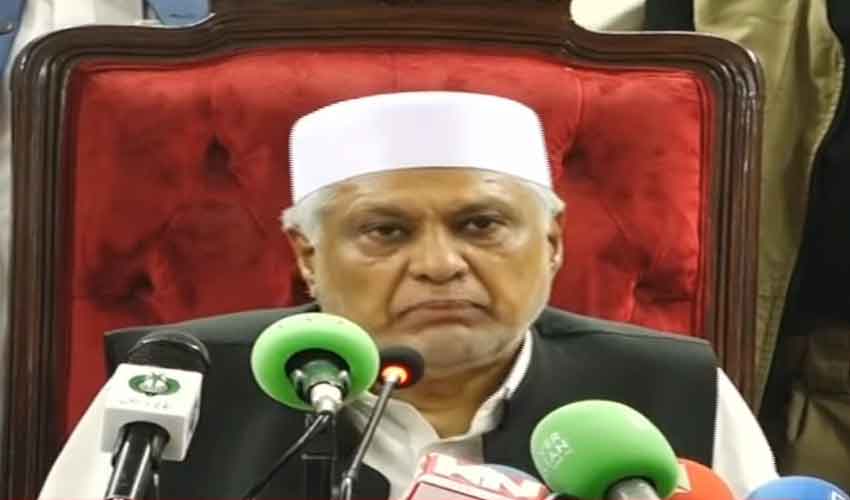
Deputy Prime Minister and Foreign Minister Ishaq Dar has said Pakistan's successful diplomacy during the Iran conflict and its victory against India have transformed the country's international standing, with the world now recognising Pakistan as a peacemaker, a middle power and a net security provider.
Addressing a gathering in Lahore, Dar said Pakistan had demonstrated both diplomatic and military strength and must now focus on becoming an economic power.
Dar said God honoured Pakistan by entrusting it with the role of mediator during the US-Iran conflict. He credited Prime Minister Shehbaz Sharif, Field Marshal Asim Munir and the Foreign Office for working together to facilitate the agreement.
"The Foreign Ministry played the role of mediator as a team," he said.
Referring to criticism that Pakistan had once been diplomatically isolated, Dar said the situation had completely changed.
"It was said Pakistan had been left diplomatically alone. Today, Pakistan is resonating across the world," he said.
According to the deputy prime minister, countries that previously knew little about Pakistan now recognise its growing diplomatic importance.
Pakistan now viewed as peacemaker
Dar said Pakistan was once unfairly labelled a terrorist country by some quarters, but today the international community considers it a peacemaker.
He added that Pakistan had become the only country to strongly condemn the attack on the "brotherly Islamic country of Iran."
"I was in Madinah after attending an OCI meeting when Iran was attacked," he said.
According to Dar, no other country issued such a strong condemnation. He said Pakistan also remained engaged with Iran throughout the conflict and urged restraint.
"We explained to Iran that Muslims are also being martyred in other countries," he said, adding that Tehran had been responding to repeated attacks.
Extensive diplomatic engagement
Dar said he remained in constant contact with his counterparts throughout the conflict, holding more than 150 conversations.
He said Prime Minister Shehbaz Sharif also maintained regular communication with world leaders, while Field Marshal Asim Munir carried out backchannel diplomacy.
According to Dar, the field marshal engaged both sides in efforts to reduce tensions. He said Pakistan successfully brought two countries to the negotiating table after 47 years.
"As a mediator, we cannot make the trust public," he said while explaining why certain diplomatic details could not be disclosed.
Islamabad MoU and venue changes
The deputy prime minister revealed that Pakistan had offered to host the negotiations. He said the agreement was initially scheduled to be signed in Geneva but was later shifted to the G7 Summit at the request of US President Donald Trump.
According to Dar, the venue for technical negotiations was also changed at Washington's request, while Bürgenstock in Switzerland was ultimately selected following Qatar's recommendation.
He said the agreement is officially called the "Islamabad Memorandum of Understanding". "The first peace talks will be written in Islamabad," he said.
Pakistan must now become economic power
Dar said Pakistan has already demonstrated its diplomatic and military capabilities and must now become an economic power. He credited former Prime Minister Zulfikar Ali Bhutto with launching Pakistan's nuclear programme and former Prime Minister Nawaz Sharif with completing it.
"Allah Almighty made Pakistan a nuclear power. Now Pakistan has to become an economic power," he said. He added that Prime Minister Shehbaz Sharif is working day and night to strengthen the country's economy.
Recalling Pakistan's economic performance in 2017, Dar said the country had become the world's 24th-largest economy. He said inflation had fallen to 3.59%, foreign exchange reserves had increased and Pakistan's economic growth was attracting attention from Western countries.
"Then what happened is history," he remarked.
He said Pakistan slipped from 24th to 47th place over the following four years.
According to Dar, the coalition government later stabilised the economy and the country is now moving towards renewed growth and development.
He acknowledged that repairing the damage inherited between 2017 and 2022 would take time but said economic indicators are now improving. He added that the government had tried to provide as much public relief as possible in the latest federal budget.
Respect for Pakistan's passport
Dar said Pakistan's international standing has improved significantly. "Now people respect Pakistan's passport," he said.
He credited Pakistan's victory in the conflict with India and its successful diplomacy during the Iran crisis for changing global perceptions.
He added that Pakistan remains a peace-loving nation committed to following the United Nations Charter and respecting the independence and sovereignty of all countries.
The deputy prime minister said Pakistan remains committed to peace but will firmly defend its sovereignty. "Those who look at Pakistan with an evil eye will be gouged out," he said.
He also described Pakistan as the "fortress of the Muslim Ummah" and said the country has an important leadership role in the Muslim world.
Concluding his address, Dar expressed confidence that Pakistan possesses all the resources needed for future progress and that the country's diplomatic success would now be followed by economic strength.