US President Donald Trump has said that the agreement reached with Iran will serve as a strong barrier against the acquisition of nuclear weapons and that Iran will not be able to develop or obtain a nuclear weapon.
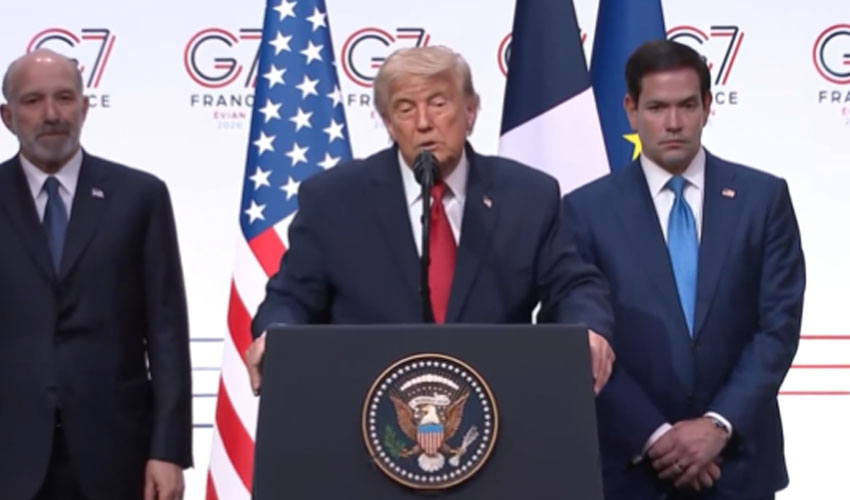
Speaking at a press conference following the G7 leaders' summit, Trump said the world could have faced an economic crisis comparable to the Great Depression of 1929 if the Strait of Hormuz had remained closed. He said the waterway is of exceptional importance to global trade and energy supplies, and its closure would have had far-reaching consequences for the world economy.
Trump claimed that diplomatic progress with Iran and the agreement reached between the two countries contributed to the reopening of the Strait of Hormuz, helping to restore stability in international markets. He said it would not have been possible to guarantee the passage remained open without the agreement.
The US president said his administration remains committed to preventing Iran from acquiring a nuclear weapon and is continuing diplomatic and strategic efforts to achieve that objective. He said reduced tensions in the region and uninterrupted energy supplies had helped restore confidence in global markets.
Trump said recent developments had contributed to a decline in global crude oil prices, raising expectations of relief for consumers and economies in several countries. He added that stability in energy markets remains essential for global economic growth and that the United States would continue its efforts in that regard.
He also said significant progress had been made in keeping the Strait of Hormuz open while pursuing measures to prevent Iran from obtaining nuclear weapons, helping to avert a potential economic crisis.
Trump stated that the United States had frozen substantial Iranian assets, describing them as Iranian funds. He said those assets may eventually be returned, adding that failure to do so could undermine international confidence in the US dollar.
The US president said Washington would not finance Iran’s reconstruction, although private investment could take place if Iran complied with the terms of the agreement. He also said access to a reported $300 billion fund would depend on Iran’s conduct.
Addressing concerns in Israel, Trump said the agreement secured the principal objective sought by Israeli Prime Minister Benjamin Netanyahu: preventing Iran from obtaining a nuclear weapon. He said he believed Israeli leaders would be satisfied with that outcome.
Trump said the memorandum of understanding with Iran could contribute to wider regional stability and expressed hope it would become the foundation of a broader peace arrangement across the Middle East. He also said the agreement could help end conflict and instability in Lebanon.
The US president thanked Pakistan and Qatar for their role in facilitating negotiations. He said both countries had worked diligently to support diplomatic efforts.
Trump said maritime traffic through the Strait of Hormuz had already increased and that normal energy flows would resume in the coming days. He added that technical discussions on the removal of Iran’s enriched uranium stockpiles would begin immediately.
French President Emmanuel Macron described the agreement as a positive development, saying it could help end fighting from the Strait of Hormuz to Lebanon while reducing economic and humanitarian risks across the region.
Trump said the agreement with Iran would be signed shortly and reiterated that Iran would neither produce nor acquire a nuclear weapon. He added that a copy of the agreement had been sent to Israel.
He maintained that without the agreement, the Strait of Hormuz would not have remained open and global markets would have faced heightened uncertainty.



.gif)
.jpg)