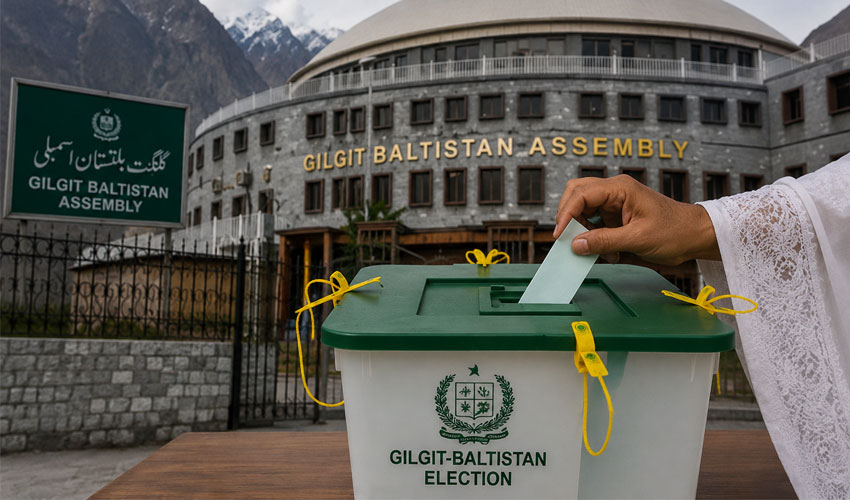
Polling for 24 general seats in the Gilgit-Baltistan elections ended at 5pm on Sunday, with voting continuing without interruption from 8am throughout the day.
Large numbers of voters turned out at polling stations across the region and cast their ballots with enthusiasm. Vote counting is now under way following the close of polling, while the release of unofficial and provisional results has begun.
Women participated in significant numbers in the electoral process. Elderly and special persons also took part actively. Long queues of voters were seen at polling stations during the day, while the overall law and order situation remained satisfactory.
A closely contested race was witnessed among the Pakistan Peoples Party (PPP), Pakistan Muslim League-Nawaz (PML-N) and Istehkam-e-Pakistan Party (IPP).
A total of 403 candidates, including eight women, are contesting the election. More than 963,000 registered voters were eligible to cast ballots to elect their representatives.
According to the Election Commission, 1,391 polling stations were established across all districts of Gilgit-Baltistan. Of these, 349 were declared sensitive and 551 highly sensitive.
The PPP fielded 23 candidates, PML-N 22, IPP 15, Pakistan Muslim League-Quaid (PML-Q) 11 and JUI-F nine candidates. Majlis Wahdat-e-Muslimeen (MWM) fielded seven candidates, while Jamaat-e-Islami and MQM each fielded six candidates. In addition, 266 independent candidates are contesting from various constituencies.
Extensive security arrangements were put in place to ensure peaceful polling. Large contingents of local police, Gilgit-Baltistan Scouts and Punjab Police personnel were deployed across the region.
Gilgit-Baltistan Chief Election Commissioner Raja Shahbaz Khan said he visited various polling stations and reviewed the electoral process. He thanked the public for participating in large numbers and said voting was continuing at polling stations where voters remained present at closing time.
He said more than 15,000 security personnel were deployed for election duty and described the polls as historic. According to the chief election commissioner, voter turnout reached around 70 per cent, exceeding the level of enthusiasm witnessed during the 2020 elections.
Raja Shahbaz Khan said no complaints had been received and added that elections across Gilgit-Baltistan were conducted in a peaceful environment.
More than 400 candidates in the fray
A total of 403 candidates, including 396 men and eight women, are contesting the elections across the 24 constituencies.
Among the major political parties, the Pakistan Peoples Party (PPP) has fielded 23 candidates, followed by the Pakistan Muslim League-Nawaz (PML-N) with 22 candidates.
The Istehkam-e-Pakistan Party (IPP) is contesting 15 seats, while the Pakistan Muslim League (PML) has fielded 11 candidates. The Jamiat Ulema-e-Islam-Fazl (JUI-F) is in the race with nine candidates.

The Majlis Wahdat-e-Muslimeen (MWM) has nominated seven candidates, while Jamaat-e-Islami and MQM-Pakistan have fielded six candidates each.
A large number of 266 independent candidates are also contesting the elections.
Assembly composition, govt formation
The Gilgit-Baltistan Assembly consists of 33 seats, including 24 directly elected general seats, six reserved seats for women, and three seats for technocrats.
Following the election results, a party or coalition will require 17 seats to secure a simple majority and form the government.
Security tightened across the region
Authorities have completed all arrangements to ensure peaceful polling across the region.
Security has been strengthened with the deployment of local police, Gilgit-Baltistan Scouts, and a large contingent of Punjab Police.
According to sources, Punjab Police has deployed 10,000 personnel to Gilgit-Baltistan for election duties, where they will remain until the completion of the electoral process. Another 1,400 Punjab Police personnel have been sent to Islamabad to assist local authorities.
Law enforcement agencies also conducted flag marches in various constituencies ahead of polling day.
Election officials confirmed that polling staff and election materials have been delivered to polling stations across the region.
Postal ballots were accepted until midnight before polling day, while authorities reiterated that voters must present a valid national identity card to cast their vote.
Officials also warned that no one would be allowed to prevent women from exercising their right to vote and that legal action would be taken against any violations.
District-wise polling station breakdown
According to the Election Commission's final classification list, Gilgit district has the highest number of polling stations at 253, including 51 normal, 48 sensitive, and 154 highly-sensitive polling stations.
Skardu has 208 polling stations, comprising 88 normal, 51 sensitive, and 69 highly-sensitive stations.
Ghizer has 207 polling stations, including 83 normal, 52 sensitive, and 69 highly-sensitive stations.
Diamer has 174 polling stations, of which 33 are normal, 22 sensitive, and 119 highly-sensitive — the highest number of highly-sensitive polling stations in any district.
Ghanche has 154 polling stations, including 89 normal, 39 sensitive, and 26 highly-sensitive stations.
Astore has 108 polling stations, comprising 40 normal, 34 sensitive, and 34 highly-sensitive stations.
In Hunza, authorities have established 88 polling stations, including 33 normal, 31 sensitive, and 24 highly-sensitive stations.
Nagar has 85 polling stations, with 28 normal, 39 sensitive, and 18 highly-sensitive polling stations.
Shigar has 71 polling stations, including 31 normal, 23 sensitive, and 17 highly-sensitive stations.
Kharmang has 43 polling stations, comprising 12 normal, 10 sensitive, and 21 highly-sensitive stations.
Election officials said all polling stations have received election materials, while security forces have conducted flag marches in various constituencies ahead of polling day.
Key battleground districts
Politically significant districts include Diamer and Skardu, which each have four constituencies, the highest in the region.
Gilgit, Ghizer and Ghanche each have three constituencies, while Nagar and Astore have two constituencies each.
The districts of Hunza, Shigar and Kharmang have one constituency each.
In Nagar's GBA-4 constituency, election preparations were completed ahead of polling, with more than 29,900 voters expected to cast their ballots. Authorities established 25 polling stations for men and 23 for women, while strict security measures remain in place.
A close contest is expected among candidates backed by the PPP, PML-N and Tehreek-e-Islami Pakistan.
Meanwhile, in Diamer district, election officials established 173 polling stations, including 68 for men, 67 for women, and 38 combined polling stations. More than 158,000 voters are expected to exercise their right to vote in the district.
Election campaigning officially ended on June 5 under Election Commission regulations, paving the way for voters to decide the region's political future.
With polling under way across all 24 constituencies, the results will determine which party or alliance secures enough support to form the next government in Gilgit-Baltistan.




.gif)
.jpg)