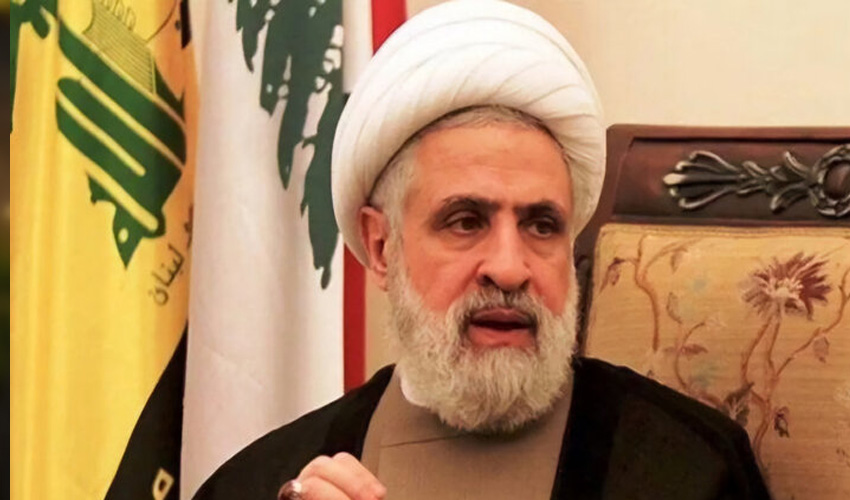
Hezbollah’s deputy chief Naim Qassem has categorically rejected mounting international calls for the disarmament of the powerful Lebanese group, saying such demands only serve Israeli interests and undermine Lebanon’s sovereignty.
Speaking on the first anniversary of the Israeli killing of senior Hezbollah commander Fuad Shukr, Qassem said the resistance movement would “not submit to Israel” or give up its arms, as pressure from the United States and other international players intensifies.
“Those who call for submitting arms practically demand submitting them to Israel,” Qassem said in a televised address. “We will not submit to Israel.”
The remarks come amid renewed diplomatic efforts to stabilise Lebanon’s southern border, where Israeli air raids and ground operations have continued despite a ceasefire agreement brokered in November last year.
According to sources cited by Reuters, Washington is pressing Beirut to issue a formal cabinet decision pledging the full disarmament of Hezbollah — a precondition for further talks on halting Israeli military operations in the country.
The ceasefire terms had stipulated that Hezbollah would redeploy its fighters north of the Litani River — about 30 kilometres from the Israeli border — leaving the Lebanese army and United Nations peacekeepers to patrol the southern region. However, implementation has faltered amid disputes over compliance and sovereignty.
Hezbollah has publicly resisted surrendering its weapons in full, though some reports suggest the group has internally considered scaling back its arsenal. Qassem, however, dismissed such speculations.
“Those who call for disarmament on a domestic, global or Arab level serve the Israeli project,” he said, accusing US special envoy Tom Barrack of pushing for disarmament solely for Israel’s benefit.
“Their demand to remove our missiles and drones is because these weapons scare Israel. But Israel will not be able to defeat us, and it will not be able to take Lebanon hostage,” Qassem declared.
He further clarified that Hezbollah considers the ceasefire agreement to be limited strictly to areas south of the Litani, distancing its military posture elsewhere from the ongoing diplomatic wrangling.
“Linking our weapons to the agreement is unacceptable. Our arms are a Lebanese internal matter and have nothing to do with the Israeli enemy,” he maintained.
Diplomatic sources told AFP on condition of anonymity that the Lebanese government is facing “serious international and regional pressure” to take an official stance on Hezbollah’s disarmament through a cabinet resolution.
However, Beirut has demanded that Israel first withdraw from five strategic positions it still occupies in southern Lebanon, a condition reportedly rejected by US mediators.
Lebanese Prime Minister Nawaf Salam has called a cabinet session for next week to discuss “the extension of state sovereignty over all its territories exclusively by its own forces.” The agenda is also expected to include Ambassador Barrack’s disarmament proposal and its implications for the ceasefire’s long-term enforcement.
The disarmament debate has sharply divided Lebanese political opinion, with Hezbollah’s allies backing its resistance posture while others call for a stronger central state free from non-state armed groups.
As diplomatic talks continue, Hezbollah remains steadfast in its stance that its arms are essential to deterring Israeli aggression.
“Israeli aggression must stop,” Qassem concluded, reiterating that any talks on the future of Hezbollah’s weapons would only follow a complete Israeli withdrawal from Lebanese territory.




.gif)

.jpg)