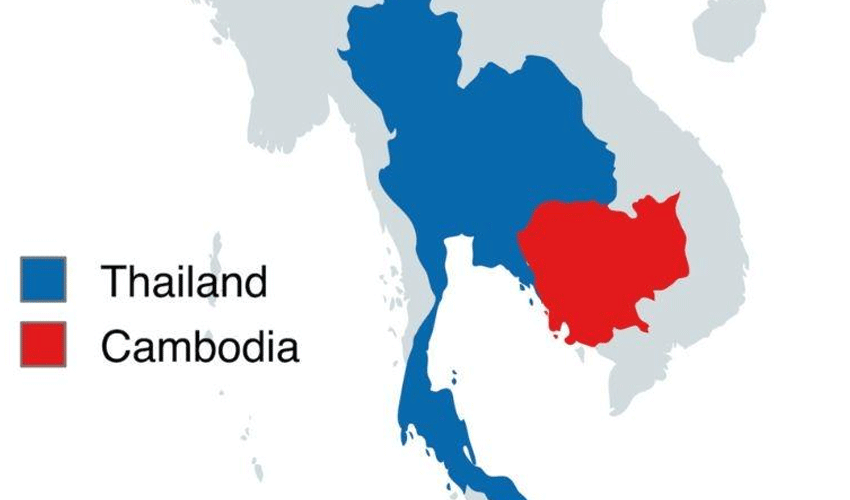
Tensions between Thailand and Cambodia have sharply escalated after deadly border clashes left at least 12 people dead, prompting mutual accusations of military aggression, civilian casualties, and diplomatic warnings from key regional stakeholders.
According to the Thai health minister, Somsak Thepsuthin, 11 civilians and one soldier from Thailand have been killed in the latest exchange of fire between the two neighbours.
Speaking to the media, the minister went further, alleging that Cambodian forces had also targeted a hospital, calling the action a "war crime."
In a detailed statement, Thailand's military condemned what it described as “Cambodian actions of using weaponry,” which it claims led to the deaths and injuries of several civilians in provinces close to the border. Notably, the army listed the following incidents:
-
Six civilians killed and two injured in Ban Phue, Sisaket province;
-
Two fatalities, including an eight-year-old boy, reported in Surin province;
-
One death and one injury in Nam Yuen district, Ubon Ratchathani;
-
One person wounded in Ban Kruad district, Buriram province.
The army also reported significant damage to residential structures and agricultural assets.
Thailand has since sealed several border crossings with Cambodia, citing security concerns.
Conflicting narratives
Both sides presented sharply contrasting versions of events.
According to Thailand’s National Security Council, the escalation began early Thursday morning when Cambodian forces deployed surveillance drones near the disputed border. Following failed attempts at verbal negotiation, the Thai military claims Cambodian troops opened fire around 8:20am, forcing a retaliatory response. They further allege that Cambodia used heavy weapons, including BM-21 rocket launchers and artillery, causing substantial damage on the Thai side.
In contrast, Cambodia's Ministry of National Defence accused Thailand of initiating hostilities by breaching a standing agreement and placing barbed wire around a culturally sensitive Khmer-Hindu temple near the frontier. Cambodian officials allege that Thai troops opened fire around 8:46am, prompting Cambodian forces to “exercise their right to self-defence.”
Speaking to the Phnom Penh Post, ministry spokesperson Maly Socheata accused Thailand of deploying air strikes and excessive troop movements.
Call for peace — and force
Cambodian Prime Minister Hun Manet posted a statement on Facebook urging calm but asserting that his country “has no choice but to respond with military force against the armed aggression.” The message emphasised that while Cambodia values peaceful conflict resolution, it will defend its sovereignty if provoked.
His father and former leader, Hun Sen, echoed the sentiment, asking citizens to continue daily activities except in the border regions.
In a significant diplomatic step, Cambodia has called on the United Nations Security Council to hold an emergency session. In a letter addressed to Council President Asim Iftikhar Ahmad, Prime Minister Hun Manet wrote, “Considering the recent extremely grave aggressions by Thailand... I earnestly request you to convene an urgent meeting of the Security Council to stop Thailand’s aggression.”
China expresses concern
China, a major ally of Cambodia and an influential actor in the region, has expressed deep concern over the escalating violence. During a press briefing, Foreign Ministry spokesperson Guo Jiaku urged both nations to resolve their differences through “dialogue and consultations.” He added that China would play a “constructive role” in de-escalating the situation and warned Chinese citizens to avoid travel to border areas.
The Chinese Embassy in Cambodia issued an advisory urging its nationals to remain vigilant and avoid regions close to the conflict zone.


.gif)
.jpg)