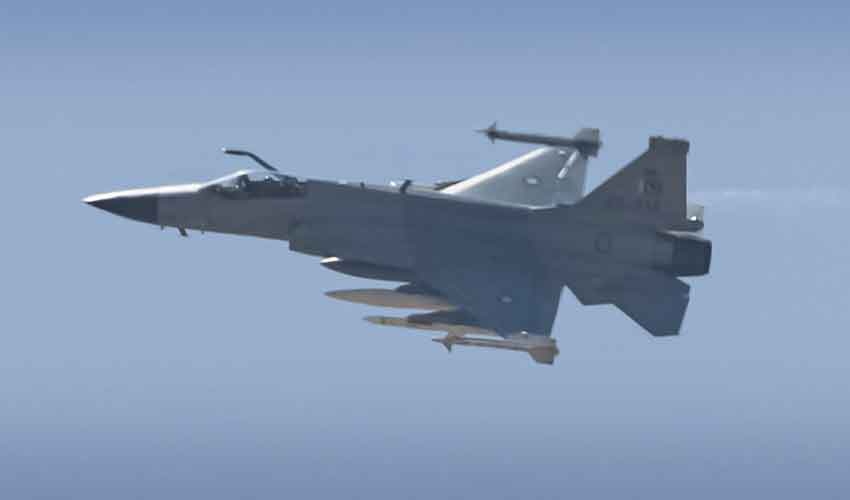
In response to Indian aggression last week, Pakistan's armed forces launched Operation Bunyanum Marsoos on May 10, targeting key Indian military installations, according to a detailed statement released by the Inter-Services Public Relations (ISPR) on Monday.
The operation was part of the broader military conflict dubbed 'Marka-e-Haq', and came after what Pakistan called “dastardly attacks” by the Indian military on the nights of May 6 and 7, which killed multiple innocent civilians, including women, children, and the elderly.
“Pakistan had vowed justice and retribution. Pakistan's armed forces have delivered the promise made to our people,” the ISPR said.
ISPR described the operation as a “textbook demonstration” of tri-services integration involving the army, air force, and navy, enabled by "real-time situational awareness, network-centric warfare capabilities, and seamless multi-domain operations" supported by cyber and information warfare capabilities.
"This synergy… allowed for precision engagement, overwhelming lethality, and lightening operational tempo. All platforms operated in synergy, delivering coordinated effects at carefully selected decisive points," the statement added.
Using precision-guided long-range Fatah F1 and F2 missiles, precision munitions of PAF, highly capable long-range loitering killer munitions, and precision long-range artillery, Pakistan reportedly struck 26 high-value military targets in both Indian Illegally Occupied Jammu and Kashmir (IIOJK) and mainland India.
Major Indian military bases targeted
According to ISPR, Indian Air Force and aviation bases that had played a role in the civilian attacks were struck, including:
-
Suratgarh, Sirsa, Bhuj, Naliya, Adampur, Bhatinda, Barnala, Halwara, Awantipura, Srinagar, Jammu, Udhampur, Mamun, Ambala, and Pathankot
-
BrahMos missile storage facilities in Beas and Nagrota, reportedly responsible for launching missiles on Pakistan targeting civilians, including women and children
-
S-400 air defense systems in Adampur and Bhuj, said to be neutralised
-
Military logistics and support sites, which helped the Indian operation against Pakistan -- like field supply depot at Uri and radar station at Poonch
-
Military command HQs such as 10 Brigade and 80 Brigade at KG Top and Naushera, alleged planners of attacks on civilians
-
Facilities which harboured, trained, and capacitated proxy elements that perpetrated terrorist attacks inside Pakistan, including intelligence units and their forward field elements at Rajauri and Naushera
-
Across the LoC, military elements, including headquarters, logistic bases, artillery positions, and posts that had caused civilian casualties in Azad Jammu and Kashmir through unprovoked artillery and small arms fire, until they raised white flags and asked for restraint
Cyber warfare and drone operations
The ISPR also disclosed that Pakistan conducted comprehensive and effective cyber operations, degrading Indian military infrastructure and digital networks used in the conflict.
Moreover, dozens of Pakistani armed drones flew over sensitive political and government facilities, including capital New Delhi, and from India-held Kashmir all the way to Gujarat to demonstrate lethal long-range unmanned capability to deter Indian use of drones for psychological intimidation.
"Pakistan Armed Forces possess an ‘adequate’ suite of very sophisticated ‘niche military technologies’, and only a limited number and type were used with restraint in this conflict," the ISPR statement said.
Restraint despite aggression
Despite the scale of India's actions, ISPR emphasized that the response was “proportionate, precise, and restrained,” aimed solely at military targets directly involved in "orchestrating and executing the cold-blooded killings of Pakistani civilians" to avoid civilian casualties.
“Only a limited number and type of our advanced technologies were used... The objective was to deliver justice without unnecessary escalation,” the military stated.
Indian-backed terrorism in KP and Balochistan
While the eastern front remained active, ISPR revealed that Pakistan also faced an abnormal and immediate spike in Indian-sponsored terrorism in Khyber Pakhtunkhwa and Balochistan. Counter-terrorism operations were carried out simultaneously, ensuring national security on both fronts.
Nation stands united
The ISPR expressed gratitude to the Pakistani nation for its "unwavering moral strength, resolve, and above all, wholehearted support and prayers", calling public support the “potent force multiplier”. It also acknowledged the role of:
-
Youth as frontline cyber and information warriors
-
Media for countering Indian media’s disinformation blitz and reckless war-mongering
-
Scientists and engineers for developing indigenous and specialized niche technologies
-
Diplomatic corps for presenting Pakistan’s case globally with clarity and conviction.
-
Political leadership across all parties for united support
-
Prime Minister and Cabinet for taking bold, “destiny-altering decisions”
“Marka-e-Haq has shown that the nation stands united. Whenever our sovereignty is threatened, our response will be decisive and overwhelming.”





.gif)
.jpg)