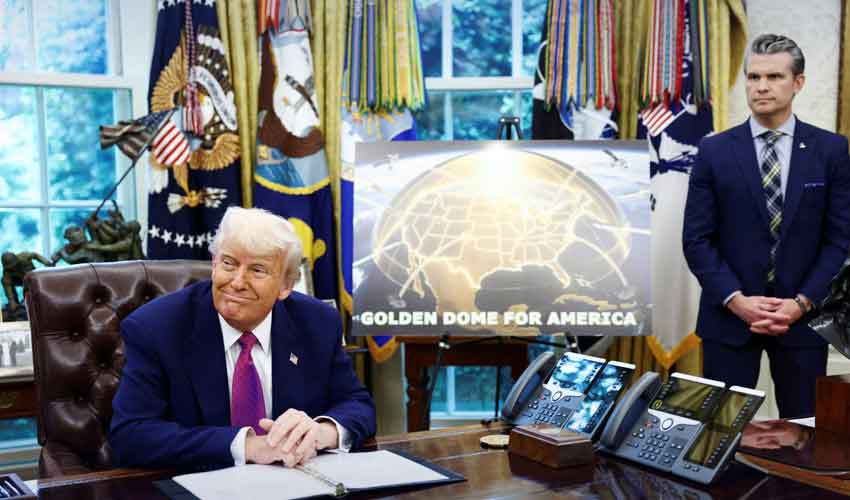
The United States has successfully completed the first live-intercept milestone test of the Golden Dome missile defence system, a flagship security initiative championed by President Donald Trump.
US Secretary of Defense Pete Hegseth described the test as a “full mission success,” saying it marked a major step toward creating a next-generation shield designed to protect the American homeland from evolving missile and aerial threats.
The Pentagon said the classified exercise took place at an undisclosed military testing range and evaluated the system’s ability to operate autonomously in dense electronic warfare conditions.
According to defence officials, the test involved advanced directed-energy technologies that successfully detected, tracked and neutralized multiple simulated incoming aerial threats simultaneously.
Today, the first milestone test of Golden Dome for America (GDA) was a full mission success — and I was honored to witness it firsthand.
— Secretary of War Pete Hegseth (@SecWar) June 24, 2026
Cutting edge directed energy was harnessed and the Dynamic Defense Autonomous Defeat (DDAD) system flawlessly and autonomously cued, targeted,…
Hegseth said he witnessed the test firsthand and praised the performance of both military personnel and the technology involved.
“Today, the first milestone test of Golden Dome for America was a full mission success — and I was honored to witness it firsthand,” he wrote on X.
Advanced technology neutralised multiple threats
According to the Department of Defense, elite warfighters worked alongside next-generation systems to stop incoming drones and cruise missiles before they could reach their targets.
Hegseth said cutting-edge directed-energy weapons were used during the exercise, while the Dynamic Defense Autonomous Defeat (DDAD) system autonomously detected, targeted and eliminated multiple threats. He added that the test was completed on schedule and that every simulated threat was successfully defeated.
“The DDAD system flawlessly and autonomously cued, targeted and eliminated a multitude of incoming threats,” Hegseth said.
Defence officials released limited technical details about the trial, stating that it combined prototype space-based sensors with terrestrial directed-energy systems. The technologies tested included high-energy lasers and high-power microwave systems designed for boost-phase interception.
Boost-phase interception aims to destroy hostile missiles shortly after launch, before they can deploy multiple warheads or release countermeasures into orbit.
Officials said the successful integration of these systems represented a significant advancement in missile defence capabilities.
Reagan-era missile defense ambitions
The Golden Dome project has been one of President Donald Trump’s signature defence priorities since he launched the initiative through an executive order in January 2025.
The system has frequently been compared to former President Ronald Reagan’s Strategic Defense Initiative, commonly known as the “Star Wars” program, as well as Israel’s Iron Dome missile interception system.
However, Golden Dome is designed on a much larger scale, with the goal of defending the entire United States against advanced threats from major military powers such as Russia and China.
Hegseth said Trump is turning Reagan’s Strategic Defense Initiative vision into reality.
“With Golden Dome, the Department of Defense will defend our homeland more powerfully than ever before. Golden Dome is real, powerful and on track,” he said.
Part of broader US defense architecture
The defense secretary said the project is being developed in close coordination with key military commands, including NORAD, US Northern Command, US Space Command and other Department of Defense stakeholders.
According to Hegseth, the goal is to ensure complete interoperability and real-time integration with America’s existing defense infrastructure.
He said the system is intended to address a rapidly evolving threat landscape and ensure the United States is not left vulnerable as adversaries develop more advanced long-range weapons.
Funding and political support
Hegseth said the successful milestone was made possible through funding provided under what he called the “One Big Beautiful Bill.”
He described Golden Dome as the “ultimate shield” to protect the United States and emphasized that the project is intended to strengthen deterrence against both nuclear and non-nuclear strategic attacks.
“The Department remains committed to providing our nation with a strong, credible deterrent,” he said.
Despite the technological breakthrough, the project continues to face intense political and fiscal scrutiny in Washington.
Earlier this month, a report from the Congressional Budget Office (CBO) estimated that deploying and maintaining the complete Golden Dome architecture could cost as much as $1.2 trillion over the next two decades.
The estimate far exceeds the Trump administration’s original projection of approximately $175 billion. The significant gap between the two figures has sparked criticism from lawmakers and budget analysts.
Critics question long-term feasibility
Several Senate Democrats have cited the CBO findings while accusing the administration of overstating the significance of early-stage testing to justify what they view as an unrealistic defense program.
Critics argue that controlled testing environments do not necessarily reflect the complexity of real-world battlefield conditions and have questioned whether the project can deliver on its ambitious promises.
Supporters, however, contend that the successful test demonstrates the potential of emerging technologies to transform missile defense and strengthen national security.
As development continues, Golden Dome is expected to remain at the center of debate over America’s future defense strategy, technological innovation and military spending priorities.