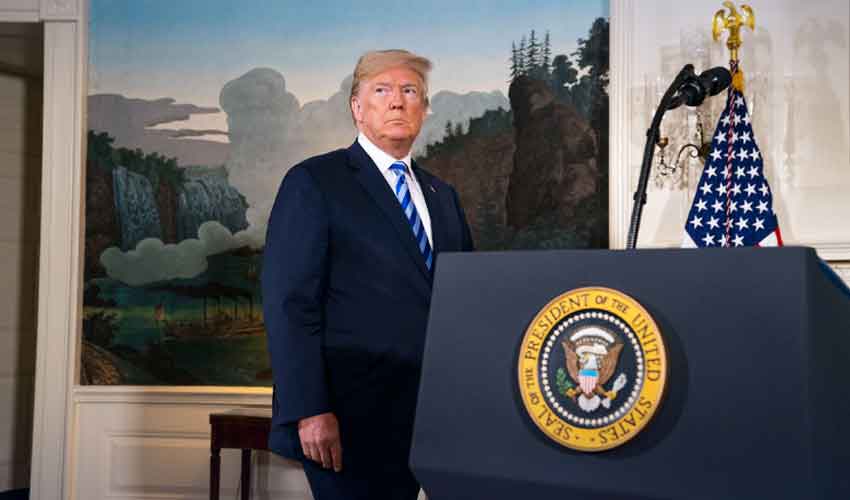
US President Donald Trump has said his administration is working toward a “fair deal” with Iran, expressing optimism over negotiations despite public disagreements between Washington and Tehran over nuclear inspections, sanctions relief and the Strait of Hormuz.
Speaking to reporters, Trump said the United States had placed Iran under “extraordinary pressure” and insisted Tehran would never be allowed to acquire a nuclear weapon.
“We’re trying to work out a fair deal with Iran,” Trump told reporters, adding that the United States and Iran were “getting along well” as negotiators work to finalise an agreement aimed at ending months of conflict.
Trump said inspectors would go to Iran “at the appropriate time,” but added that there was “no rush” for their deployment.
The remarks came after Washington and Tehran reached a framework agreement intended to end hostilities and open the way for broader talks on Iran’s nuclear programme.
Dispute over nuclear inspections continues
Trump dismissed Iranian reports that Tehran had rejected nuclear inspections, insisting that Iran had already agreed to the plan as part of the peace framework.
“They’re wrong. They know they’re wrong. They told us inside, and we have it down, 100 percent, inspections. And if they were right, I’d cancel the meetings right now,” Trump said when asked about Iran’s denial.
The US president said Iran had agreed to inspections of its nuclear facilities, adding that negotiations would not have been possible without this concession.
Iran denies making new nuclear commitments
Iranian officials, however, have publicly disputed Washington’s claim.
Iran’s foreign ministry told state media that no new commitments had been made regarding nuclear inspections. Iranian state media and the foreign ministry also strongly denied that Tehran had accepted fresh nuclear obligations.
Also Read: Trump claims Iran agrees to nuclear inspections, Tehran denies
The Trump administration, along with US Vice President JD Vance, who landed in the UAE as part of his Gulf visit, maintains that Iran has agreed to allow International Atomic Energy Agency inspectors back into the country and has conceded that it will not possess nuclear weapons.
IAEA access remains limited
The International Atomic Energy Agency inspected an operating Iranian nuclear site in early June during a routine visit to the Bushehr nuclear power plant.
However, the agency has not had access for nearly a year to nuclear facilities damaged during the 2025 US-Israeli conflict with Iran.
Trump did not provide a specific timeline for when inspectors would be on the ground in Iran, saying only that it would happen “at the appropriate time.”
Strait of Hormuz remains central to deal
Trump said that after Iran’s concession on inspections, it was agreed to keep the Strait of Hormuz open and lift the blockade.
In a social media message, he said all ships would remain in their positions until a final agreement is reached. The US president also said that 19 million barrels of oil passed through the Strait of Hormuz on Tuesday, describing it as a new record so far.
“Yesterday, 19 million barrels of oil passed through the Strait of Hormuz,” Trump said in another message.
Washington has agreed to a 60-day sanctions waiver on Iranian crude oil and petrochemical exports as part of the framework.
The United States will also permit Iran to access portions of its frozen funds, but Trump said the released money would remain under Washington’s control.
According to Trump, the funds would only be spent on the purchase of food and medical supplies, including US humanitarian goods.
Lebanon issue also part of negotiations
Trump also said matters regarding Lebanon would move forward positively, suggesting that “things will move forward well” on the issue.
Lebanon remains one of the major sticking points in the broader framework, as Washington and Tehran continue discussions linked to ending months of regional conflict.
Despite Trump’s optimistic tone, both sides have continued to offer conflicting accounts of what has actually been agreed.
While Washington says Iran has accepted long-term nuclear inspections and agreed it will not possess nuclear weapons, Tehran insists that no final deal has been reached on those issues.
The disagreement has kept attention focused on the fragile framework agreement as both countries continue negotiations toward a final settlement.