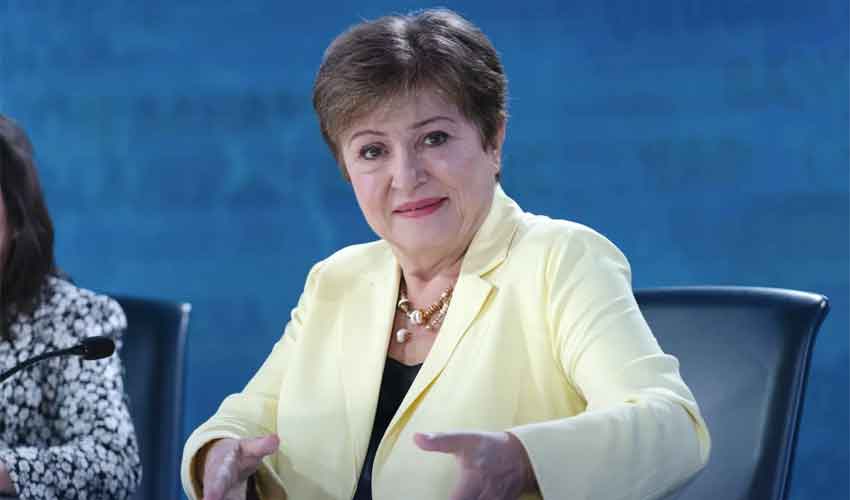
IMF Managing Director Kristalina Georgieva has welcomed the US-Iran ceasefire and the reopening of the Strait of Hormuz, saying the global economy has remained stable despite the Middle East conflict, though major risks still persist.
Georgieva said the Fund welcomes the ceasefire agreement between the United States and Iran.
She also welcomed the decision to reopen the Strait of Hormuz, a key global energy route whose disruption had raised concerns over oil supplies and international markets.
Global economy stable, but risks remain
The IMF chief said there are currently no clear signs of a slowdown in the global economy. Despite the war in the Middle East, she said, the global economy has so far shown resilience and stability.
However, Georgieva warned that risks remain and could still affect growth if energy prices stay elevated.
Georgieva said the IMF will release its new forecast for global economic growth on July 8. In April, the IMF had estimated global growth at 3.1%.
She said the Fund is closely monitoring the impact of geopolitical tensions, energy costs and inflationary pressures on different regions.
Oil prices remain above pre-war levels
Despite the ceasefire, oil prices are still around 30% higher than before the war, according to the IMF chief.
Georgieva warned that expensive energy could push up the cost of fertilizers and food, creating fresh pressure on households and governments. She said rising energy prices remain a serious concern for both developed and developing economies.
Georgieva said petrol prices in emerging Asian economies have risen by nearly 40%. African countries, meanwhile, are facing fuel shortages, rising inflation and growing fiscal pressure.
In Europe, expensive energy is putting pressure on economic activity and slowing growth momentum.
Gulf economies may also slow
The IMF chief said the economic growth of several oil-exporting Gulf countries may also be affected. Although higher oil prices can support revenue, prolonged instability and market uncertainty may weigh on investment and economic planning.
Georgieva said the economies of the United States and China are continuing to move forward at a strong pace. Their resilience has helped support the broader global outlook, even as other regions face pressure from energy costs and geopolitical uncertainty.
Countries seek policy guidance
According to Georgieva, most countries are currently seeking policy guidance rather than direct financial assistance from the IMF. She said the Fund is working with several countries on changes to debt programs and new support measures where needed.




.gif)
.jpg)