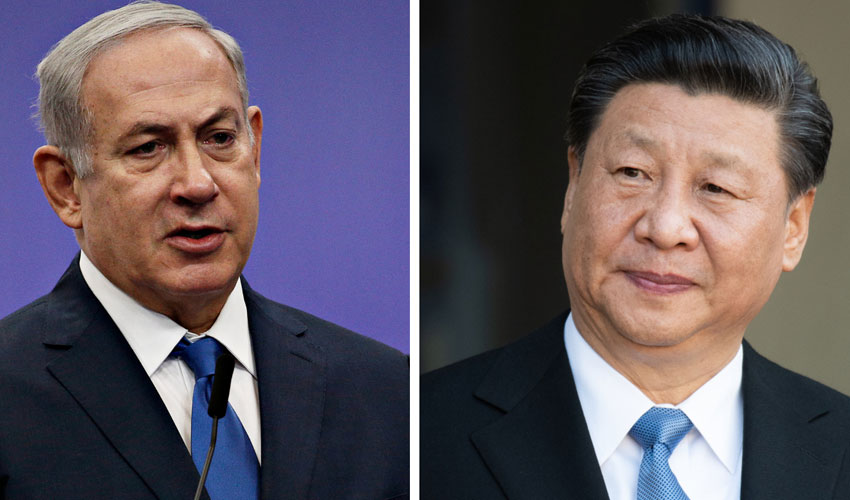
Prime Minister Benjamin Netanyahu on Monday accused China and Qatar of mounting a political campaign to isolate Israel, comparing it to Iran’s military pressure through regional proxies.
Speaking to U.S. lawmakers, he admitted Israel now faces rising international isolation and may need to rely on itself economically and militarily.
Addressing a bipartisan delegation of 250 U.S. legislators in Jerusalem, Netanyahu said both Democrats and Republicans remain valued allies but cautioned that “an active effort” is underway to weaken that support.
He likened the campaign to a “political blockade,” accusing China and Qatar of orchestrating attacks on Israel’s legitimacy across social media platforms in Europe and the United States.
According to Netanyahu, “large Islamist minorities in western Europe” aligned with Hamas and Iran are fueling pressure on governments through “violent protests and constant intimidation.”
Qatar hosts Arab and Islamic leaders
The Israeli leader’s remarks came as Qatar hosted a high-level summit of Arab and Islamic nations in Doha. The meeting aimed to present a united front against Israel following its strikes on Hamas leaders in the Qatari capital last week.
RELATED: Pakistan proposes Arab-Islamic Task Force to hold Israel accountable
During the summit, Qatar’s emir Sheikh Tamim bin Hamad Al Thani accused Israel of seeking to make Gaza “no longer livable,” intensifying tensions ahead of the United Nations General Assembly session.
US support amid international condemnation
U.S. Secretary of State Marco Rubio also visited Israel on Monday to signal Washington’s continued backing. Netanyahu told him, “Your presence here in Israel today is a clear message that America stands with Israel. You stand with us in the face of terror.”
The visit comes as Israel braces for sharp criticism and possible resolutions against its Gaza operations at the upcoming UN gathering.
Netanyahu admits Israel faces isolation
Later the same day, Netanyahu addressed a Finance Ministry conference in Jerusalem where he openly acknowledged Israel’s growing economic and political isolation.
“Israel is in a sort of isolation,” he said, warning that the country may be forced into “an economy with autarkic characteristics” — a system marked by self-reliance and limited trade.
While stressing his preference for free-market economics, Netanyahu conceded that looming arms embargoes and sanctions could compel Israel to build full domestic capacity for weapons production.
Netanyahu attributed Israel’s predicament to two emerging threats: demographic changes in Europe due to Muslim immigration and the rise of anti-Israel campaigns on digital platforms, amplified by actors such as Qatar and China.
He said these trends had long been evolving but surged during the current war, triggered by Hamas’s October 7, 2023, attack on southern Israel.
Despite the challenges, Netanyahu praised Israel’s military campaigns against Iran and its regional proxies. He argued that these actions “eliminated an existential threat” and that all other economic or internal issues would pale in comparison had Israel failed to defend itself.



.jpg)