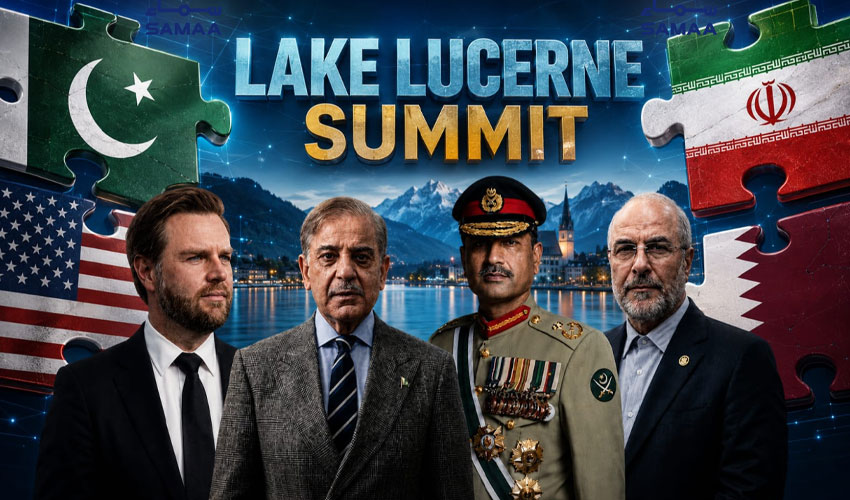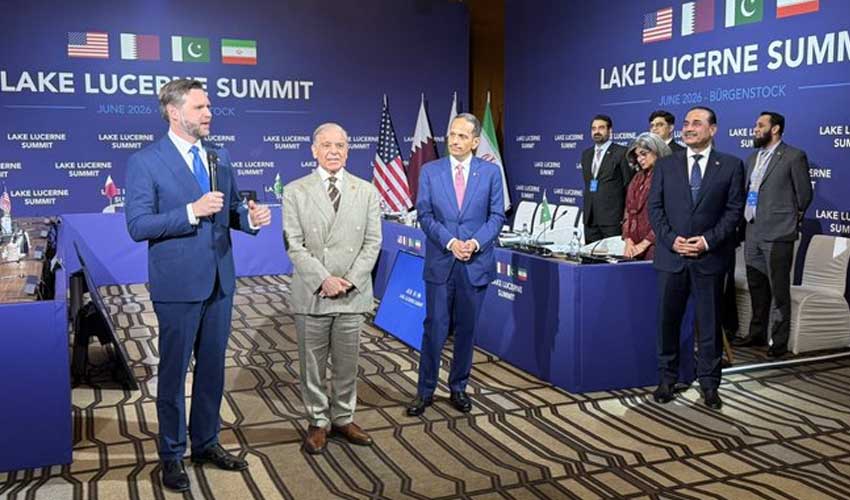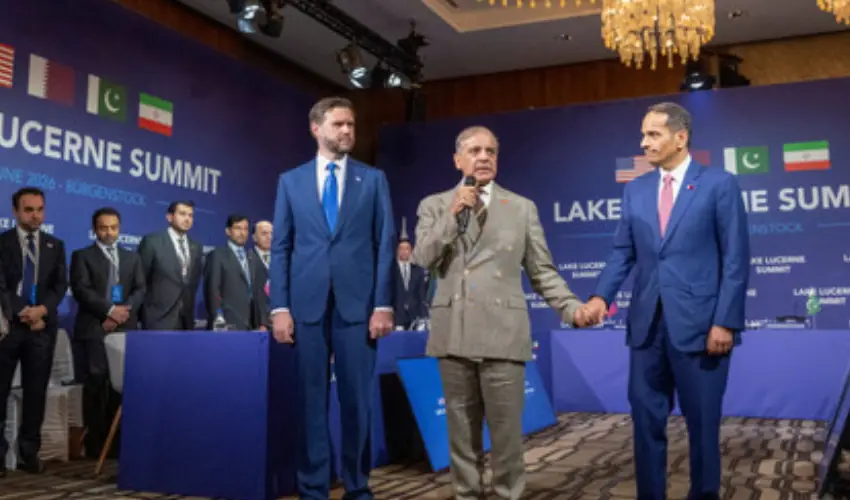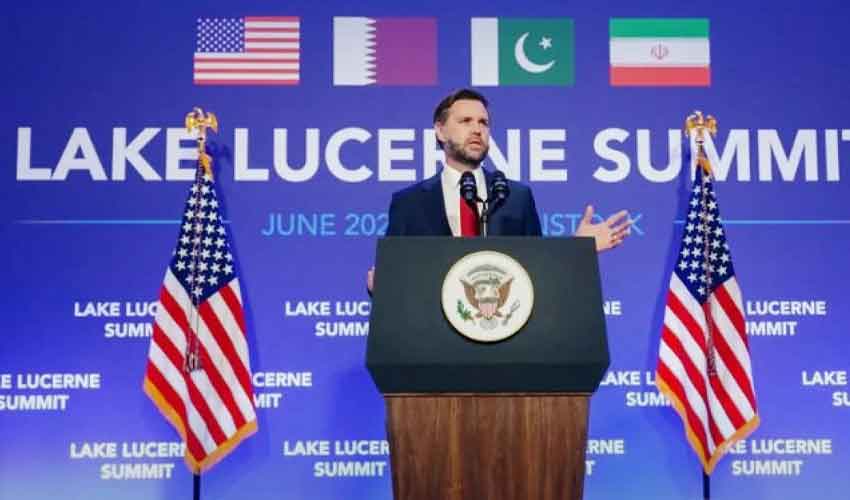
US Vice President JD Vance said on Monday that Iran-US talks in Switzerland had made “significant progress,” adding that both sides achieved what they wanted and laid a solid foundation for a final peace agreement.
Speaking at a press conference in Switzerland, JD Vance said the Bürgenstock talks were highly productive and had created a “good foundation” for a successful final deal.
“Yesterday was a great day,” Vance said, adding that the teams made major progress and achieved exactly what they wanted.
JD Vance:
— Clash Report (@clashreport) June 22, 2026
The final deal is the house. We set the foundation. We haven't built the house, but we laid a successful foundation. pic.twitter.com/riUjMfTIpP
He said technical negotiations with Iran would continue over the next two weeks, while teams from the United States, Iran, Pakistan and Qatar would remain engaged at the technical level.
Roadmap agreed for final deal
The talks built on the interim agreement signed last week, with Pakistan and Qatar acting as mediators.
According to mediators, the two sides agreed on a roadmap toward a permanent agreement within 60 days at the Qatari-owned Swiss mountain resort of Bürgenstock.
Vance said the discussions had laid a strong foundation for a final agreement and that technical-level work would continue in the coming days.
Strait of Hormuz formally opened
The US vice president said Washington wanted to establish a system to keep the Strait of Hormuz open, and that objective had now been achieved.
“The Strait of Hormuz has now been formally opened,” Vance said.
The vital global oil route had become a major flashpoint after Iran again stopped maritime traffic through the strait, citing Washington’s failure to halt fighting in Lebanon.
Mechanism agreed to prevent regional flare-ups
Vance said the talks also focused on creating a mechanism to prevent conflict from spreading during the regional ceasefire.
He said if fighting breaks out, whether through a Hezbollah attack on Israel, an Israeli response, or another regional clash, the parties would use mutual contacts to determine how to stop the fire.
JD Vance:
— Clash Report (@clashreport) June 22, 2026
As Trump said, sometimes these ceasefires mean you are shooting a little bit less.
But we wanted to make sure that we have the proper coordination set up so that if there is shooting, if Hezbollah fires at Israel, or if Israel responds, we are actually talking to each… pic.twitter.com/ScH6fxDpEI
“There will be minor ceasefire violations,” Vance said, adding that they must be handled through diplomatic channels.
He warned that if tensions spiral out of control, it would be harmful for everyone. Vance said Iran had agreed to allow International Atomic Energy Agency inspectors back into the country.
Since US strikes on Iranian nuclear facilities in June last year, Iran had only allowed the IAEA to inspect facilities that were not targeted. Inspections were halted altogether after US-Israeli strikes began the war with Iran on February 28 and had not resumed since.
According to Vance, Iran’s agreement to recall IAEA inspectors marked another major step forward in the negotiations.
JD Vance:
— Clash Report (@clashreport) June 22, 2026
The Iranians have agreed to invite IAEA inspectors back into their country. pic.twitter.com/riROv2dCtS
Frozen assets and essential goods
Vance said progress was also made on a mechanism to handle Iran’s frozen assets abroad. He said the United States wanted to ensure that Iran’s recovered assets are spent on the Iranian people.
According to Vance, the release of Iranian frozen assets would first be approved by the US and then by Qatar. He said Iran would use the recovered funds to buy grain and other essential goods from the United States.
Vance added that the arrangement would also bring wealth to American farmers through purchases of US corn, soy and wheat.
Kushner’s role in funds mechanism
Vance said White House envoy Jared Kushner, who is also President Donald Trump’s son-in-law, helped develop the process for managing Iranian funds once they are unfrozen.
JD Vance: "What Jared and the Qataris…accomplished is to me a classic Trump deal"
— Republicans against Trump (@RpsAgainstTrump) June 22, 2026
(As if we needed any more proof this was a disastrous deal) pic.twitter.com/XjXHO3tL2T
Under the proposed arrangement, the US and Qatar would have control over the money to ensure it is spent on approved goods.
Iranian Foreign Minister Abbas Araqchi said on social media that Tehran had secured waivers for oil and petrochemical exports, the release of some frozen assets and the launch of a reconstruction and development plan for Iran.
US license allows Iranian oil sales
Following the interim deal, the US Treasury Department issued a general license for Iran on Monday.
The license authorizes the production, delivery and sale of crude oil, petrochemical and petroleum products of Iranian origin through August 21.
The move followed Iran’s demand for relief related to oil and petrochemical exports as part of the broader negotiation process.
Trump threat played down
Vance played down tensions caused by President Donald Trump’s warning on Sunday that the war could restart if Iran again tried to close the Strait of Hormuz.
“There was a little bit of threatening, there was a little bit of whining, but at the end of the day the talks continued and we made great progress,” Vance said.
Before the talks formally began, Fox News quoted Trump as saying he had told Iranian officials, “you won’t have a country” if they tried to close the strait again.
Iran’s semi-official Tasnim news agency, citing an informed source, reported that after Trump’s threats became public, the Iranian delegation refused to return to the room where talks were being held, though messages continued to be exchanged through mediators.
Lebanon issue also sees progress
Vance said there had also been progress on the Lebanon issue. He said Israel had no intention of occupying southern Lebanon and that Israeli forces were present there because of Hezbollah.
The US vice president added that Washington remained in constant contact with both Israelis and Lebanese officials.
JD Vance:
— Clash Report (@clashreport) June 22, 2026
Israel and every other nation in the region has the right of self-defense. pic.twitter.com/WcEYwl0Fpq
He said it could not be expected that President Trump would not respond to any threat, but stressed that ceasefire violations should be handled diplomatically.
Violence in Lebanon eases
The memorandum of understanding calls for the reopening of the Strait of Hormuz and an end to all hostilities, including in Lebanon.
Violence had continued in Lebanon after a ceasefire was declared on Friday, but security sources said Israel’s last airstrike took place on Saturday evening.
JD Vance on Lebanon:
— Clash Report (@clashreport) June 22, 2026
Sometimes a junior guy fires a drone that didn't have approval from the high command.
Of course, Israel has to respond to that, but we could have a more peaceful situation if Israel responds in the context of the conversation that is ongoing between… pic.twitter.com/jDq4TR2XeM
Thousands of people have been killed in the US-Israeli war against Iran, mostly in Iran and Lebanon, where Hezbollah opened fire in support of Iran on March 2.
Reflecting reduced tensions, the Israeli military lifted safety restrictions in eight communities near the Lebanese border from 6am local time on Monday.
Lebanese and Israeli leaders respond
Lebanese President Joseph Aoun discussed efforts to maintain the ceasefire and stop Israeli military escalation during a phone call with Vance, Qatar’s prime minister and Jared Kushner, according to the Lebanese presidency.
Israeli President Isaac Herzog said Israel was not opposed to a diplomatic end to the Iran war.
However, Herzog said any agreement must ensure Tehran cannot use funds received under the deal for military purposes or to support regional proxies.
Oil prices fall after progress
Oil prices had risen sharply when Tehran began blockading the Strait of Hormuz, prompting a US blockade of Iranian ports. However, prices fell after the interim deal to their lowest level since the war began.
Oil prices dipped further after Monday’s joint statement by Pakistan and Qatar, as fears of a supply shortage eased. Global benchmark Brent crude was trading below $80 per barrel.
Ship-tracking data showed two crude tankers carrying just under 2 million barrels of oil sailed through the strait on Monday, indicating traffic was beginning to resume, though crossings remained far below the pre-war average of 125 vessels per day.
Pakistan says talks concluded successfully
Technical talks were expected to continue for the rest of the week. Prime Minister Shehbaz Sharif wrote on X that the first round of talks had concluded successfully.
“The discussions were held in a positive and constructive atmosphere and yielded encouraging progress,” the prime minister said.
Vance said teams working with Iranians, Qataris and Pakistanis had made significant progress and would continue working at the technical level to move toward a final agreement.