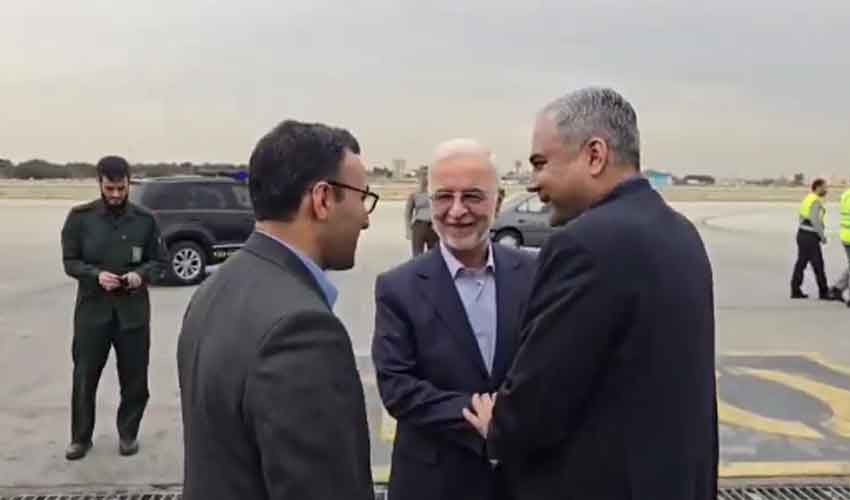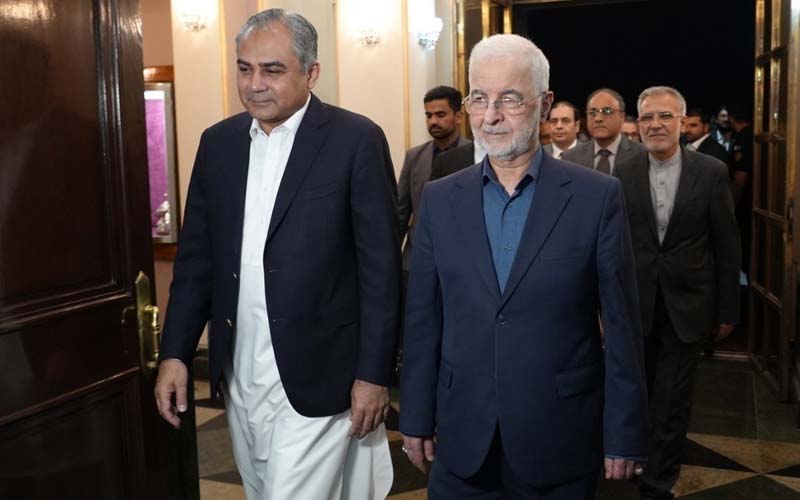
Pakistan's Interior Minister Mohsin Naqvi arrived in Tehran, where he was received at the airport by his Iranian counterpart, Eskandar Momeni.
Pakistan's newly appointed Ambassador to Iran, Imran Siddiqui, was also present at the airport to welcome the interior minister. A formal meeting was held between Mohsin Naqvi and Iranian Interior Minister Eskandar Momeni following his arrival.
Efforts for lasting peace in the Middle East have been further intensified. Sources said Mohsin Naqvi will convey a special message from Field Marshal Syed Asim Munir to Iran's Supreme Leader. The message is regarded as significant in the context of sustainable regional peace.
Naqvi is also scheduled to meet Iranian President Masoud Pezeshkian. Meetings with the Speaker of the Iranian Parliament and the Secretary of Iran's Supreme National Security Council are also expected.
Before departing for Iran, Mohsin Naqvi met Prime Minister Shehbaz Sharif in Lahore. According to a spokesperson for the Prime Minister's House, Naqvi briefed the prime minister on the Shanghai Cooperation Organisation conference held in Bishkek and informed him about meetings with various regional leaders.
The two also held consultations regarding Naqvi's Tehran visit. Prime Minister Shehbaz Sharif provided guidance concerning the visit.
The meeting included a detailed discussion on the country's overall law and order and security situation. Naqvi briefed the prime minister on measures taken to maintain public order. The prime minister stressed the importance of strengthening security arrangements and called for close coordination and a unified strategy among relevant institutions.
Earlier in Bishkek, Mohsin Naqvi held separate meetings with the interior ministers of Russia, Tajikistan, Uzbekistan, Kyrgyzstan and Kazakhstan. The discussions centred on cooperation in counter-narcotics efforts, prevention of illegal immigration and other areas of mutual interest.
Officials said the engagements were aimed at strengthening regional security cooperation and improving coordination among interior ministries.
During talks with Russian Interior Minister Vladimir Kolokoltsev, agreements were signed to increase Pakistan-Russia cooperation against illegal immigration and to facilitate the repatriation of citizens residing unlawfully in each other's countries. The meeting also addressed cooperation against drug trafficking.
In a meeting with Tajik Interior Minister Ramazan Rahimzadeh, both sides discussed militant camps in Afghanistan and expressed concern over terrorist activity and narcotics production, describing them as threats to regional security. The two ministers stated that 25 terrorist organisations are currently active in Afghanistan.
Naqvi also met Uzbekistan's Interior Minister Major General Aziz Tashpulatov. The talks focused on cooperation and joint training between law enforcement agencies. It was agreed that a working group would be established to enhance cooperation between the two ministries.
In separate talks with Kyrgyz Interior Minister Niyazbekov Ulan Omokanovich, both sides agreed to expand cooperation in areas of mutual interest. Naqvi congratulated Kyrgyzstan on its election as a non-permanent member of the United Nations Security Council and thanked the Kyrgyz government for arrangements made for the SCO Interior Ministers' Meeting.
Naqvi also met Kazakhstan's Interior Minister Yerzhan Sadenov. Both sides agreed to strengthen cooperation against illegal immigration and establish a working group to broaden bilateral coordination.
Officials said Pakistan remains engaged in regional diplomacy focused on mediation, regional stability and practical cooperation on security matters, including terrorism, narcotics trafficking and illegal migration.
The Tehran visit is expected to focus on the Middle East situation and efforts aimed at reducing tensions through diplomatic engagement.