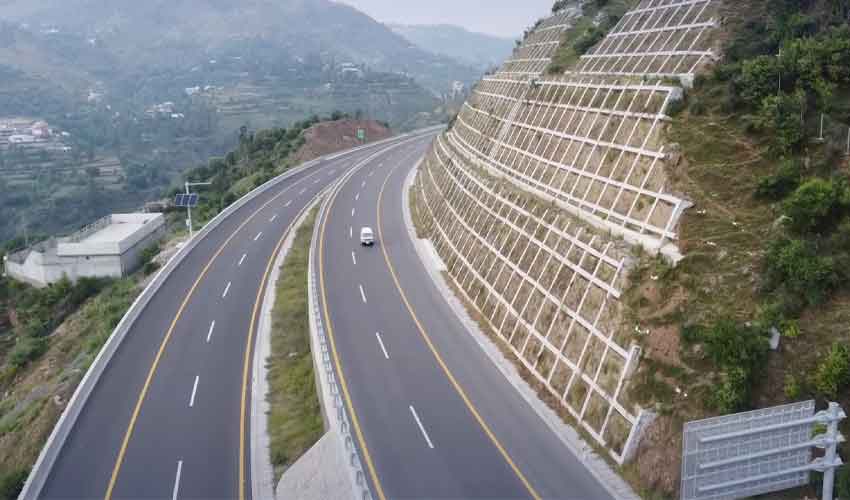
The National Highway Authority (NHA) has decided to accelerate work on the long-awaited Mansehra-Chilas Motorway project, a major infrastructure initiative that will directly connect Pakistan’s road network with China and significantly improve trade and tourism routes.
The decision was taken during an important NHA meeting chaired by Federal Minister for Communications Abdul Aleem Khan, where officials conducted a detailed review of the project’s progress and future roadmap.
During the meeting, officials briefed the federal minister on various technical and administrative aspects of the Mansehra-Chilas Motorway project.
The proposed motorway will pass through Mansehra, Kaghan, Naran, Jhalakand and Chilas, creating a modern transport corridor through northern Pakistan’s mountainous terrain.
Aleem Khan directed authorities to accelerate progress on the project, describing it as a key national infrastructure initiative.
Motorway to be completed in two phases
According to the briefing, the 172-kilometre-long motorway will be constructed in two phases. The first phase will cover the route from Mansehra to Kaghan, Naran and Babusar Top.
In the second phase, the motorway will be extended from Babusar Top to Chilas, completing the full corridor.
Pakistan’s longest Babusar Tunnel included
One of the most significant features of the project will be the Babusar Tunnel, which is planned to be 13.5 kilometres long. The tunnel will become the longest tunnel in Pakistan and is expected to improve year-round connectivity through the mountainous region.
Officials said the tunnel will play a crucial role in ensuring safer and faster travel along the route.
Direct road link with China
The minister said the new motorway will be directly connected to China, making it a strategically important route for regional trade and transportation. He noted that the project would shorten travel on the Karakoram Highway by approximately 120 kilometres.
According to the minister, the motorway will further improve access from western China to the ports of Karachi and Gwadar and is expected to become the fastest land route connecting China with the Arabian Sea.
Khan described the motorway as a game-changing project for Pakistan’s future trade and tourism sectors.
The improved road network is expected to facilitate the movement of goods, enhance regional connectivity and attract more domestic and international tourists to the scenic northern areas. The project is also expected to strengthen Pakistan’s role as a regional transit and trade hub.
Modern facilities planned along the route
Officials informed the meeting that the four-lane motorway will be designed in a way that allows future expansion to six lanes if required. Modern rest areas will be developed at intervals of approximately 25 to 30 kilometres to improve traveler convenience.
In addition, dedicated trucking terminals will be constructed on both sides of the motorway to support commercial transport and logistics operations.
The meeting concluded with renewed commitment to push forward the ambitious project, which has long been viewed as a transformative transportation corridor for northern Pakistan.




.jpg)