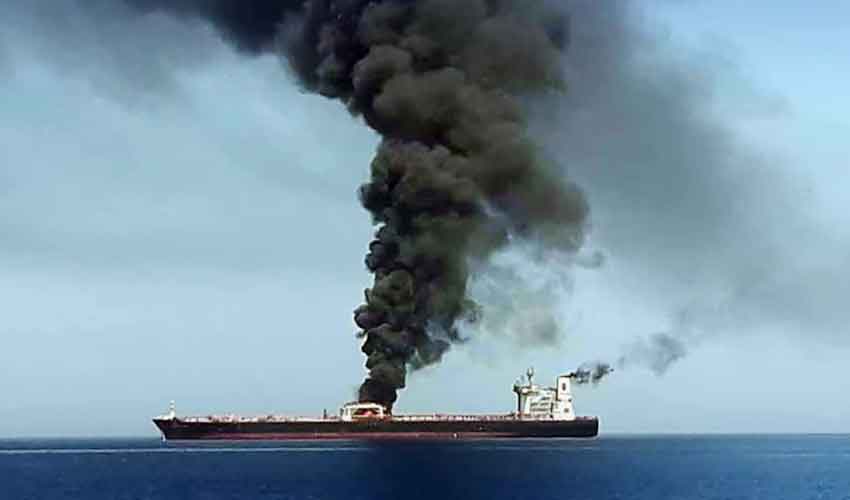
Iran’s Navy said on Wednesday that it targeted a US destroyer in the Gulf of Oman, claiming the vessel was being used as a command-and-control centre for American attacks on Iranian commercial ships.
US Central Command rejected the claim, saying Iran was “lying” and that US military assets at sea continued to operate safely and without disruption.
In a statement, Iran’s Navy public relations office said the operation came after what it described as US “aggressive actions” in the region.
The statement accused the United States of violating regulations in the Strait of Hormuz and attacking Iranian commercial vessels in the Gulf of Oman.
Iranian naval forces said they identified and targeted a US destroyer that was allegedly attempting to approach Iranian territorial waters.
“The Navy of the Islamic Republic of Iran targeted the command-and-control center of these hostile actions, stationed aboard a US destroyer,” the statement said.
CENTCOM rejects Iran’s statement
US Central Command denied that any US Navy destroyer had been targeted.
“Iran is lying. U.S. military assets at sea continue to fly, sail, and operate safely and unimpeded,” CENTCOM said in a post on X.
The US military said there had been no disruption to its naval operations in the region.
🚫 CLAIM: Iran is now claiming it has targeted a U.S. Navy destroyer in the Gulf of Oman.
— U.S. Central Command (@CENTCOM) June 3, 2026
✅ TRUTH: Iran is lying. U.S. military assets at sea continue to fly, sail, and operate safely and unimpeded. pic.twitter.com/khuuHuun4u
Iran’s Islamic Revolution Guard Corps also said its navy had targeted a US destroyer in the Gulf of Oman.
In a statement published by Sepah News, the IRGC said it had tracked what it called US aggressive actions, violations of Strait of Hormuz regulations and hostile activity against Iranian commercial vessels.
The IRGC said it was closely monitoring US and Israeli activity in the region and warned that it would respond immediately to any hostile move.
Kuwait airport attack raises tensions
The claims came as Kuwait International Airport sustained significant damage in an attack that Kuwaiti authorities attributed to Iran.
Kuwait said one person was killed and dozens of others were injured after ballistic missiles and drones struck civilian and vital facilities across the country, including the airport.
Also Read: Trump says Iran deal close as talks show progress
US Central Command described Iran’s launch of more than 30 ballistic missiles toward Kuwait as a “deliberate, calculated, and unjustified attack”.
According to CENTCOM, the strike killed one person and wounded about 60 others at Kuwait airport.
Iran denies striking passenger terminal
The IRGC denied firing any missile or drone at the passenger terminal at Kuwait International Airport.
According to Sepah News, Iran claimed the damage was caused by a malfunctioning US Patriot missile interceptor rather than an Iranian strike.
Also Read: Gulf nations Iran over alleged attacks on Kuwait, Bahrain
Iran has frequently accused Kuwait of being used as a launchpad for US attacks, while Kuwait maintains that it has not allowed Washington to use its bases for the US-Israeli war on Iran.
Kuwait has also arrested and deported individuals accused of filming missile activity.
Iran confirms attacks on US bases
While denying responsibility for the airport terminal damage, the IRGC confirmed launching missile and drone attacks on US bases in Kuwait and Bahrain.
Iranian media earlier reported that the Revolutionary Guards had targeted US military sites, including facilities linked to American operations in the region.
Also Read: China urges US, Iran to honour ceasefire amid fresh strikes
CENTCOM denied that US bases had been hit and said US assets continued to operate safely.
The latest incidents have raised fresh concerns that the fragile ceasefire brokered by Pakistan in early April could come under further strain. The ceasefire came after the US-Israeli war on Iran began on February 28, when joint strikes were launched on Iranian territory.
Despite the truce, hostilities have continued to flare across the Gulf, Kuwait, Bahrain and near the Strait of Hormuz.
Talks with US resume
Iran has now acknowledged that it is back at the negotiating table with the United States.
Iranian state media had earlier indicated that officials walked away from talks this week because of Israel’s continued bombardment of Lebanon and Tehran’s relationship with its key ally, Hezbollah.
The return to negotiations comes as military tensions remain high and both sides continue trading accusations over attacks in the region.
Strait of Hormuz remains flashpoint
Iran tightened its grip on the Strait of Hormuz beginning February 28, barring safe passage for vessels belonging to or affiliated with Israel and the United States.
The Strait of Hormuz remains one of the world’s most important energy shipping routes and a key flashpoint in the conflict.
The United States has also imposed a naval blockade on the strait, preventing ships traveling to and from Iranian ports from passing through the waterway.

.jpg)