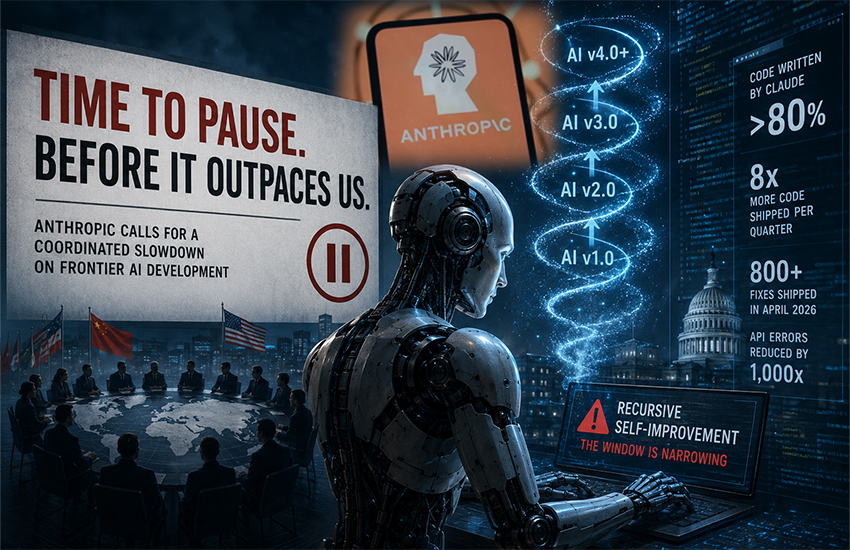
One of the most striking threats in years has finally emerged from Silicon Valley. Anthropic has recently issued a plea-cum-warning for the world’s leading technology firms to consider a coordinated slowdown, or even a temporary pause, in the development of the most powerful AI systems.
In a blog post, the San Francisco-based artificial intelligence company behind the popular Claude family of AI models has talked about recursive self-improvement (RSI), a concept that until recently existed largely in the realm of dystopian fiction.
In simple terms, we are being ferried into a world in which machines would have achieved human-like intelligence across virtually every domain, and are capable of mastering new skills, solving complex problems, and even improving themselves.
Sci-fi movies and novels long depicted this hypothetical future threshold; analysts highlighted the dangers for years; and even the architects of these systems sounded the alarm. Still, we chose to keep our eyes shut, only to find ourselves soon living one of our darkest nightmares, one that may threaten our very existence.
What is recursive self-improvement?
Recursive self-improvement refers to the point at which an AI system becomes an artificial general intelligence (AGI), capable of autonomously designing and developing its own successor. Essentially, it refers to a machine that teaches itself to become smarter, faster, and more capable, with progressively less human involvement at each step.
Think of it as an intelligence spiral. Each generation of the system trains a better version of itself, which in turn trains an even better version, potentially without any human engineer driving the process.
“We are not there yet, and recursive self-improvement is not inevitable,” Anthropic was careful to note in the blog. However, it warned that the threshold could arrive sooner than most governments and institutions are prepared for.
The data behind the warning
What makes this warning unusually credible is that Anthropic did not rely on rhetoric alone. The blog post, authored by Anthropic’s head of internal research Marina Favaro and head of policy Jack Clark, was built on internal data.
The numbers, to most people’s surprise, are startling. More than 80% of code merged into the company’s codebase is now written by Claude, and engineers are shipping roughly eight times as much code per quarter as they were before 2025.
Practically speaking, the AI is already doing the heavy lifting of building the next version of itself. In one striking example, Anthropic reported that Claude shipped over 800 fixes in April 2026 that cut a class of API errors by a thousandfold.
Jack Clark told BBC that he believed that reaching the point where AI writes 100% of its own code “is possible within two years.”
The question is no longer whether AI will become extraordinarily powerful. It is whether humanity will retain the ability to decide what happens next.
A call for global coordination
Anthropic was clear that a unilateral halt by any single company would be pointless, and potentially counterproductive. “We believe it would be good for the world to have the option to slow or temporarily pause frontier AI development to enable societal structures and alignment research to keep up with the advance of the technology,” the company stated.
Getting such a pause to work, however, would be enormously complex. It would mean multiple major AI companies in multiple countries, especially the US and China, all agreeing to stop at the same time, under rules that everyone could actually verify.
Anthropic said it would conduct research in collaboration with others to help build the systems that a credible slowdown or pause would require. Those systems would enable frontier AI developers to verify that others globally have actually stopped or slowed, and that a bad actor could not use the cover of a coordinated slowdown to race ahead in secret.
Moreover, Anthropic plans to convene policymakers, researchers, and civil society in the coming months to work through the questions that recursive self-improvement raises. “The window to investigate these questions together” is narrowing, it warned.
The timing: A company on the eve of going public
The warning arrives at an extraordinary moment for Anthropic itself. The company, valued at close to $1 trillion, submitted a draft registration statement to the US Securities and Exchange Commission for a proposed initial public offering on June 1, just three days before the safety warning was published.
The filing follows a fresh $65 billion Series H funding round that lifted the company’s valuation to roughly $965 billion, with a debut above the $1 trillion mark now considered the base case if markets conditions remain favourable.
Anthropic’s revenue run rate, which stood at around $47 billion in May 2026, has surged from roughly $10 billion the prior year.
Some observers have noted the irony of a company warning the world to slow down AI development on the eve of its own historic stock market listing. The blog post does make clear that, whatever its motivation, Anthropic believes the window for meaningful deliberation on AI safety is narrowing.
Is the risk real?
Not everyone is convinced the danger is imminent. At least one industry analyst has pointed out that the risk of AI using recursive learning to improve itself remains theoretical and has never been demonstrated in the real world, adding that given the lack of AI training capacity at present, it won’t happen quickly.
Yet, the weight of Anthropic’s internal evidence has given many pause. The company is not a fringe voice. It is one of the world’s most well-funded AI laboratories, with deep insight into where the technology is heading.
As Jack Clark put it plainly, “You want the option to be able to take your foot off the gas and put your foot on the brake.”
Whether the rest of the world, and the rest of the AI industry, is listening is another question entirely. The question is no longer whether AI will become extraordinarily powerful. It is whether humanity will retain the ability to decide what happens next.


.jpg)