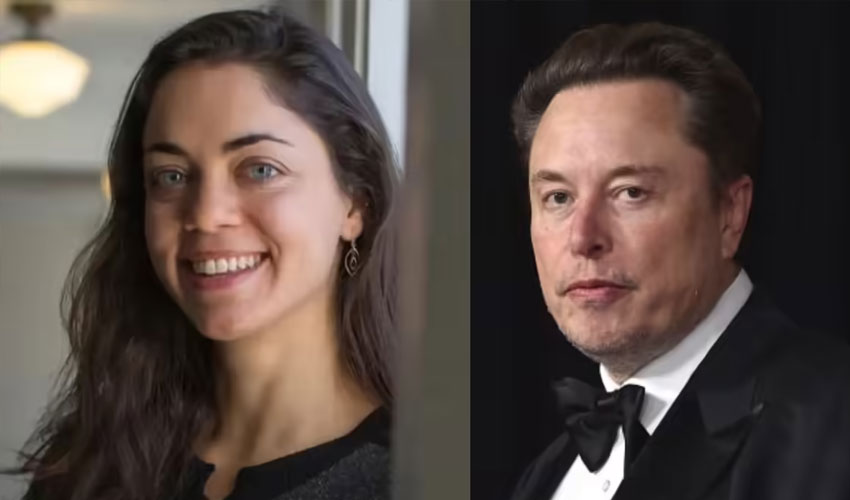
A former board member of OpenAI has testified in a federal courtroom in Oakland, California, revealing details about her personal relationship with billionaire Elon Musk, including his offer to donate sperm so she could have children.
The testimony was given by Shivon Zilis during proceedings linked to Musk’s lawsuit seeking to reverse OpenAI’s transition into a for-profit structure.
During hours of testimony in a courtroom in Oakland, Zilis explained how her relationship with Musk evolved both professionally and personally while she worked across his tech ecosystem.
She told the court that Musk offered to donate sperm in 2020 after learning she wanted to become a mother.
“He was encouraging everyone around him at that time to have kids,” Zilis said, adding that she accepted the offer during a period when she was reconsidering her long-term personal plans due to health concerns.
From early connection to four children
Zilis stated she first met Musk through her advisory role at OpenAI in 2016, shortly after the organization was founded.
She also revealed that she had a brief romantic relationship with Musk around a decade ago but said they were not romantically involved at the time of the 2020 arrangement.
According to her testimony, the initial agreement included keeping Musk’s paternity confidential, and he was not expected to play a traditional parental role at first.
Today, she said Musk is actively involved in the lives of their four children, and they spend several hours together each week as a family.
Zilis told the court that she did not initially disclose Musk’s paternity of her twins born in 2021 to OpenAI CEO Sam Altman due to a confidentiality agreement with Musk.
She later informed Altman after reports were about to surface in the media.
Despite the revelation, Altman and OpenAI president Greg Brockman reportedly supported her continued involvement on the board.
Brockman previously stated: “We trusted her to keep the Elon conflict under control.”
Zilis remained on OpenAI’s board until March 2023, leaving around the time Musk launched xAI, a competitor in the artificial intelligence sector.
Court documents and emails presented during the trial also highlighted internal debates over OpenAI’s structure.
Early discussions included proposals to shift OpenAI from a non-profit model to a for-profit or hybrid structure to attract billions in investment.
Musk reportedly suggested increasing control over the organization, including the possibility of integrating it into Tesla as a subsidiary or restructuring it under a mission-focused model.
Some founders, including Ilya Sutskever, reportedly opposed granting Musk control over the company’s direction.
Background
The ongoing lawsuit centers on OpenAI’s transition into a for-profit structure, which Musk argues diverges from its original mission.
Zilis’s testimony has become a key element in the case due to her dual role as both an early advisor and board member at OpenAI, as well as her executive positions across Musk-led companies including Neuralink.