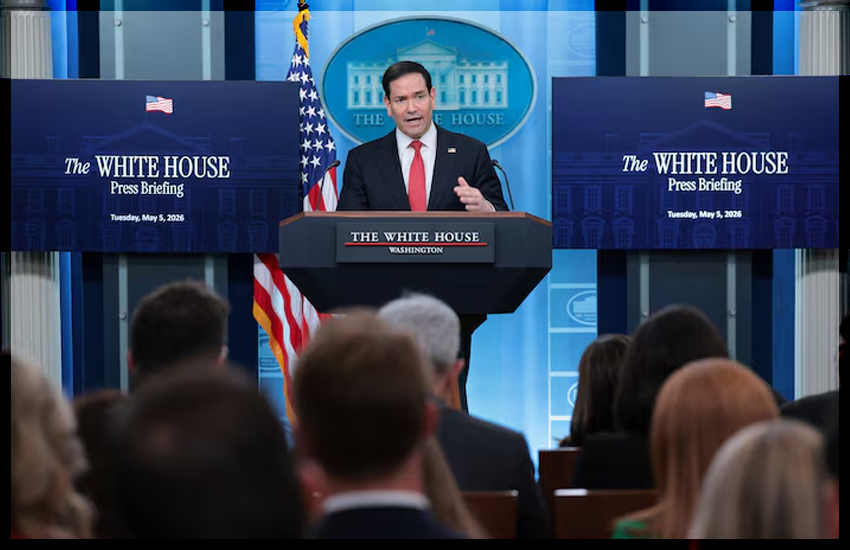
US Secretary of State Marco Rubio said that 10 civilian sailors have died due to the ongoing conflict in the Strait of Hormuz. Speaking at the White House, Rubio said the US would continue to deploy its assets to defend freedom of navigation in the key thoroughfare.
"They're isolated, they're starving, they're vulnerable and at least 10 sailors have died as a result, civilian sailors," Rubio said, without providing additional details.
US Defends Naval Operations
Rubio insisted the US was taking defensive action in enforcing its blockade of Iranian ports. The initial military operation against Iran was over, he said. He also reiterated that operations were aimed at maintaining maritime security and enforcing restrictions on Iran.
“We are only responding if attacked first,” he said. “If no shots are fired at these ships and no shots are fired at us, we’re not firing shots.”
The remarks come as the US continues efforts to guide vessels out of the strait, with officials saying they are in contact with multiple ships seeking safe passage.
Shipping Bottleneck Grows
US Defense Secretary Pete Hegseth said hundreds of vessels are waiting to transit the waterway, highlighting the scale of disruption to global trade.
Before the conflict erupted in late February, roughly 20% of the world’s oil shipments passed through the strait each day, making the current bottleneck a major concern for energy markets.
Meanwhile, the United Arab Emirates said it faced missile and drone attacks on Tuesday, even as Washington maintained that a fragile ceasefire remained in place.
Diplomatic Efforts Continue
Rubio said the United States is pursuing a diplomatic resolution alongside its military posture, with envoys Steve Witkoff and Jared Kushner engaged in ongoing efforts.
He said any agreement would need to address Iran’s nuclear capabilities, including the status of material that could potentially be used in the future.
“This is highly complex and highly technical,” Rubio said, adding that negotiations would take time and require clarity on the scope of concessions from all sides.
The comments underscore the dual-track approach being taken by Washington, combining military measures to secure shipping routes with diplomatic outreach aimed at de-escalating tensions in the region.