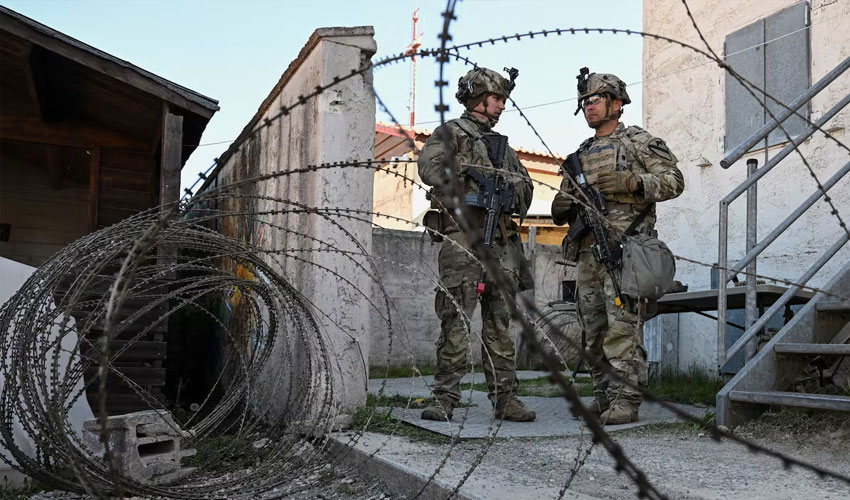
The U.S. Department of Defense has announced plans to withdraw around 5,000 troops from Germany.
The decision comes amid escalating political tensions between U.S. President Donald Trump and German Chancellor Friedrich Merz over remarks linked to the Iran conflict.
The Pentagon stated that the troop reduction will be carried out over the next six to twelve months.
According to spokesperson Sean Parnell, the order came from Defence Secretary Pete Hegseth following a review of U.S. force posture in Europe.
The decision follows a public exchange between Trump and Merz after comments about the Iran situation.
Merz reportedly said the United States had been “humiliated” in negotiations with Iranian officials, while also questioning the lack of a clear U.S. strategy.
Trump’s strong response on social media
In posts on his platform Truth Social, Trump criticized Merz’s leadership, calling him ineffective and blaming Germany for economic and policy issues.
He also suggested that both Italy and Spain could face similar troop reductions, accusing them of not supporting U.S. operations related to the Iran conflict.
US military presence in Germany
Germany hosts the largest U.S. military presence in Europe, with more than 36,000 active-duty troops stationed across multiple bases.
A significant portion of these forces are based at Ramstein Air Base near Kaiserslautern.
For comparison, Italy hosts around 12,000 U.S. troops, while the United Kingdom has approximately 10,000.
Strategic review behind the move
Officials said the withdrawal reflects a broader reassessment of global U.S. military deployments.
The move aligns with earlier steps under Trump’s policy direction to focus more on the Indo-Pacific region and reduce European troop presence.
Germany has significantly increased its defence spending in recent years.
The country is projected to spend €105.8 billion (£91 billion) in 2027, with defence expenditure expected to reach 3.1% of GDP next year—well above NATO’s 2% target.
A similar proposal in 2020 to withdraw 12,000 troops from Germany was blocked by the U.S. Congress and later reversed under President Joe Biden.
At the time, Trump had criticized Germany for underfunding its military.