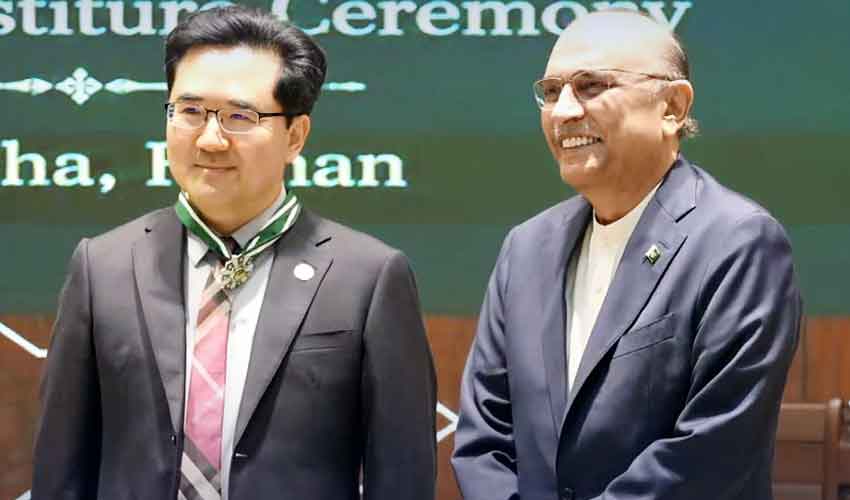
President Asif Ali Zardari attended a signing ceremony of memorandums of understanding between Pakistan and China in Changsha, marking new cooperation in seawater utilization, agricultural technology and the tea sector.
The agreements include collaboration on a seawater desalination project aimed at supplying water to Karachi city. The signing ceremony was held in Changsha during President Asif Zardari’s visit.
The first MoU was signed between the Sindh Local Government Department and Luoshan Environmental Technology Group. Under the agreement, cooperation will be provided for a project to desalinate seawater for Karachi’s water supply.
President Asif Ali Zardari conferred Sitara-i-Pakistan on Prof. Pan Xiangbin in Changsha, recognising his contributions to cardiac care, including treatment of Pakistani children with congenital heart disease and training of local medical professionals. pic.twitter.com/CbyfZHHZR2
— The President of Pakistan (@PresOfPakistan) April 27, 2026
Sindh Senior Minister Sharjeel Memon and Yuhui, Party Branch Secretary of Luoshan Environmental Technology Group, signed the MoU.
Agricultural tech cooperation also agreed
The second MoU was signed between the Sindh Local Government Department and Longpin High-Tech Information Company. The agreement focuses on cooperation in agricultural technology.
Sindh Senior Minister Sharjeel Memon signed the MoU on behalf of Sindh, while Chairman Chen Zhishen signed on behalf of the Chinese company.
President Asif Ali Zardari witnessed the signing of three MoUs in Changsha relating to water desalination in Karachi, agricultural technology and tea sector cooperation, marking continued engagement between Pakistan and China in priority sectors. pic.twitter.com/L4XPTBPjDr
— The President of Pakistan (@PresOfPakistan) April 27, 2026
New chapter in Pakistan-China cooperation
The agreements highlight growing Pakistan-China cooperation beyond traditional infrastructure projects. The seawater desalination initiative is particularly significant for Karachi, where water supply remains a major civic challenge.
The agricultural technology and tea sector cooperation also reflects efforts to strengthen productivity, innovation and development partnerships between the two countries.


.jpg)