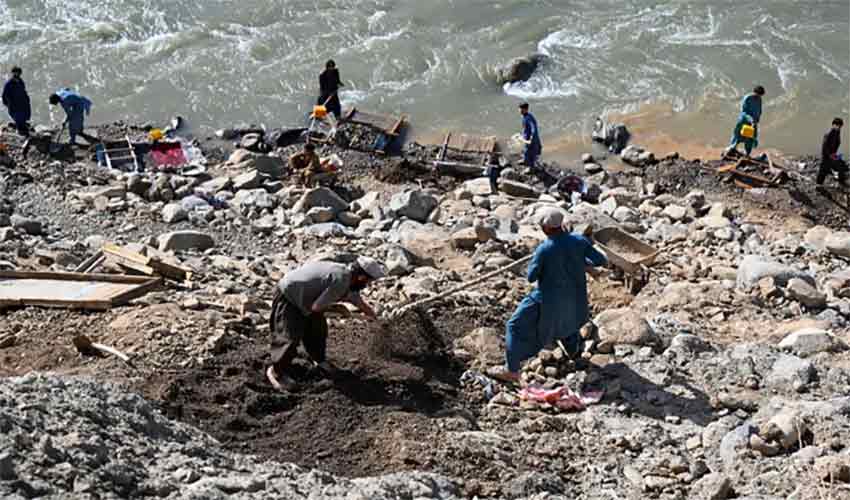
In the rugged mountains of eastern Afghanistan, hundreds of men are turning to traditional gold panning along the Kunar River in search of income amid limited job opportunities.
In the remote province of Kunar Province, near the border with Pakistan, workers dig into dry riverbeds and nearby mountainsides, sifting through rocks and sand to find tiny flakes of gold. The labor-intensive process involves carrying heavy loads of stones down steep slopes and washing them repeatedly with river water in the hope of discovering small gold particles.
Many of the workers, like 50-year-old Shahzahdah Gollalah, have abandoned other forms of employment due to a lack of opportunities. A father of eight, he said gold panning has become a self-created means of survival, though the returns are minimal. “The gold we find is often smaller than a grain of wheat,” he noted.
Despite the challenges, some miners manage to earn modest amounts. A worker named Gul Ahmad Jan said that, in a good week, he can collect up to one gram of gold, which sells for around 8,000 Afghanis (approximately $125).
Local officials say gold panning has been practiced in the region for over a decade, with knowledge passed on from miners arriving from other resource-rich areas. Thousands of residents are now involved in the activity, using traditional, manual techniques permitted by authorities.
Efforts to introduce heavy machinery have been discouraged after concerns were raised about environmental damage to rivers and mountains. Authorities have instead supported small-scale, traditional mining methods.
Afghanistan’s vast natural resources have long remained underutilized due to decades of conflict. However, in recent years, the ruling administration has sought to promote mining activities to boost the economy, attracting both local and foreign interest.
For many in Kunar, however, gold panning remains less about opportunity and more about survival in a challenging economic landscape.