The head of the UN nuclear watchdog has warned of a significant increase in North Korea’s ability to produce nuclear weapons, raising fresh concerns over the country’s growing military capabilities.
Speaking during a visit to Seoul, Rafael Grossi, Director General of the International Atomic Energy Agency, said there has been a “very serious increase” in activity at key nuclear facilities in North Korea.
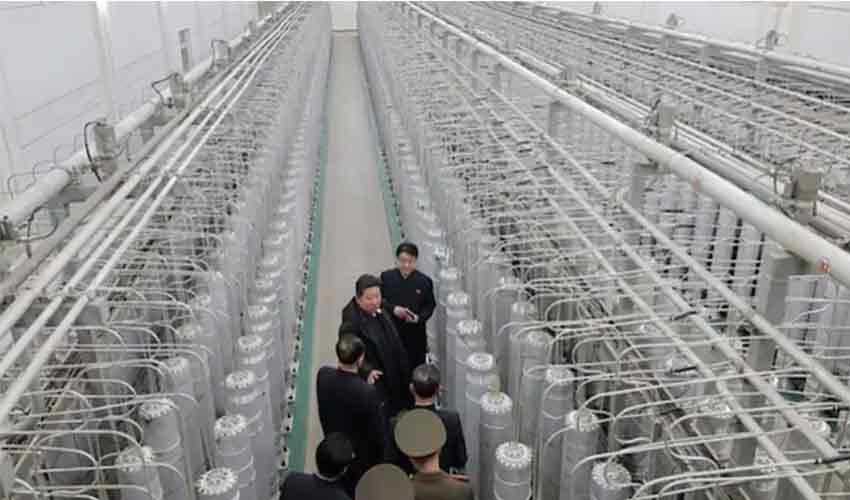
According to the agency’s assessments, operations at the Yongbyon nuclear complex—including its reactor, reprocessing unit, and light-water reactor—have intensified. Grossi also pointed to the activation of additional facilities, indicating a broader expansion of the country’s nuclear programme.
North Korea, officially known as the Democratic People’s Republic of Korea (DPRK), is believed to operate multiple uranium enrichment sites, a critical component in the production of nuclear warheads. Estimates suggest the country may already possess dozens of such weapons.
The Yongbyon facility, once reportedly shut down during diplomatic negotiations, was reactivated in 2021. The IAEA has also observed the construction of a new site resembling existing enrichment facilities, which could further boost production capacity.
Grossi noted that without on-site inspections, it is difficult to precisely calculate the scale of expansion. However, external indicators strongly suggest a significant increase in enrichment capabilities.
North Korea conducted its first nuclear test in 2006 and remains under extensive UN sanctions over its weapons programme. The country expelled IAEA inspectors in 2009 and has since refused to grant access, maintaining that it will not give up its nuclear arsenal.
Responding to questions about possible Russian assistance, Grossi said the agency has not observed any concrete evidence of such cooperation, despite reports of growing military ties between Pyongyang and Moscow.