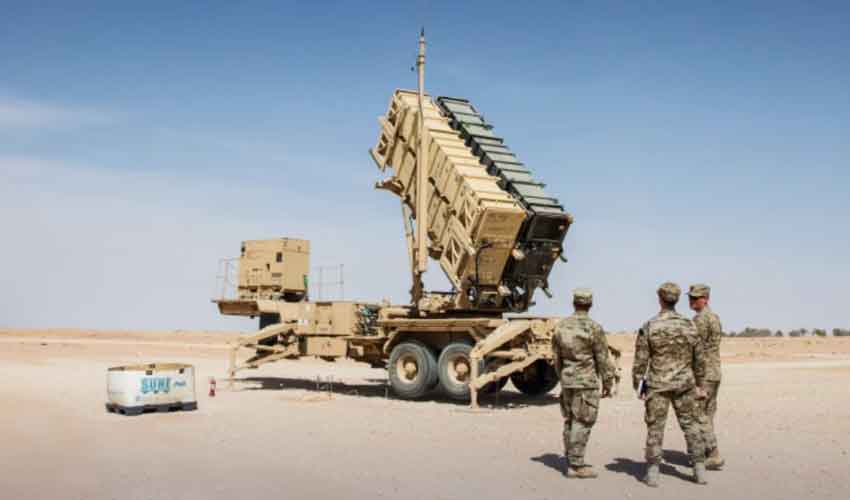
Saudi Arabia’s air defense systems intercepted and destroyed multiple missiles and drones early Friday that were targeting different locations across the Kingdom, the Saudi Ministry of Defense confirmed.
The attempted strikes come amid escalating tensions in the Middle East following the widening war involving Iran, Israel, and the United States.
According to the Saudi Ministry of Defense, four missiles and five drones aimed at targets inside the Kingdom were intercepted and destroyed in a series of defensive operations early Friday.
In its first announcement shortly after midnight, the ministry said three ballistic missiles were launched toward Prince Sultan Air Base in Al-Kharj governorate.
Defense Ministry spokesperson Maj. Gen. Turki Al-Maliki confirmed that Saudi air defenses successfully intercepted and destroyed all three missiles before they could reach the base.
Additional drones, cruise missile
Saudi air defense units also intercepted two drones, one in the Eastern Province and another east of Al-Kharj, according to the ministry.
Later updates said a cruise missile was intercepted and destroyed east of Al-Kharj governorate, although authorities did not provide further details about the projectile.
In another announcement early Friday morning, the ministry confirmed that three additional drones were shot down east of the Riyadh region.
The overnight barrage came shortly after Saudi defenses had already neutralized three cruise missiles targeting Al-Kharj on Thursday. Air defense units also intercepted three drones near the governorate in earlier attacks.
A separate drone attack over the Ras Tanura oil refinery in the Eastern Province was also thwarted hours before Friday’s missile barrage.
Al-Kharj, located about 80 kilometers southeast of Riyadh, is a major industrial hub and hosts Prince Sultan Air Base, an important military installation.
Previous drone attacks near Riyadh
On March 3, Saudi air defenses had also intercepted eight drones near Riyadh and Al-Kharj. During the same day, the US Embassy in Riyadh was struck by drones, causing a small fire and minor structural damage at the compound.
Despite the attack, Iran’s ambassador to Saudi Arabia, Alireza Enayati, denied Tehran’s involvement in a statement issued Thursday.
Escalation linked to wider Iran–Israel war
The latest attacks follow a large-scale air campaign launched by Israel and the United States against Iran last Saturday, which triggered a wave of retaliatory strikes by Tehran across the region.
The conflict, which escalated sharply on February 28, 2026, has spread far beyond Iran’s borders.
All Gulf Cooperation Council (GCC) member states have reported attacks linked to the crisis, with Iranian strikes across the Gulf region reportedly killing at least nine people.
Maritime trade disrupted near Strait of Hormuz
The expanding conflict has also severely affected maritime trade.
A missile strike on a commercial vessel off Oman has contributed to a growing congestion of ships near the Strait of Hormuz, where around 150 oil tankers are now backed up.
Shipping data indicates that oil traffic through the strategic waterway has dropped by about 86 percent, raising concerns about global energy supply disruptions.
Saudi Arabia issued a strong condemnation on Thursday after Iranian drone and missile strikes targeted Azerbaijan and NATO-protected Turkish airspace. The Kingdom described the attacks as “blatant and cowardly.”
During an extraordinary GCC ministerial meeting held in Riyadh on March 1, member states reaffirmed their collective right to defend their territories against what they called “treacherous Iranian aggression.”
Saudi Arabia vows to defend territory
Following a Cabinet meeting chaired by Crown Prince Mohammed bin Salman on March 3, Saudi Arabia declared that it reserves the “full right” to respond to attacks.
The Cabinet stressed that the Kingdom would take all necessary measures to protect its territory, citizens, and residents from continued missile and drone strikes.






.gif)


.jpg)