With COP30 set to take place in Brazil later this year, Pakistan’s leading sustainable development and climate expert Ali Tauqeer Sheikh has sounded a stark warning: growing global militarism, coupled with corporate backtracking and right-wing extremism, could derail decades of fragile climate cooperation.
As the world’s largest diplomatic gathering on climate draws near, Ali Tauqeer cautions that climate finance may become the first victim of shifting global priorities.
Understanding stakes at COP30
COPs (Conferences of the Parties) are the formal decision-making bodies under international climate agreements, where UN agencies, governments, intergovernmental and non-governmental organizations participate. While the private sector often joins national delegations, it does not hold an official observer status.
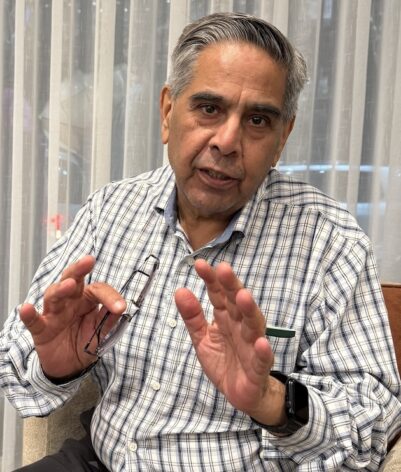
In such fragile contexts, Ali T. Sheikh argues, escalating global defense budgets pose a grave threat to already fragile climate finance flows. NATO countries, for example, agreed this July to increase defense expenditure by 5% of GDP—a move Sheikh warns will directly cut into funds for climate action.
“The axe will fall on climate finance,” he said. “It will bring the world upside down and undo 30 years of climate cooperation since the first COP.”
Pakistan’s vulnerability and Trump’s denial
The threat of shrinking climate finance is especially alarming for countries like Pakistan, which rank among the most climate-vulnerable nations. GermanWatch’s Climate Risk Index 2025 places Pakistan at the top due to its “exceptionally high relative economic losses.”
Sheikh strongly criticized US President Donald Trump’s remarks at the UN General Assembly on September 23, where Trump dismissed climate change as the “greatest con job ever” and called renewable energy a “joke.”
“From the perspective of a developing country like Pakistan, statements that dismiss climate change as a ‘con job’ are not just politically charged—they are a profound denial of the lived reality of the people,” said Sheikh.
He recalled how the 2022 floods caused damages of over USD 30 billion, setting Pakistan back years, while the 2025 floods again submerged vast parts of the country and displaced millions.
Beyond protests: Pakistan’s strategy for COP30
Sheikh urged Pakistan’s delegation to go to COP30 not merely to demand aid, but to present itself as a partner.
“We have a lot to offer and several successful projects to showcase,” he said, citing Sindh’s flood-housing project and the evacuation of 3 million people during recent floods.
He emphasized Pakistan’s priorities must include:
-
Improving construction standards for resilient housing and infrastructure
-
Leveraging AI for disaster management
-
Regional cooperation on shared climate risks
He also suggested Pakistan adopt a more outward-looking strategy at COP30. “Our pavilions at COPs are often set up in a way that we end up speaking only to ourselves,” Sheikh noted. “Instead, look for opportunities to present Pakistan’s case at other countries’ or organizations’ pavilions.”
Tauqeer Sheikh argued that Pakistan’s climate challenges—heatwaves, glacial outburst floods, tropical storms—are inherently regional. Even a modest dialogue with India, he said, could mark a critical first step.
He pointed to the stalled Indus Waters Treaty following the April Pahalgam attack, saying COP30 could serve as a neutral ground to restart cooperation through data-sharing on rainfall and monsoon patterns.
Climate dinance as investment, not burden
Shifting focus to the larger global picture, Sheikh argued that climate finance must be reframed as an investment in the future.
“For us, a transition to cleaner energy and greater climate resilience is not a political choice—it is a matter of national survival and economic stability,” he explained.
But the absence of major powers like the U.S. from COP30 raises doubts about global commitment. “That didn’t stop it from influencing negotiations behind the scenes—through its alliances and financial commitments,” Sheikh warned.
Brazil’s role and global expectations
Hosting COP30 in Brazil, home to the Amazon rainforest, is expected to put indigenous rights, biodiversity, and climate justice at the forefront. Yet Brazil itself faces challenges, with deforestation and new oil drilling projects casting doubt on its ability to lead.
According to Sheikh, the summit will be judged on its ability to deliver stronger commitments on adaptation, loss and damage, and access to climate finance—issues historically the hardest to negotiate.
Despite growing criticism of COPs as “talk shops,” Sheikh defended their importance. He described the exhausting schedule—running between halls, long queues for coffee, sleepless nights—but emphasized that real action often happens off stage.
Behind-the-scenes deal-making, informal pledges, and quiet coalition building, Sheikh said, are often more consequential than official speeches.
“To say that nothing ever happens and it’s a waste of everyone’s time is a simplistic view,” he added.
This interview was originally published by the Inter Press Service (IPS) News Agency.