Careem, Uber's ride-hailing arm in the Middle East, will suspend its Pakistan service on July 18, citing economic challenges, rising competition, and capital constraints, ending its core business in a country where it helped pioneer app-based transport nearly a decade ago.
The move underscores strain on Pakistan’s digital economy, as tech firms scale back amid high inflation, weak consumer demand, and tighter global capital flows. It ends a nearly decade-long run for Careem, which launched in 2015 and became a dominant player in app-based mobility.
“It is with a heavy heart that I share this update: Careem will suspend its ride-hailing service in Pakistan on July 18,” Co-founder and CEO Mudassir Sheikha said, adding that it was “an incredibly difficult decision".
“The challenging macroeconomic reality, intensifying competition, and global capital allocation made it hard to justify the investment levels required to deliver a safe and dependable service in the country. In the end, the Careem Rides team had to make this tough call,” he said, calling it "the end of an iconic chapter".
Sheikha further noted that while ride-hailing was being suspended, Careem continued to operate in Pakistan "in a different role".
"Careem Technologies (the spinout building the Everything App) will continue to build from Pakistan for the region. Nearly 400 colleagues across all functions (including engineering) are building the Everything App and its ecosystem of verticals (food/grocery delivery, payments, and more)," he added.
“Pakistan is in Careem’s DNA — our first line of code was written here, and the country remains a rich source of innovation and talent for us,” he said.
Careem helped normalize digital payments, app-based bookings, and female ridership in Pakistan.
In a message sent to users, Careem said this was "not an easy decision".
"We're deeply thankful for every booking you made with us - from everyday errands to big life moments. You've been at the heart of our journey," it noted, adding, "If you have a remaining balance in your Careem Wallet, we'll be in touch soon with clear instructions on how to reclaim it."
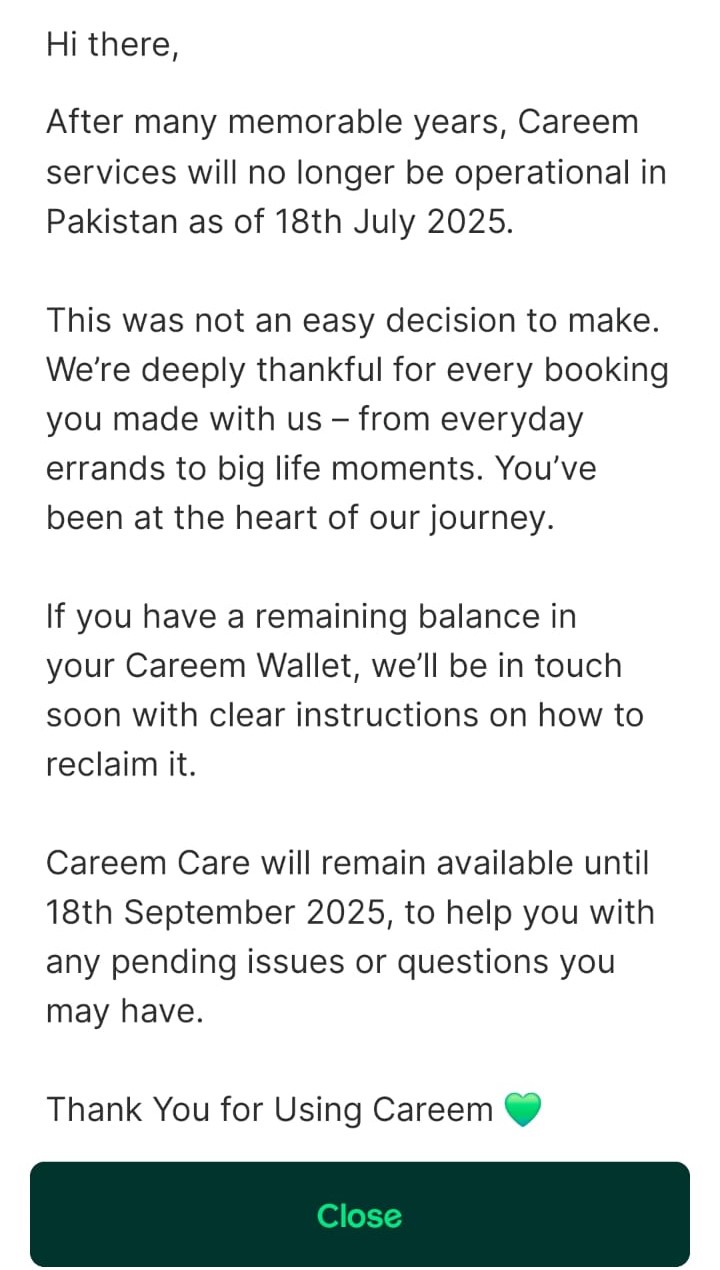
The company said Careem Care will remain available until Sept 18 to help users with any pending issues or questions you may have.
The decision follows Uber’s exit from Pakistan in 2022. Newer entrants such as Russia-backed Yango and Latin America’s inDrive have expanded in major cities, offering low-cost models.
Pakistan’s startup ecosystem has come under pressure since 2022 as venture funding dried up, inflation surged to a record 38% before falling to 3.5%, and consumption weakened. Startups including Airlift, Swvl, VavaCars and Truck It In have shut down or scaled back.
Globally, firms like Uber, Lyft and Grab have exited unprofitable markets, narrowed focus, or expanded into adjacent services such as deliveries and payments. Rising costs, regulation, and thin margins in emerging markets have added to the strain.
Uber still operates in parts of the Middle East and North Africa but has pulled back where profitability remains elusive.