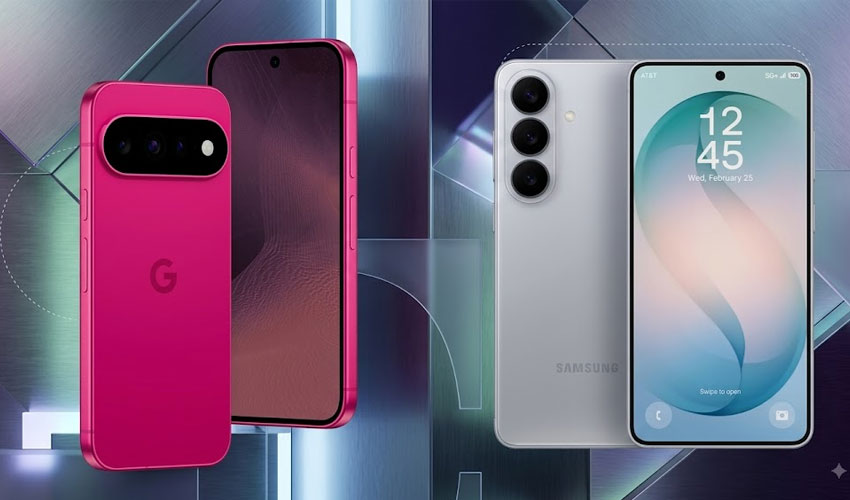
Google's new Pixel 11 takes on Samsung's Galaxy S26 with a brighter display, larger battery and new AI features, while Samsung counters with a lighter design and more flexible display technology.
Google has officially entered the next phase of its smartphone battle with Samsung, launching the Pixel 11 as a direct rival to the Galaxy S26.
Both phones sit around the $900 price point and target buyers who want flagship-level performance without moving to the more expensive Pro or Ultra models. While the Pixel 11 starts at $899, the Galaxy S26 carries a regular starting price of $900 for the 256GB model.
The Pixel 11 is available for preorder and is scheduled to reach stores on August 20, while the Galaxy S26 is already available to buy.
Although both phones share several similarities, including 6.3-inch displays, triple rear cameras, 12GB of RAM and seven years of software and security updates, Google and Samsung have taken different approaches to design, photography, battery life and artificial intelligence.
Pixel 11 vs Galaxy S26: Design and display
The Pixel 11 features a 6.3-inch OLED display with a resolution of 2,424 x 1,080 pixels and a 120Hz refresh rate.
Samsung's Galaxy S26 also has a 6.3-inch display, using AMOLED technology with a 2,340 x 1,080 resolution and an adaptive refresh rate ranging from 1Hz to 120Hz.
Google's phone has the sharper display on paper and can reach a peak brightness of 3,000 nits, compared with 2,600 nits on the Galaxy S26. That could give the Pixel 11 an advantage when viewing the screen outdoors under strong sunlight.
Samsung, however, has slimmer and more uniform bezels, giving the Galaxy S26 a more immersive appearance. Its ability to drop the refresh rate to 1Hz can also help conserve battery during less demanding tasks.
Both phones carry IP68 ratings for dust and water resistance and use Gorilla Glass Victus 2 for additional protection.
Weight is another major difference. The Pixel 11 weighs around 195 grams, while the Galaxy S26 is considerably lighter at 167 grams.
Pixel 11 vs Galaxy S26: Camera comparison
Both smartphones feature triple-camera systems, although neither represents a dramatic hardware upgrade over its predecessor.
The Pixel 11 has a 48-megapixel main camera, a 13-megapixel ultrawide camera and a 10.8-megapixel telephoto camera. It also has a 10.5-megapixel front camera.
The Galaxy S26 features a 50-megapixel main camera, 12-megapixel ultrawide and 10-megapixel telephoto camera, along with a 12-megapixel selfie camera.
Google is putting significant emphasis on AI-powered photography.
One of the Pixel 11's new features is Magic Capture, which uses AI to select high-quality still images from a short video. The phone also introduces Camera Looks, allowing users to apply different visual styles and film-inspired colour profiles.
The Pixel 11 supports up to 30x digital zoom and records video at up to 4K resolution at 60 frames per second.
Samsung, meanwhile, has introduced Horizontal Lock, a stabilization feature designed to keep the horizon level even when the phone is rotated or moved while recording.
The Galaxy S26 can also record video in 8K, giving Samsung an advantage for users who prioritize maximum video resolution.
Samsung's Galaxy AI tools additionally offer features such as object removal, AI-powered photo editing and the ability to modify elements of images using prompts.
Performance and software
The Pixel 11 is powered by Google's new Tensor G6 processor, paired with 12GB of RAM.
Google says the chip has been designed with efficiency and artificial intelligence in mind and was developed alongside Google DeepMind's latest AI models.
The phone comes with 256GB or 512GB of storage. Google has dropped the 128GB option, meaning there is no longer a $799 entry-level version of the standard Pixel.
Samsung's Galaxy S26 uses the Snapdragon 8 Elite Gen 5 for Galaxy, also paired with 12GB of RAM and either 256GB or 512GB of storage.
The Pixel 11 runs Android 17 with Google's Pixel interface, while the Galaxy S26 currently runs Android 16 with Samsung's One UI.
Google is introducing several software features with the Pixel 11, including Rambler, which can clean up voice-to-text transcriptions by removing filler words.
Samsung continues to offer deeper customization through tools such as Good Lock, while Galaxy AI provides a broad range of productivity and editing features.
Battery and charging
Battery capacity is one area where Google has a clear advantage on paper.
The Pixel 11 packs a 4,985mAh battery, compared with around 4,300mAh in the Galaxy S26.
Google also supports 30W wired charging and up to 25W Qi2.2 wireless charging.
The Galaxy S26 supports 25W wired charging and 15W wireless charging, although Samsung's phone supports newer Qi2.2 wireless charging speeds according to the comparison data.
The Pixel 11 also supports magnetic accessories through Google's PixelSnap system and is compatible with many MagSafe accessories.
Samsung's Galaxy S26 does not have built-in magnets, meaning users need a compatible magnetic case to use accessories such as magnetic battery packs.
Actual battery-life performance will depend on software optimization and usage, but the Pixel 11's larger battery gives Google an advantage in capacity.
Pixel 11 vs Galaxy S26: Key specifications
| Feature | Google Pixel 11 | Samsung Galaxy S26 |
|---|---|---|
| Display | 6.3-inch OLED | 6.3-inch AMOLED |
| Resolution | 2,424 x 1,080 | 2,340 x 1,080 |
| Refresh rate | Up to 120Hz | 1-120Hz adaptive |
| Peak brightness | 3,000 nits | 2,600 nits |
| Main camera | 48MP | 50MP |
| Ultrawide | 13MP | 12MP |
| Telephoto | 10.8MP | 10MP, 3x |
| Selfie camera | 10.5MP | 12MP |
| Video | Up to 4K/60fps | Up to 8K |
| Processor | Tensor G6 | Snapdragon 8 Elite Gen 5 for Galaxy |
| RAM | 12GB | 12GB |
| Storage | 256GB, 512GB | 256GB, 512GB |
| Battery | 4,985mAh | 4,300mAh |
| Wired charging | 30W | 25W |
| Wireless charging | Up to 25W Qi2.2 | 15W |
| Software | Android 17 | Android 16 |
| Water resistance | IP68 | IP68 |
| Weight | 195g | 167g |
| Starting price | $899 | $900 |
Which phone should you buy?
The Pixel 11 looks particularly attractive for buyers who prioritize Google's AI features, a brighter display, a larger battery and magnetic wireless accessories. Its new photography tools also give it a distinct identity beyond raw camera specifications.
The Galaxy S26, meanwhile, is the better fit for users who want a lighter phone, an adaptive 1-120Hz display, more advanced video recording and Samsung's extensive customization and Galaxy AI ecosystem.
Price is unlikely to be the deciding factor because the two phones are separated by just $1 at their standard 256GB configurations.
Ultimately, the choice comes down to priorities: Google is leaning heavily into AI, photography and battery capacity, while Samsung continues to emphasize hardware refinement, customization and video capabilities.