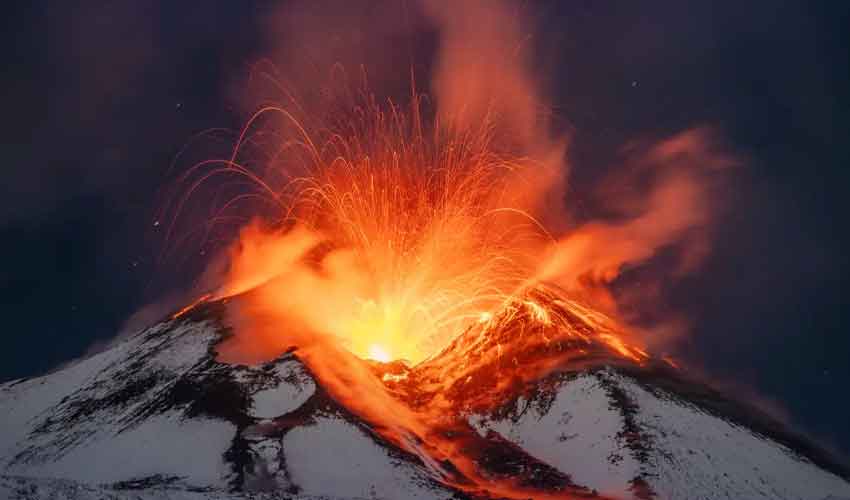
Mount Etna erupted again on Sunday, sending thick clouds of ash into the sky over Sicily and disrupting air travel at Catania Airport.
Catania Airport said airspace in the area was heavily restricted until 7pm local time (1700 GMT) on Sunday, affecting both takeoffs and landings.
Local outlet La Sicilia reported that all incoming flights were cancelled due to safety concerns as volcanic ash spread across parts of Sicily. Flight monitoring service FlightRadar24 also showed arriving flights at Catania Airport as cancelled.
Italy’s flagship carrier ITA said all its flights arriving at and departing from Catania Airport would be cancelled or rescheduled because of the ongoing volcanic activity.
The disruption came as ash from Mount Etna drifted across the region, raising safety concerns for aircraft operations.
INGV reports summit ash emissions
Italy’s National Institute of Geophysics and Volcanology said ash emissions began early Sunday from a vent at Mount Etna’s summit.
The activity intensified later in the morning, producing an eruption column that rose about 1.5 kilometers, nearly 1 mile, above the crater.
Video shared on social media showed ash beginning to rise from the volcano at around 7:45am, before intensifying shortly before 9am. Forecasters expected the ash cloud to continue drifting southward over the following hours.
Red alert after days of volcanic activity
A red alert was issued by Italy’s Department of Civil Protection after Mount Etna erupted on July 2.
The volcano has continued erupting for its ninth consecutive day, sending large clouds of ash from its summit.
Mount Etna began its latest eruptive activity on June 26 from around 3,000 meters above sea level. The eruption has caused lava to flow downhill and triggered volcanic tremors.
Rising roughly 3,300 meters (10,800 feet) on Sicily’s eastern coast, Mount Etna is the largest active volcano in Europe and one of the world’s most active volcanoes.
It frequently produces lava flows, ash emissions, and powerful summit explosions.