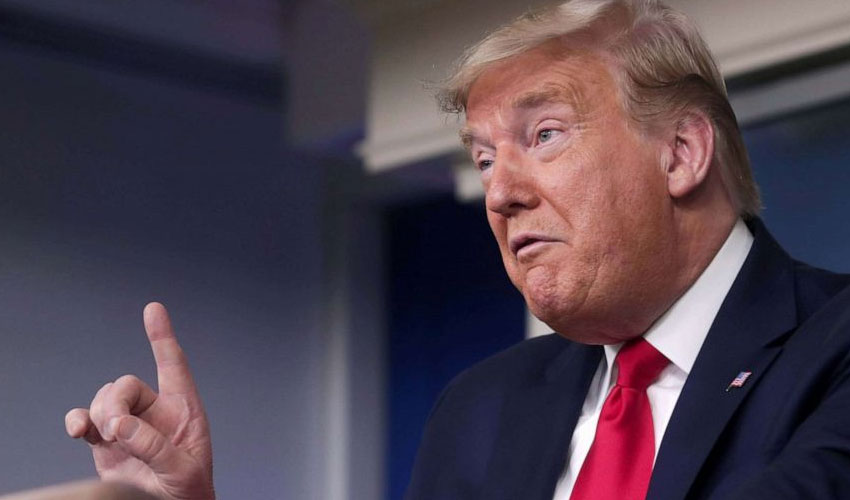
US President Donald Trump has again warned that Iran will never be allowed to acquire nuclear weapons, saying Tehran would use them “within the first hour” if it ever obtained them.
Speaking at a White House ceremony and dinner with farmers, Trump said the United States was negotiating with Iran from a position of “pure strength” after recent military action against Tehran.
Trump said Iran’s air force and navy had been destroyed during the conflict and claimed Tehran was now eager for an agreement.
“We’re negotiating with Iran from pure strength,” Trump said, adding that Iranian leaders want a deal “badly” and that the two sides “will probably make a deal.”
He defended his decision to strike Iran, saying the operation prevented Tehran from obtaining a nuclear weapon.
Trump said that if the United States had not acted, Iran would have acquired nuclear weapons, putting the entire world in grave danger. He added that Israel would not have been safe, the Middle East would have faced destruction, and serious threats would have emerged for the whole world.
US president defends military action
Trump said he had made it clear that Washington would do whatever was necessary to stop Iran from getting nuclear weapons.
“That is what we did. We attacked them with full force,” he said, adding that the United States was now negotiating from a very strong position.
The US president said the Strait of Hormuz had already reopened and traffic was continuing as usual. However, he said military action was necessary because Washington could not allow Iran to acquire nuclear weapons.
“If you want to see big problems in the world, then give Iran nuclear weapons,” Trump said. “I believe that if they get this weapon, they will use it within an hour, and we will never let that happen.”
Trump also claimed Iran had “100%” agreed that it would not acquire nuclear weapons.
Plan to buy crops using Iranian funds
Trump also announced that the US government would soon buy wheat, soybeans and corn from American farmers using Iranian assets frozen under US sanctions.
He made the remarks while signing an executive order related to agriculture and said his administration would bring innovation to the agricultural sector.
Trump insisted that no direct cash would reach Tehran, saying the funds would instead be used to buy American goods, including agricultural products, to address what he described as Iran’s food needs.
US Vice President JD Vance also said that if Iranian assets were unfrozen, they would be used to “make American farmers richer and feed the Iranian people.”
Iran rejects US claim on purchases
Iran rejected the US claim that its unfrozen assets would be used to buy American agricultural products.
Mohammad Bagher Ghalibaf, Iran’s parliament speaker and head of the country’s negotiating team, said on social media that Washington’s claim was false.
“America falsely claims our unfrozen assets will buy their agriculture,” Ghalibaf wrote on X.
He said the only crop Iran was harvesting was “decades of mistrust,” adding that US exports were limited to “GMO soybeans, broken promises and trash talk.”
America falsely claims our unfrozen assets will buy their agriculture. Interesting. The only crop we're harvesting is what you planted: decades of mistrust. It's organic, abundant, and homegrown. But apparently the US only exports GMO soybeans, broken promises and trash talks.
— محمدباقر قالیباف | MB Ghalibaf (@mb_ghalibaf) June 25, 2026
Iranian state and semi-official media framed the emerging agreement as a strategic victory rather than a concession. According to reports from Mehr News Agency, Ghalibaf described the memorandum during a diplomatic visit to Baku as a “declaration of US defeat.”
He said the text does not contain any legal clause requiring Iran to buy US commodities.
Iran’s central bank governor also said earlier that funds released under the emerging agreement with the United States would not necessarily be restricted to essential goods.
Rubio says US wants secure deal
US Secretary of State Marco Rubio, speaking alongside Bahraini leaders in Manama, said Washington wanted a deal that would not compromise the security or prosperity of the United States or its regional allies.
Rubio met Gulf Cooperation Council ministers in Bahrain, where he sought support from regional allies for the US-Iran interim deal.
In a joint Gulf-US statement issued after the talks, the group demanded the immediate reopening of the Strait of Hormuz and said unrestricted freedom of navigation was essential for global stability.
Revolutionary Guards warn ships over Hormuz routes
Iran’s Islamic Revolutionary Guard Corps warned against any crossing of the Strait of Hormuz without authorisation, saying vessels that do not comply “will be dealt with.”
The IRGC said the only authorised route through the Strait of Hormuz is the route announced by the Islamic Republic of Iran. Any crossing without authorisation is “unacceptable and extremely dangerous,” the IRGC said.
The Guards also criticised what they described as a new shipping route announced by “certain authorities,” without naming them.
The future of the Strait of Hormuz remains a key sticking point in negotiations between the United States and Iran. The waterway, which is vital for global energy shipments, was effectively blocked by Iran during the more than 100-day war.
Tehran has said it plans to impose maritime service fees in the future, while the United States argues that the Strait of Hormuz is an international waterway and passage should not be subject to charges.
Iran says no plan to inspect damaged nuclear sites
Iranian Foreign Ministry spokesman Esmaeil Baqaei said Tehran currently has no intention of allowing inspections of its damaged nuclear facilities.
His statement came as negotiations continue over the next phase of the US-Iran framework, which is expected to include talks on Iran’s nuclear programme.
The deal sets up 60 days of talks to address more difficult issues, including nuclear inspections, financial relief, regional security and control of the Strait of Hormuz.
Tehran demands NATO accountability
Baqaei also called for accountability from NATO and several European countries after comments by NATO Secretary General Mark Rutte about Western support for US operations during the recent war against Iran.
In a post on X, Baqaei said Rutte’s remarks amounted to an acknowledgment of NATO’s involvement in what he called an unlawful act of aggression against a sovereign United Nations member state.
This is a clear and damning admission of NATO’s active complicity in an unlawful war of aggression against a sovereign UN Member State — a flagrant violation of peremptory norms of international law and the core principles of the UN Charter.
— Esmaeil Baqaei (@IRIMFA_SPOX) June 25, 2026
The Organization and its individual… pic.twitter.com/q2OPKVrSkM
He said NATO and member states involved in decision-making must be held accountable for the consequences.
Baqaei named Italy and Romania, saying they had been explicitly mentioned by NATO’s secretary general as having participated in the aggression against Iran.
He said those countries, along with every European country that assisted what he called the American-Israeli aggression against Iran, must explain their role to their own people and the world.
He also referred to attacks on Iranian cities, including Minab, Lamerd, Tehran, Isfahan, Sanandaj, Hamadan, Tabriz, Shiraz and Bandar Abbas.