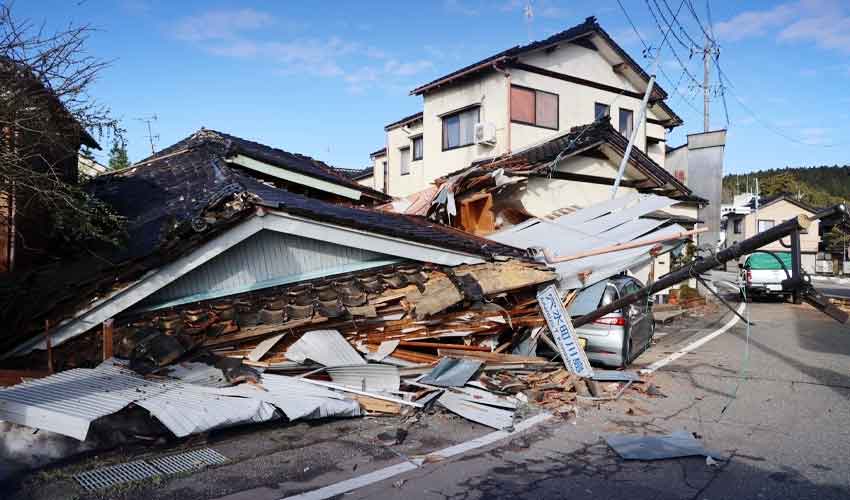
A magnitude 6.9 earthquake struck off Japan’s northeast coast on Thursday morning, injuring at least six people and forcing authorities to halt trains and inspect roads, while no tsunami warning was issued.
The quake hit off the coast of Iwate Prefecture at a depth of about 50 kilometers, with strong shaking reported across parts of northern Japan and mild tremors felt in Tokyo.
The Japan Meteorological Agency said the earthquake’s epicenter was off Iwate Prefecture, and no tsunami damage was expected, apart from possible slight sea level changes.
The hardest-hit area was Aomori Prefecture, where the town of Hashikami registered an upper 6 on Japan’s seismic intensity scale of 0 to 7. The city of Hachinohe recorded a lower 6, while some cities in Iwate Prefecture registered an upper 5.
According to the JMA, an upper 6 intensity means people may be unable to walk and can only crawl during shaking. Unsecured furniture can topple over at that level.
Six people injured after quake
At least six people were injured in the earthquake, according to local authorities. Aomori Prefecture reported five injuries, while in Iwate Prefecture, a woman in her 90s sustained a minor injury after falling.
There were no immediate reports of major structural damage, and officials continued gathering information from affected areas.
No nuclear abnormalities reported
Chief Cabinet Secretary Minoru Kihara said no irregularities had been found at nuclear power facilities in the region.
Tohoku Electric Power said its Onagawa nuclear power plant and idled Higashidori nuclear power plant showed no abnormalities after the quake.
The Nuclear Regulation Authority also said nearby nuclear facilities operated by Tokyo Electric Power and other companies had reported no irregularities.
Trains halted and expressways inspected
East Japan Railway temporarily halted some train services after the earthquake, including the Tohoku Shinkansen high-speed rail line.
Most Tohoku Shinkansen services resumed by 1pm, but numerous train lines in Iwate and Aomori prefectures remained suspended, with no clear timeline for full restoration.
Expressway routes in Aomori were also closed for safety inspections following the strong tremors.
Japan’s government set up an emergency team to collect information and prepare for disaster relief operations. The Prime Minister’s Office also established a task force to respond to the earthquake.
Prime Minister Sanae Takaichi told reporters there was “no tsunami concern” but urged residents in affected areas to remain vigilant for the possibility of another earthquake of similar magnitude.
Defense Minister Shinjiro Koizumi ordered the Self-Defense Forces to carry out aerial intelligence-gathering operations in the quake-hit areas.
JMA warns of possible strong aftershocks
At a press conference on Thursday morning, JMA officials warned residents in the most affected areas to stay alert for future earthquakes for up to a week.
The agency particularly urged caution for people living near the Japan Trench and Kuril Trench.
Officials said that after a large earthquake, there is a 10% to 20% chance of another major quake occurring in the same area, especially within the following two to three days.
Japan remains highly quake-prone
Earthquakes are common in Japan, one of the world’s most seismically active countries. Japan accounts for around one-fifth of the world’s earthquakes of magnitude 6 or greater.
Northern Japan has also experienced several earthquakes in recent months.
In March 2011, Japan’s northeast coast was struck by a magnitude 9 earthquake, the strongest ever recorded in the country, followed by a massive tsunami.
That disaster triggered the world’s worst nuclear crisis since Chornobyl a quarter of a century earlier.