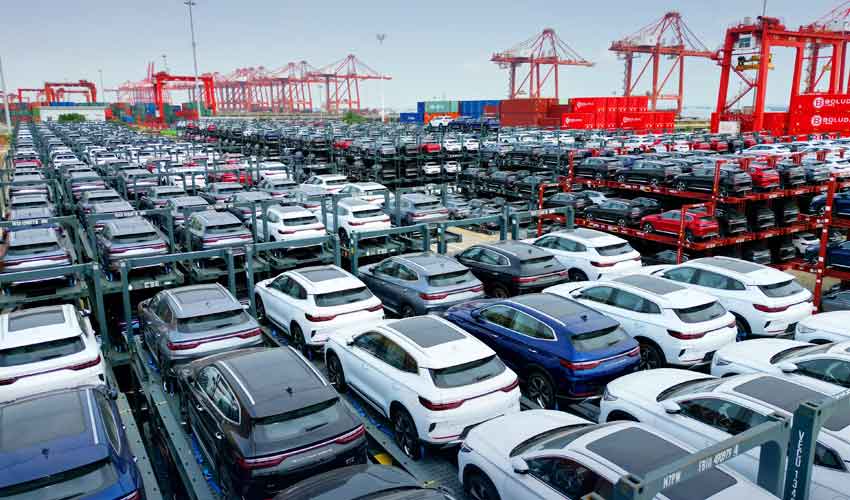
The government has decided to protect Pakistan’s automotive sector from becoming a dumping ground for imported vehicles by introducing a series of anti-dumping measures in the country’s new auto policy.
According to policy documents, the measures are aimed at safeguarding local manufacturing, protecting approximately 2.5 million jobs, and encouraging greater localization in the automobile industry.
Details of the new auto policy reveal that the government has incorporated anti-dumping provisions to support domestic vehicle manufacturers and parts producers.
Officials believe that an influx of low-cost imported vehicles could pose a serious threat to local production, investment and employment in the automotive sector.
The policy emphasizes the need to balance market openness with the protection of Pakistan’s industrial base.
Cheap imports seen as threat to jobs
According to the policy document, inexpensive imported vehicles are placing increasing pressure on local manufacturers and could endanger nearly 2.5 million jobs linked to the auto industry and its supply chain.
The government argues that unchecked imports may weaken domestic production capacity and reduce opportunities for local businesses involved in manufacturing and assembly.
As a result, policymakers have opted for a cautious approach to market liberalization.
Tariff reductions to be gradual
Under the new framework, any reduction in tariffs on imported vehicles will be implemented gradually and carefully.
The document states that tariff reforms will follow a phased approach to prevent sudden disruptions to the local market and allow domestic manufacturers sufficient time to adapt.
This strategy is intended to support long-term industry growth while maintaining competitiveness.
Fully assembled vehicle tariffs
The policy specifies that tariffs on completely built-up (CBU) or fully assembled imported vehicles will remain between 40% and 75%.
Officials believe these tariff levels will help discourage excessive imports while providing local manufacturers with a stable environment for investment and production.
The government views the measure as a key safeguard against vehicle dumping in the domestic market.
To strengthen Pakistan’s automotive supply chain, the new auto policy includes special incentives for companies involved in local parts manufacturing. The government aims to increase the production of locally manufactured components and reduce reliance on imported parts.
Industry stakeholders who invest in localization are expected to benefit from these incentives.
Concessions linked to localisation targets
According to the policy document, companies that fail to meet prescribed localization targets will not be eligible for concessional facilities. Only manufacturers that actively localize production within Pakistan will qualify for incentives and policy benefits.
The move is designed to encourage long-term investment in domestic manufacturing capabilities.
The document notes that major automobile-producing countries, including China and the United States, also maintain safeguard tariffs and other protective measures on vehicle imports.
The government argues that Pakistan’s approach is consistent with international practices aimed at protecting local industries and employment.
Officials say these examples support the need for similar protections in Pakistan’s automotive sector.
Misuse of auto parts imports
The new policy also proposes strict measures to discourage the import of auto parts under the guise of scrap. Authorities believe such practices can undermine local manufacturers and distort market competition.
To address the issue, stronger regulatory oversight and enforcement mechanisms have been recommended.
As part of the reforms, the Federal Board of Revenue (FBR) has been instructed to make the valuation system for imported vehicles more effective.
The objective is to ensure fair taxation, improve transparency and prevent under-invoicing or other practices that may harm domestic industry. Officials believe a stronger valuation mechanism will support the broader goals of the new auto policy.
Policy aims to balance growth and protection
The government says the new auto policy is designed to strike a balance between promoting competition and protecting local industry.
By combining phased tariff reforms, localization incentives and anti-dumping safeguards, policymakers hope to strengthen Pakistan’s automotive sector while preserving jobs and encouraging future investment.







.jpg)