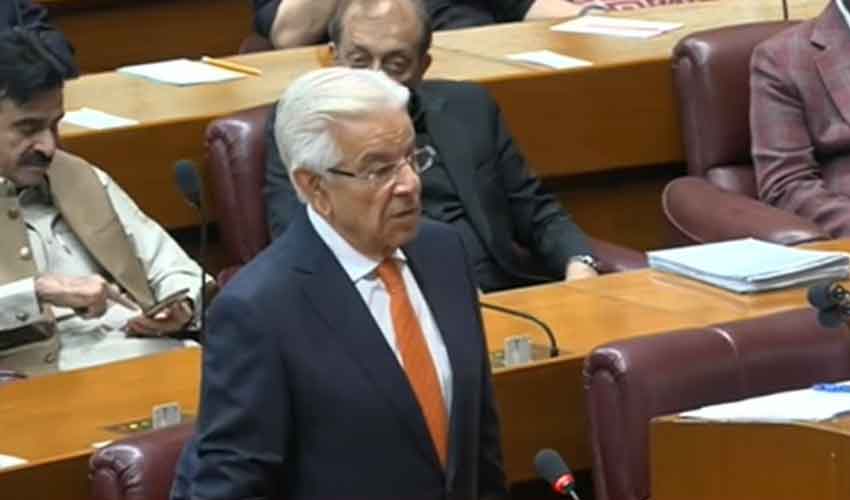
Defence Minister Khawaja Asif has called on the Pakistan Tehreek-e-Insaf (PTI) to become part of a new Charter of Democracy, arguing that political forces must learn from past mistakes and work together to strengthen democratic institutions.
Speaking in the National Assembly, Asif drew parallels with the historic Charter of Democracy signed by the Pakistan Muslim League-Nawaz (PML-N) and Pakistan Peoples Party (PPP), while criticizing PTI’s political conduct and urging the opposition to reflect on its own past.
Addressing lawmakers, Asif said Pakistan’s political leadership should focus on correcting past mistakes rather than repeating them.
He noted that PML-N and PPP had once endured severe political tensions during the 1990s but eventually chose reconciliation over confrontation.
According to the defence minister, former prime ministers Nawaz Sharif and Benazir Bhutto learned from those experiences and signed the Charter of Democracy to strengthen democratic norms.
“Come and become part of the Charter of Democracy. You can sign it too,” Asif told PTI members.
Criticism of PTI’s political conduct
Khawaja Asif launched a strong criticism of PTI and its founder, accusing the party of damaging parliamentary traditions and democratic values.
He claimed that PTI weakened the parliamentary system and caused unprecedented harm to democratic institutions.
The defence minister said the party had damaged political culture and questioned what kind of democracy PTI was advocating.
He also recalled incidents during PTI’s tenure in power, alleging that parliamentary norms were repeatedly violated.
References to National Assembly incidents
Asif cited several events from PTI’s time in government, including the passage of dozens of laws in a short period and the dissolution of the National Assembly.
He alleged that 55 laws were passed within half an hour and referred to the controversial dissolution of the assembly while a speaker was in the chair.
The defence minister also recalled scenes in the National Assembly involving former PTI leader Murad Saeed, saying parliamentary decorum had suffered during that period.
“What did not happen in this House during the PTI era?” he asked.
Praise for government's engagement with opposition
Highlighting the current government's approach, Asif praised Prime Minister Shehbaz Sharif for engaging directly with opposition lawmakers.
He noted that the prime minister had personally met opposition leaders and taken steps to improve political dialogue.
In contrast, Asif claimed that such engagement was absent during PTI's government and alleged that party members avoided contact with political opponents out of fear of displeasing their leadership.
“No party can run by following one individual alone,” he said.
Comments on Mahmood Achakzai draw attention
During his speech, Khawaja Asif also commented on Opposition Leader Mahmood Khan Achakzai’s political alliance with PTI.
The defence minister said Achakzai appeared out of place sitting alongside PTI lawmakers because, in his view, the veteran nationalist leader represented political traditions that PTI lacked.
“Mahmood Achakzai has traditions, while PTI has no traditions,” Asif remarked.
His comments prompted a reaction from Achakzai, who interrupted the speech by saying, “Enough is enough.” Following the intervention, Khawaja Asif immediately concluded that part of his remarks and took his seat.
Defence minister defends remarks on Kashmir
The speech also revisited a controversy surrounding Khawaja Asif’s earlier comments regarding Kashmir.
Responding to objections raised by former prime minister Raja Pervez Ashraf, the defence minister said his remarks had been misunderstood.
He maintained that his statements were intended to highlight the sacrifices made by Kashmiris and Pakistan’s longstanding support for the Kashmir cause.
According to Asif, Kashmiris have demonstrated their commitment to Pakistan through immense sacrifices rather than through documentation or formal status alone.
‘Kashmiris are defined by sacrifices’
Defending his position, the defence minister said Kashmiris should be recognized by their sacrifices rather than birth certificates.
He pointed to the struggle in Indian-administered Kashmir and said many Kashmiris continue to sacrifice their lives while expressing loyalty to Pakistan.
“Kashmiris are not made by birth certificates; they are made by sacrifices,” he said.
Asif added that Pakistan had fought five wars over Kashmir and argued that criticism of Pakistan despite those sacrifices was unjustified.
Remarks on citizenship and national loyalty
Khawaja Asif also spoke about citizenship and national identity during his address.
He said holding Pakistani citizenship comes with responsibilities and maintained that anyone speaking against Pakistan could not genuinely represent the country's interests.
The defence minister stressed that all his statements were supported by facts and evidence and reiterated that he stood by his earlier remarks.
“I stand by my statement,” he told the House.
Political reconciliation remains key theme
Despite his criticism of PTI, Khawaja Asif repeatedly returned to the theme of political reconciliation.
He acknowledged that the political past of all parties was not ideal but argued that meaningful progress requires learning from previous mistakes.
“Our past is not enviable, but we tried to correct it,” he said.
The defence minister concluded by inviting political opponents to join a broader democratic consensus, saying that strengthening parliamentary traditions and democratic institutions should remain a shared national objective.