For years, solar panels were viewed as practical but unattractive additions to buildings and public spaces. That perception is changing rapidly as architects and designers around the world create innovative solar-powered structures that generate clean energy while serving as architectural masterpieces.
Traditional solar panels have long been associated with flat, blue-black rectangular grids installed primarily for function rather than appearance. While effective at generating electricity, they often clashed with architectural aesthetics and were frequently hidden from view.
Advances in flexible thin-film solar cells and organic photovoltaics (OPV) are now allowing designers to integrate renewable energy into creative forms. These technologies enable solar surfaces to bend, curve, and adapt to complex structures, turning energy systems into design features rather than afterthoughts.
The Sweet Spot: A Solar-Powered Badminton Landmark
One of the most ambitious examples of solar architecture is The Sweet Spot, a sports complex designed by MVRDV and Huayi Design in Shenzhen, China.


The complex features a dramatic 240-metre-long roof shaped like a badminton racket, complete with a string-like grid structure embedded with photovoltaic panels. The rooftop generates renewable energy while creating a powerful visual identity for the facility.
The development will serve as China's National Badminton Training Centre and includes professional sports venues, fitness facilities, commercial spaces, parks, and public recreation areas.
A 23-storey tower inspired by a shuttlecock provides accommodation for athletes and visitors, reinforcing the project's connection to the sport.
Solar Trees Inspired by Nature
Biomimicry Meets Renewable Energy
Designers are increasingly turning to nature for inspiration, creating solar installations that resemble trees and plants.


One notable example is Ecacia, a solar canopy designed by Samuel Wilkinson. Inspired by African acacia trees, the structure combines shade and clean energy generation in a single installation.
The canopy incorporates 708 monocrystalline solar panels within its umbrella-like roof. Captured energy can power public amenities, lighting systems, electric vehicle chargers, or be fed into the electricity grid.
The structure is designed to withstand winds of up to 160 kilometres per hour and can be installed individually or in groups across public spaces.
Turning Energy Generation Into Public Art
Solar sculptures are increasingly being designed as interactive public installations that showcase renewable energy production.
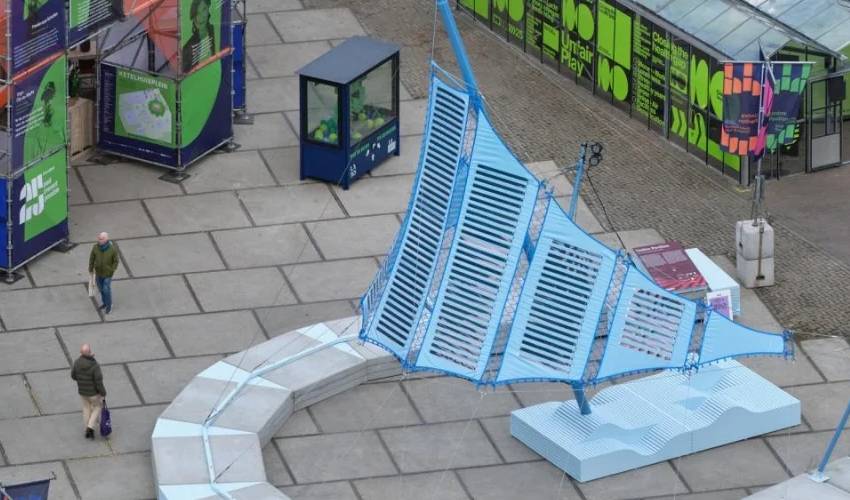
One example is the Umbra Pavilion, created by Dutch designer Pauline van Dongen.


The pavilion uses Heliotex, a textile canopy woven from recycled polyester yarn and embedded with 150 organic photovoltaic cells. The 40-square-metre structure combines lightweight architecture with clean energy generation.
Unlike traditional solar panels, the photovoltaic cells are integrated directly into flexible fabric, allowing variations in transparency, colour, and design while maintaining energy production capabilities.
The system currently generates 53 watts per square metre and is designed to withstand weather, ultraviolet exposure, and fire.
Changing Public Attitudes Toward Renewable Infrastructure
Renewable energy projects have often faced opposition because of concerns about visual impact. Designers are now addressing this challenge by creating installations that communities view as assets rather than intrusions.
The Aeroleaf Hybrid
French company New World Wind has developed the Aeroleaf Hybrid, a tree-like structure that combines solar and wind energy generation.


The design incorporates leaf-shaped micro-wind turbines that capture wind from any direction, alongside discreet solar panels. Available as the Wind Tree, Wind Palm, and Wind Bush models, the system is intended for urban environments where traditional renewable energy infrastructure may be impractical.
Each Aeroleaf unit can generate at least 300 watts of electricity while maintaining a visually appealing appearance suitable for public spaces.
The Future of Multi-Functional Solar Infrastructure
Modern solar sculptures are increasingly designed to serve multiple purposes beyond energy generation.
Many incorporate features such as:
- Public seating
- Shade structures
- LED lighting
- Wi-Fi connectivity
- Mobile device charging stations
- Electric vehicle charging points
By combining utility, sustainability, and aesthetics, these installations are helping renewable energy become a visible and celebrated part of urban life.
A New Era for Solar Design
The emergence of solar sculptures marks a significant shift in how renewable energy is integrated into the built environment. Rather than hiding solar technology, architects and designers are embracing it as a defining visual element.
As innovations in photovoltaic materials continue to advance, solar panels are increasingly becoming part of the architectural narrative—transforming from functional necessities into iconic landmarks that generate both energy and public interest.