Pakistan has highlighted a series of diplomatic engagements over the past two weeks, reaffirming its efforts to promote peace in the region while voicing concerns over India's water projects, the Kashmir dispute and security challenges emanating from Afghanistan.
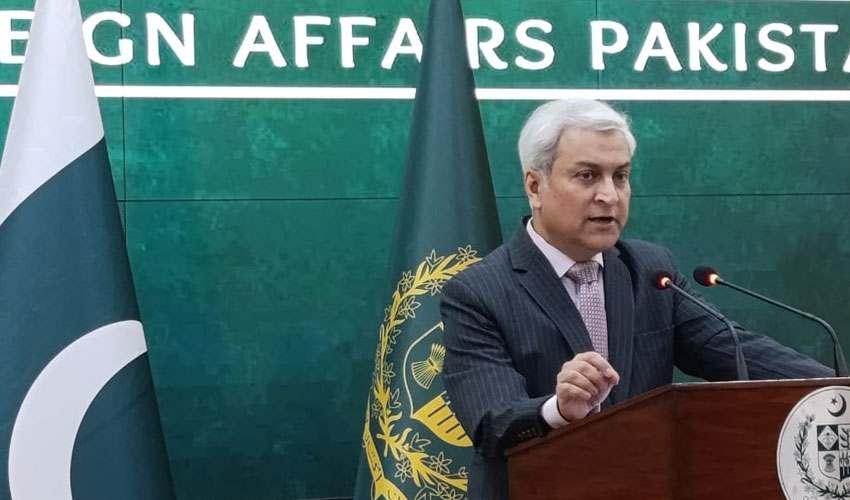
Speaking during the weekly media briefing, Foreign Office spokesperson Tahir Hussain Andrabi said Pakistan remained actively engaged on key regional and international issues through high-level diplomatic contacts and strategic dialogues.
The spokesperson said Prime Minister Shehbaz Sharif recently paid a successful official visit to China.
During the visit, the prime minister held meetings with China’s top leadership, while several memorandums of understanding were signed between Pakistan and China to further strengthen bilateral cooperation.
🔴LIVE: Spokesperson's Weekly Press Briefing 04-06-2026 at Ministry of Foreign Affairs, Islamabad https://t.co/3ebcyb2jT0
— Ministry of Foreign Affairs - Pakistan (@ForeignOfficePk) June 4, 2026
According to Andrabi, the visit marked an important step in deepening strategic and economic ties between the two countries.
Ishaq Dar’s US visit focused on peace efforts
The Foreign Office spokesperson said Deputy Prime Minister and Foreign Minister Ishaq Dar visited the United States after completing his visit to China.
During his stay in the US, Dar attended various United Nations events and held meetings with several counterparts, world leaders and senior UN officials.
Also Read: EU wants Pakistan to progress in human rights, labour protection
Among the key engagements was a meeting with US Secretary of State Marco Rubio. According to Andrabi, Rubio acknowledged Pakistan’s diplomatic and mediation efforts and praised the country's role in promoting peace and stability.
The spokesperson said the US leadership appreciated Pakistan’s contributions toward regional peace initiatives.
Pakistan continues diplomatic efforts in Middle East
The spokesperson said Pakistan’s efforts to help reduce tensions in the Middle East remain ongoing. Prime Minister Shehbaz Sharif remained in contact with regional leaders, including the presidents and leaders of Iran and Kuwait.
He said Iranian President Masoud Pezeshkian also contacted Prime Minister Sharif during this period. According to Andrabi, Pakistan is playing its most sincere and constructive role in efforts aimed at promoting peace across the region.
Following his return from the United States, Ishaq Dar also held contacts with the foreign ministers of Egypt and Kuwait.
The spokesperson further noted that eight foreign ministers from Islamic countries issued a joint statement regarding the recent provocation at Al-Aqsa Mosque. Pakistan also welcomed US efforts aimed at securing a ceasefire between Israel and Lebanon.
EU high representative’s significant visit
Andrabi described the recent visit of European Union High Representative for Foreign Affairs and Security Policy Kaja Kallas as highly important.
During the visit, Kallas met Prime Minister Shehbaz Sharif and other members of the Pakistani leadership. The spokesperson said Kallas and Deputy Prime Minister Ishaq Dar co-chaired the Pakistan-EU Strategic Dialogue.
He added that Pakistan maintains a productive dialogue with the European Union on various issues, including human rights.
Pakistan condemns Israeli actions in Palestine
The Foreign Office reiterated Pakistan’s strong condemnation of Israeli actions in Palestine.
The spokesperson said Pakistan’s position on the issue remains consistent and is based on support for the establishment of a sustainable and independent Palestinian state.
He also emphasized that Pakistan’s position regarding the Abraham Accords remains clear and unchanged.
Intelligence-sharing allegations
Responding to reports regarding Iran, the spokesperson rejected allegations that Pakistan shared intelligence with the United States. He said the deputy prime minister did not share any such information with the US secretary of state.
“The allegation of intelligence sharing regarding Iran is completely baseless,” Andrabi said. He added that such claims appear aimed at derailing ongoing peace efforts.
Concerns over Indian water projects
A significant portion of the briefing focused on Pakistan’s concerns regarding India's water-related projects.
The spokesperson said India has invited tenders for the Chenab-Beas Link Tunnel project, describing the move as a violation of international law, the Indus Waters Treaty and the Geneva Water Convention.
According to Andrabi, India has not provided Pakistan with any formal information regarding these projects. He accused India of once again attempting to use water as a weapon and warned that illegal actions threatening food and water security would not be accepted.
Pakistan, he said, reserves the right to exercise all available response options in this regard.
The Foreign Office also expressed concern over the de-silting of the Salal Dam in India-held Kashmir. According to the spokesperson, such de-silting is not permitted under the 1978 Salal Agreement.
He said India did not provide prior notice to Pakistan before undertaking the activity. Andrabi reiterated that Pakistan enjoys unrestricted rights to utilize the waters of the western rivers under the Indus Waters Treaty.
He further stated that India is fully aware of efforts related to the diversion of Chenab River water toward the Beas River.
Kashmir remains internationally recognised dispute
Reaffirming Pakistan’s position on the disputed Kashmir valley, the spokesperson said the issue remains an internationally recognized dispute. He stressed that visits by foreign personalities to Indian-held Kashmir cannot alter the legal and political status of the territory.
Regarding reports about the Swiss ambassador’s visit to the region, Andrabi said Pakistan remains in contact with Swiss authorities on the matter.
Afghanistan and terrorism concerns
The spokesperson also highlighted Pakistan’s concerns regarding terrorism originating from Afghan soil. He said Pakistan continues to face security threats from terrorist groups operating from across the border.
According to Andrabi, Pakistan has every right to take legitimate legal measures to protect its citizens and national security. He added that the European Union understands Pakistan’s position on Afghanistan.
Human rights dialogue with EU
Responding to questions about remarks made by the EU Special Representative, the spokesperson said Pakistan maintains a constructive dialogue with the European Union on human rights issues.
He stated that Pakistan is making positive progress in the area of human rights and regularly submits reports to relevant international institutions. The issue was also discussed during engagements with European officials, he added.
Commenting on reports regarding a possible agreement between Russia and the Taliban administration, Andrabi said it was too early to draw conclusions. He said developments would become clearer in due course and Pakistan would continue to monitor the situation.
The spokesperson noted that discussions during the joint press conference with European representatives also covered matters related to Pakistan’s defense cooperation and broader strategic interests.


.jpg)