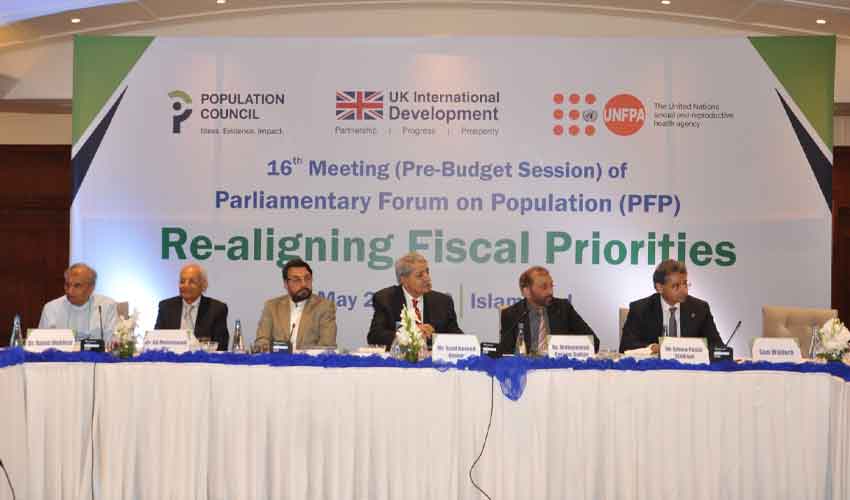
The pre-budget session of the Parliamentary Forum on Population (PFP) brought together more than 40 parliamentarians from all provincial assemblies, Gilgit-Baltistan, and AJK, to deliberate on urgent fiscal and policy priorities ahead of the federal budget 2026–27.
This multiparty session was convened by the Population Council with the support of UNFPA.
Senator Sherry Rehman, chairperson of the PFP, while chairing the session, underscored the urgency of addressing rapid population growth as a national priority.
“Population is a ticking time bomb for every resource this country generates,” she said. She called for the immediate removal of the tax on contraceptives and stronger political ownership across all legislatures.
She emphasised that population must be framed as both a national and family issue, requiring sustained attention in federal and provincial budget debates.
Delivering the keynote address, Adnan Pasha Siddiqui, advisor to the finance minister on special initiatives, highlighted population growth as a central macroeconomic challenge.
“Had population growth been better managed over the years, Pakistan’s GDP and per capita income would be significantly higher today,” he noted. He outlined key fiscal and structural reforms, including revisiting the NFC formula, strengthening fiscal prioritisation, and advancing a long-term National Population Stabilisation Programme.
He warned that unless structural fiscal incentives are corrected, population pressures will continue to undermine Pakistan’s long-term economic competitiveness and human capital development.
Senior economist Dr Hanid Mukhtar observed that Pakistan allocates only a modest share of public expenditure to population-related priorities despite the scale of the federal development budget, terming it “not a lack of resources, but a lack of fiscal priority.”
Dr. Melania Hidayat, international family planning advisor at UNFPA Pakistan, highlighted the significant financing gap in family planning. “Family planning is not only a vital health intervention, but also a sound economic investment that delivers substantial social and economic returns,” she stated, urging policymakers to operationalise the Pakistan Population Fund, ring-fence allocations, and formalise the removal of the contraceptive tax through the Finance Bill.
The plenary discussion, moderated by MNA Dr Farooq Sattar, brought forward perspectives from legislators across all regions, reflecting strong cross-party consensus.
Participants emphasised the need to revisit the NFC formula, reduce over-reliance on population-based criteria, link resource allocation with human development indicators, address regional disparities, and strengthen last-mile service delivery.
The discussion underscored both regional disparities and structural financing gaps in Pakistan’s population and health systems.
Dr Farooq Sattar stressed the importance of engaging local government institutions in population stabilisation strategies, including programme accountability and implementation mechanisms.
In his concluding remarks, National Assembly Standing Committee on Finance and Revenue Chairman Naveed Qamar reaffirmed parliamentary commitment to accountability. He emphasised that parliament would continue to closely review budgetary commitments related to population and family planning to ensure that policy commitments are effectively translated into measurable action and implementation.




.jpg)