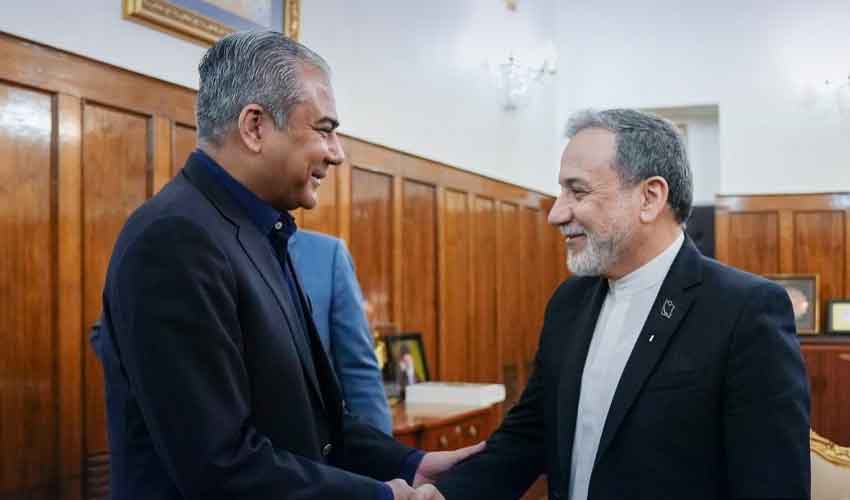
Interior Minister Mohsin Naqvi held another round of talks with Iranian Foreign Minister Abbas Araghchi on Friday as Pakistan continued efforts to help bridge differences between the United States and Iran.
The meeting focused on the latest draft proposal to end the war, with uranium enrichment and control of the Strait of Hormuz still emerging as the biggest sticking points.
According to Iranian media, Naqvi and Araghchi held detailed discussions on points of disagreement between Washington and Tehran.
The meeting came two days after Naqvi presented the latest US message to Iranian officials as part of ongoing mediation efforts.
Iran’s semi-official Tasnim and ISNA news agencies reported that Naqvi was helping facilitate communication to reach a framework for ending the war and resolving differences.
Naqvi has been in Tehran for several days as Pakistan tries to pave the way for a possible US-Iran agreement.
Rubio sees 'good signs' but warns over Hormuz
US Secretary of State Marco Rubio said Thursday there had been “some good signs” in the negotiations.
“I don’t want to be overly optimistic ... So, let’s see what happens over the next few days,” Rubio told reporters. However, he warned that no diplomatic solution would be possible if Tehran enforced a tolling system in the Strait of Hormuz.
Also Read: Iran's Supreme Leader rejects uranium transfer abroad
Iran effectively closed the key waterway to most shipping after the war began on February 28.
Uranium and Strait of Hormuz major obstacles
A senior Iranian source told Reuters on Thursday that gaps between the two sides had narrowed, but uranium enrichment and the Strait of Hormuz remained unresolved.
The Strait of Hormuz is vital to global energy markets. Before the war, about one-fifth of the world’s oil and liquefied natural gas shipments passed through it.
Traffic has since fallen sharply, compared with 125 to 140 daily passages before the conflict.
Also Read: US-Iran talks show progress, yet at odds on key issues
Iran says it wants to reopen the strait to friendly countries that follow its terms, which could include fees. Rubio called such a move a threat to the world and “completely illegal.”
Trump says US will recover Iran’s uranium stockpile
US President Donald Trump said Washington would eventually recover Iran’s stockpile of highly enriched uranium.
“We will get it. We don’t need it, we don’t want it. We’ll probably destroy it after we get it, but we’re not going to let them have it,” Trump said at the White House on Thursday.
Washington believes the uranium could be used for a nuclear weapon, while Tehran says its program is purely peaceful.
Two senior Iranian sources said before Trump’s remarks that Supreme Leader Ayatollah Mojtaba Khamenei had directed that the uranium should not be sent abroad.
Trump also criticized Tehran’s reported plan to charge ships using the Strait of Hormuz. “We want it open, we want it free. We don’t want tolls,” he said. “It’s an international waterway.”
Also Read: Netanyahu emerges as obstacle to peace after tense Trump call
Trump is also facing domestic pressure ahead of November midterm elections, as Americans express anger over rising fuel prices.
His approval rating is reportedly near its lowest level since he returned to the White House last year.
Iran’s latest offer repeats earlier demands
Tehran submitted its latest offer to Washington earlier this week. Descriptions of the proposal suggest it largely repeats terms Trump previously rejected.
These include Iranian control of the Strait of Hormuz, compensation for war damage, lifting of sanctions, release of frozen assets, and the withdrawal of US troops.
The International Energy Agency says the conflict has caused the world’s worst energy shock. It warned Thursday that peak summer fuel demand, combined with limited new Middle East supply, could push the market into the “red zone” in July and August.
Oil prices climbed Friday as investors doubted the chances of a breakthrough, while the US dollar hovered near a six-week high amid uncertainty over the talks.
Also Read: Iran sets up new authority for Strait of Hormuz shipping control
Tony Sycamore, a market analyst at IG, said he was not convinced a resolution was close.
“We’re coming to the end of week 12, we’re six weeks in the ceasefire, and I’m just not really that convinced we’re any closer to a resolution between the US and Iran,” he said.
War aims and Iran’s remaining capabilities
Trump and Israeli Prime Minister Benjamin Netanyahu have said their war aims are to curb Iran’s support for regional militias, dismantle its nuclear program, destroy its missile capabilities, and make it easier for Iranians to topple their rulers.
But Iran has so far retained its stockpile of near-weapons-grade enriched uranium.
It also still has the ability to threaten neighbours through missiles, drones, and proxy militias.



.jpg)