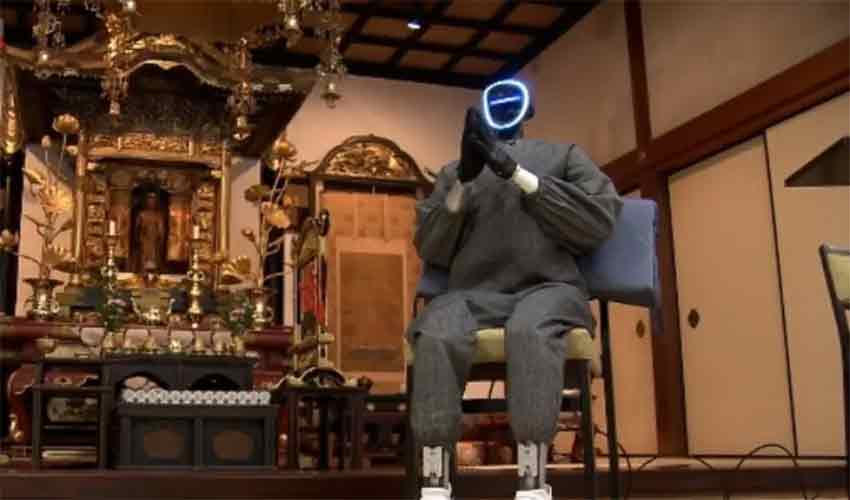
Japanese researchers have introduced an AI-powered robot monk designed to provide spiritual guidance and potentially address shortages of human clergy in the future.
Known as “Buddharoid,” the two-legged humanoid has been trained on a wide range of Buddhist scriptures, allowing it to answer sensitive questions that people might hesitate to ask human monks. Beyond voice interactions, the robot can also provide a sense of presence at temples and religious sites.
“In the future, it is conceivable that these robots may assist with or even perform some of the rituals traditionally carried out by human monks,” said Kyoto University in a Wednesday statement.
Buddharoid is the latest creation of Professor Seiji Kumagai from the university’s Institute for the Future of Human Society. Kumagai has previously developed AI-based religious chatbots, including Buddha Bot and catechism bots, in collaboration with engineering firms. For this project, his updated “BuddhaBotPlus” software was installed on a Chinese-made “Unitree G1” humanoid robot to create a mobile AI monk.
During a media demonstration at a temple on Tuesday, the robot—wearing a simple grey garment and without a facial display—walked, sat, and held its gloved hands in a prayer gesture. It offered advice to a young journalist, speaking in a calming baritone:
“Buddhism teaches that it is important not to blindly follow one’s thoughts or rush headlong into things. One approach is to calm your mind and let go of the thought itself.”
While religious AI chatbots already exist across multiple faiths, combining AI with humanoid robotics allows Buddharoid to deliver guidance while performing human-like physical movements. Previous examples include Kyoto’s non-AI android Mindar, which delivers sermons, and a 2017 German robot that offered blessings in multiple languages.
Kyoto University emphasized the need for ongoing ethical discussions regarding AI’s role in religious settings. However, with Japan facing a shrinking and aging population, humanoid robots like Buddharoid may increasingly assist in rituals and other tasks traditionally performed by human priests, potentially transforming religious culture.



.jpg)