Pakistan has reached one of its largest-ever defence export agreements, finalising a multibillion-dollar deal to supply conventional military equipment to Libya’s eastern-based Libyan National Army (LNA), a move that underscores Islamabad’s push toward an export-driven, self-sustaining economy.
According to four Pakistani officials involved in defence matters, Pakistan will supply military equipment worth more than $4 billion to the LNA. Two officials placed the value at $4 billion, while two others said it could reach $4.6 billion, according to Reuters.
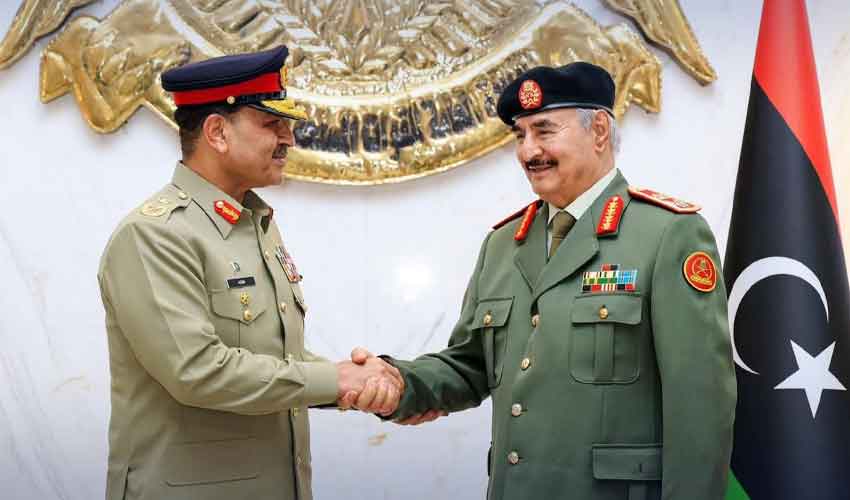
The agreement was finalised after a meeting last week between Chief of Defence Forces and Chief of Army Staff Field Marshal Asim Munir and Saddam Khalifa Haftar, the deputy commander-in-chief of the LNA, in Benghazi.
Weapons, platforms included in agreement
A copy of the deal seen by Reutrs before finalisation lists the purchase of 16 JF-17 Thunder multi-role fighter jets, jointly developed by Pakistan and China, along with 12 Super Mushak trainer aircraft used for basic pilot training.
One Pakistani official confirmed to Reuters the list was accurate, while another said the deal also includes land, sea and air equipment to be delivered over approximately two and a half years, though exact quantities could vary.
Strategic military cooperation
The LNA’s official media channel reported on Sunday that it had entered into a defence cooperation pact with Pakistan, covering weapons sales, joint training and military manufacturing.
“We announce the launch of a new phase of strategic military cooperation with Pakistan,” Haftar said in remarks broadcast by Al-Hadath.
Pakistan’s foreign ministry, defence ministry and military did not respond to Reuters' requests for comment. Authorities in Benghazi also did not immediately reply to media inquiries.
The officials who confirmed the deal requested anonymity due to the sensitivity of the agreement.
UN arms embargo, scrutiny concerns
Libya has been under a United Nations arms embargo since 2011, requiring UN approval for weapons transfers. Any arms deal involving Libya is likely to face scrutiny due to the country’s prolonged instability following the NATO-backed uprising that toppled Muammar Gaddafi.
A UN panel of experts reported in December 2024 that the embargo remained “ineffective,” noting that multiple foreign states have openly provided military training and assistance to forces in both eastern and western Libya.
It remains unclear whether Pakistan or Libyan authorities applied for exemptions under the embargo. However, three Pakistani officials told Reuters the deal did not violate UN restrictions.
One official said Pakistan was not the only country supplying Libya, another said there were no sanctions on Haftar, and a third pointed to improving relations between Benghazi authorities and Western governments amid rising fuel exports.
Libya remains split between rival administrations. The UN-recognised Government of National Unity, led by Abdulhamid Dbeibah, controls much of western Libya, while Haftar’s LNA governs the east and south, including major oilfields, and does not recognise the western government.
Boost for Pakistan’s defence export ambitions
The Libya deal reflects Pakistan’s broader effort to expand defence exports, leveraging decades of counterinsurgency experience and a growing domestic defence industry covering aircraft production, armoured vehicles, munitions and naval construction.
Islamabad has highlighted the performance of the Pakistan Air Force in clashes with India in May as evidence of its advanced capabilities.
“Our recent war with India demonstrated our advanced capabilities to the world,” Munir said in remarks aired by Al-Hadath.
Pakistan markets the JF-17 as a cost-effective, multi-role fighter jet and positions itself as a supplier capable of offering aircraft, training and maintenance outside traditional Western supply chains.
The country has also strengthened defence ties with Gulf partners, signing a Strategic Mutual Defence Agreement with Saudi Arabia in September 2025 and holding senior-level defence talks with Qatar.
Analysts say the Libya agreement significantly expands Pakistan’s footprint in North Africa, a region where regional and global powers are competing for influence over Libya’s fragmented security institutions and oil-backed economy.
The deal is being described as historic in scale and financial impact, placing Pakistan among the emerging exporters of conventional arms and military equipment worldwide.




.jpg)