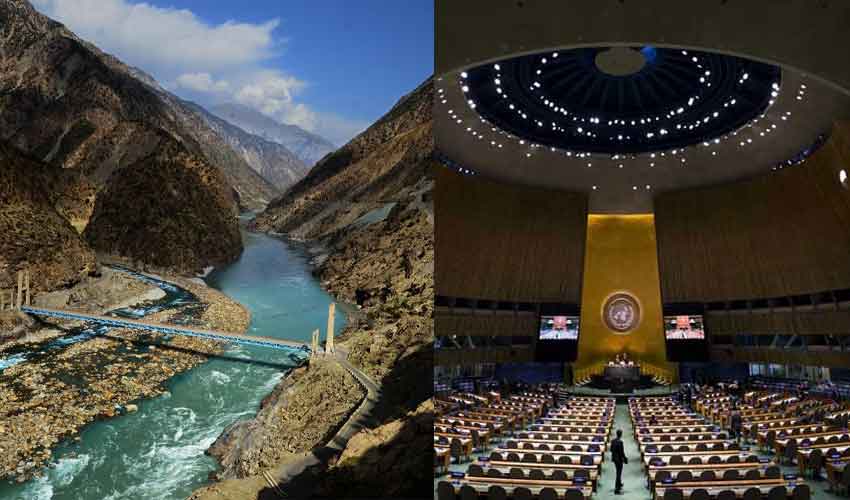
The United Nations has declared India’s unilateral suspension of the Indus Waters Treaty illegal, fully endorsing Pakistan’s long-standing position on the issue.
UN special experts warned that disrupting water flows threatens the fundamental rights of millions of Pakistanis and violates international law.
In a detailed experts’ report, the United Nations stated that no party can unilaterally suspend the Indus Waters Treaty, declaring India’s action unlawful. The report emphasized that the treaty is a bilateral agreement and cannot be terminated or suspended by the decision of one party alone.
UN experts confirmed that Pakistan’s stance on the treaty is correct and grounded in international legal principles.
The UN experts expressed deep concern over India’s announcement to suspend the treaty, stating that interruption or threats of interruption in water flow directly affect the fundamental rights of millions of people in Pakistan.
According to the report, the rights to water, food, employment, health, environment, and development are all impacted by interference in cross-border water flows. The experts stressed that such actions must be avoided under international law.
Water can't be used as political or economic weapon
The UN report categorically stated that water cannot be used as a tool for political or economic pressure. Experts said India’s unilateral suspension of the treaty, while ignoring agreed procedures, is illegal and violates Pakistan’s rights.
They added that interference in cross-border water arrangements undermines regional stability and international norms.
The experts rejected India’s claims linking the treaty suspension to alleged “cross-border terrorism,” stating that such allegations are irrelevant to the Indus Waters Treaty. The report noted that India failed to present credible and coherent evidence to support these accusations.
The UN experts urged India to implement the treaty in good faith and refrain from actions that violate Pakistan’s legal and humanitarian rights.
Civil notice sent to Modi govt
UN experts also sent a civil complaint to the Modi government, exposing what they described as misleading claims by India. In a five-point questionnaire, the experts sought evidence for allegations against Pakistan and asked whether India would compensate for loss of life resulting from the illegal use of force.
The questionnaire also asked about steps to grant the right to self-determination to Kashmiris. India failed to respond within the required 60-day period, after which the experts issued their report.
Report published without Pakistan’s involvement
Indus Water Commissioner Mehr Ali Shah clarified that the report emerged through international mechanisms and was not issued by Pakistan. He said the document is an independent assessment by UN experts and is based entirely on facts and reality.
“This report has come in the media; it is not from Pakistan. It is a report by UN experts,” he stated.
Shah said India illegally suspended the Indus Waters Treaty and described India’s actions as a false flag operation. He stressed that the treaty is bilateral and cannot be altered unilaterally under any circumstances.
He added that the report was published in October, but India chose not to respond to it.
Violations in Jhelum, Chenab rivers highlighted
According to the Indus Waters Treaty, India cannot change the natural flow patterns of the Jhelum and Chenab rivers. Mehr Ali Shah revealed that India altered water flows twice — once in May and again in December.
He said water flow was maintained for 159 hours, but later dropped sharply to about 10 percent of normal levels.
The commissioner stated that the average water flow has fallen to 4,000–5,000 cusecs, and after India’s measures, it further dropped to 870–1,000 cusecs. He warned that such drastic reductions pose serious risks to agriculture, livelihoods, and water security in Pakistan.
Pakistan claims diplomatic, legal victory
Officials described the UN report as a major diplomatic and legal win for Pakistan on the Indus Waters Treaty issue. The confirmation by UN experts strengthens Pakistan’s position internationally and highlights India’s treaty violations.
Pakistan has reiterated its call for India to restore full compliance with the treaty and act responsibly to protect regional peace.




.jpg)