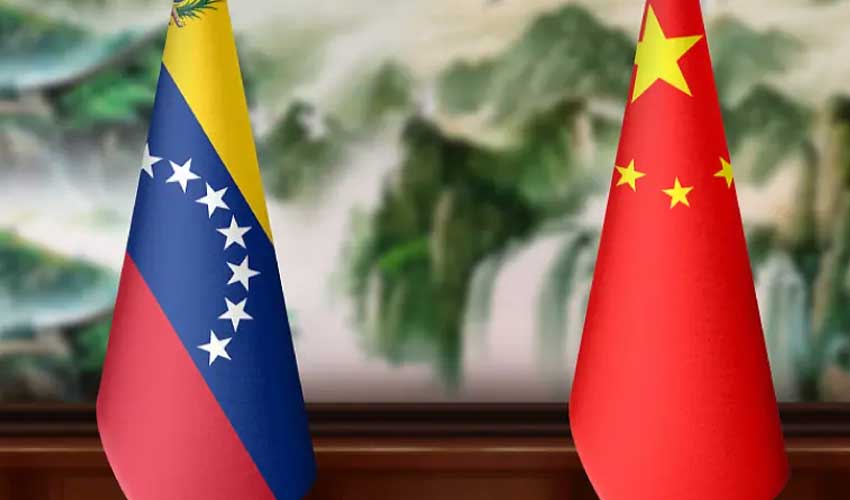
China opposes "unilateral bullying" and supports countries in safeguarding their own sovereignty, Foreign Minister Wang Yi told his Venezuelan counterpart on Wednesday, as U.S. President Donald Trump ramps up pressure on the South American country.
Wang said in a phone call with Venezuelan Foreign Minister Yvan Gil that China and Venezuela are strategic partners and that mutual trust and support are a tradition of bilateral ties, according to a Chinese foreign ministry statement.
"China believes the international community understands and supports Venezuela's position in defending its legitimate rights and interests," he said.
Separately, US President Donald Trump ordered on Tuesday a "blockade" of all sanctioned oil tankers entering and leaving Venezuela, in Washington's latest move to increase pressure on Nicolas Maduro's government, targeting its main source of income.
It is unclear how Trump will impose the move against the sanctioned vessels, and whether he will turn to the Coast Guard to interdict vessels like he did last week. The administration has moved thousands of troops and nearly a dozen warships - including an aircraft carrier - to the region.
"For the theft of our Assets, and many other reasons, including Terrorism, Drug Smuggling, and Human Trafficking, the Venezuelan Regime has been designated a FOREIGN TERRORIST ORGANIZATION," Trump wrote on Truth Social. "Therefore, today, I am ordering A TOTAL AND COMPLETE BLOCKADE OF ALL SANCTIONED OIL TANKERS going into, and out of, Venezuela."
In a statement, Venezuela's government said it rejected Trump's "grotesque threat."
Oil prices rose more than 1% in Asian trade on Wednesday. Brent crude futures LCOc1 were up 70 cents, or 1.2%, at $59.62 a barrel at 0245 GMT, while US West Texas Intermediate crude CLc1 rose 73 cents, or 1.3%, to $56.00 a barrel.
US crude futures climbed over 1% to $55.96 a barrel in Asian trading after Trump's announcement. Oil prices settled at $55.27 a barrel on Tuesday, the lowest close since February 2021.
Oil market participants said prices were rising in anticipation of a potential reduction in Venezuelan exports, although they were still waiting to see how Trump’s blockade would be enforced and whether it would extend to include non-sanctioned vessels.
LEGAL QUESTIONS
American presidents have broad discretion to deploy US forces abroad, but Trump’s asserted blockade marks a new test of presidential authority, said international law scholar Elena Chachko of UC Berkeley Law School.
Blockades have traditionally been treated as permissible “instruments of war,” but only under strict conditions, Chachko said. “There are serious questions on both the domestic law front and international law front,” she added.