China on Sunday defended its new export controls on rare earth materials as a “legitimate” step under international law, rebuffing U.S. accusations of economic coercion after Washington imposed sweeping 100% tariffs and export restrictions in retaliation.
In a statement, the Chinese Ministry of Commerce said the Oct. 9 measures were intended to “strengthen export control systems and safeguard world peace and regional stability” amid growing global uncertainty.
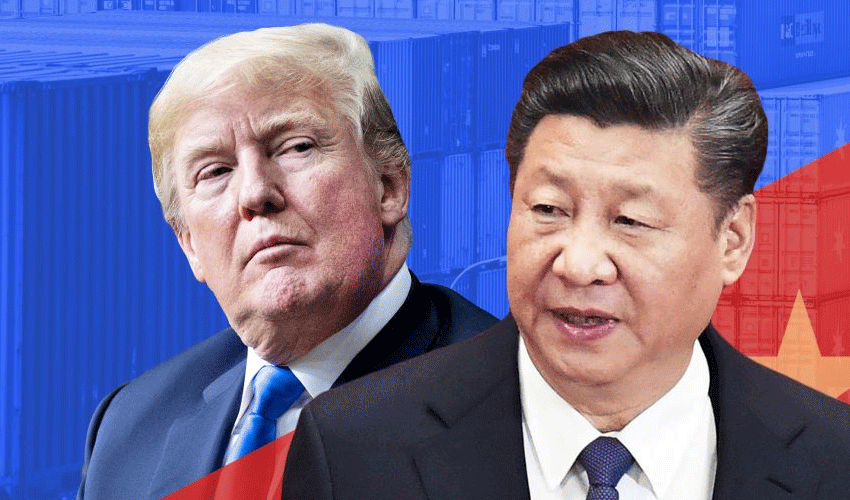
The restrictions now cover rare earth materials, technologies, and related intellectual property, just weeks before a possible meeting between U.S. President Donald Trump and Chinese leader Xi Jinping.
“These controls do not constitute export bans. Applications that meet requirements will be approved,” the ministry said, adding that China had “fully assessed the potential impact on global supply chains” and expected it to be “very limited.”
Under the new rules, any product containing more than 0.1% of China-sourced rare earths, or manufactured using its extraction and refining technologies, will require an export license. Applications for items that could serve military or terrorist purposes will be rejected.
The U.S. responded swiftly. On Oct. 10, President Trump announced 100% tariffs on all Chinese imports, effective Nov. 1, along with export controls on “any and all critical software.”
Beijing hit back, accusing Washington of “double standards.”
“For a long time, the U.S. has abused export controls under the guise of national security,” the ministry said, noting that the U.S. list of restricted items exceeds 3,000, compared to fewer than 1,000 on China’s list.
China, which supplies about 70% of the world’s rare earths, has often leveraged its dominance in the sector as a strategic bargaining chip in trade disputes.
Reciprocal measures and trade tensions
In a separate move, China announced that starting Oct. 14, it would charge docking fees to U.S. ships — a reciprocal response to Washington’s decision to impose fees on Chinese vessels at American ports.
Calling the decision “a necessary passive defensive action,” Beijing said the U.S. measures had “seriously undermined the atmosphere of ongoing trade talks.”
Trade negotiations between the two countries have seen uneven progress. After rounds of talks in Geneva, London, and Madrid, both sides had reached a basic framework consensus in September — including steps toward the divestment of Chinese-owned TikTok from its U.S. operations.
Trump and Xi last spoke on Sept. 19, agreeing in principle to meet on the sidelines of the Asia-Pacific Economic Cooperation (APEC) forum in Gyeongju, South Korea, later this month.
However, following Beijing’s latest export curbs, Trump hinted at canceling the planned meeting, warning that continued restrictions on rare earths could “further strain” U.S.-China ties.
.jpg)