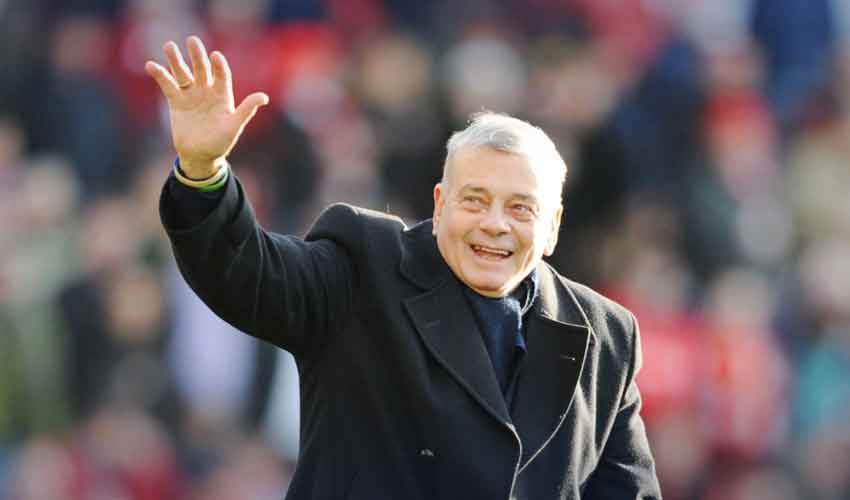
Dickie Bird, the renowned former Test cricket umpire revered throughout the game, has died at the age of 92.
Yorkshire Cricket Club announced the death of Harold Dennis "Dickie" Bird MBE OBE.
“It is with profound sadness that The Yorkshire County Cricket Club announces the passing of Harold Dennis “Dickie” Bird MBE OBE, one of cricket’s most beloved figures, who died peacefully at home at the age of 92.
“The thoughts of everyone at the Yorkshire County Cricket Club are with Dickie’s family and friends during this time. He will be truly missed by all at the club having spent an incredible amount of time in support of everyone here and will be remembered as one the greatest characters in Yorkshire’s history.”
Bird set records for the most Test matches (66) and one-day internationals (69) umpired over a 26-year officiating career, and he became perhaps the most popular official in all sports. His eccentricities contributed to his charm and provided some memorable anecdotes.
According to his close friend, the late journalist and TV host Michael Parkison, “Only Shakespeare could have invented a character so full of life’s rich juices as Dickie Bird. Cricket’s genius has been to accommodate his foibles and celebrate his humour."
Harold Dennis Bird earned the nickname "Dickie" in school, and it stuck with him throughout his life. Bird, the son of a coal miner, grew up in Barnsley and was proud of both his working-class roots and his Yorkshire identity, eventually representing his county. His image is still cast in bronze on a high plinth on Barnsley's Church Lane, where he was born. The statue had to be raised to prevent people from hanging items, often women's underwear, from his outstretched finger.
Bird was a useful player who enjoyed opening the batting, but a persistent knee injury hampered his development. He scored two first-class centuries in 93 matches, including 181 not out against Glamorgan at Bradford in 1959, after filling in as opener for Ken Taylor, who was on international duty with England. Despite his impressive score, Bird lost his spot when Taylor returned.
He never represented his country, but he scored over 3,000 runs at an average of 20.71 for Yorkshire and Leicestershire before spending four years playing for Paignton and coaching at Plymouth College.
At the age of 36, Bird began umpiring. He led his first county game in 1970 and his first Test match three years later, against New Zealand, at Yorkshire's home ground, Headingley.
In 1975, he also umpired the first Cricket World Cup final, which produced one of his most memorable moments. Following the victory, West Indian fans invaded the pitch, and Bird's wide-brim hat was pinched in the melee. A year later, he saw it on the head of a London bus driver.
Bird could be a bowler's nightmare at times, refusing to declare LBW unless absolutely certain. But he had a good sense of humour and a dry wit, and he was respected and liked by everyone in the cricket community. Bird was also a great character, or “barking mad” as Sir Ian Botham described him.
There are numerous stories about Bird's unique approach to his extraordinary life. Bird was so worried about being late for lunch with the cricket-mad prime minister, John Major, that he drove through the night and arrived at Chequers at 7am. Security was perplexed, and Major was still in bed, but he was ushered to breakfast. "We ended up having breakfast and lunch together," Bird explained. "He sends me a lovely card every Christmas."
Bird once said of his approach to umpiring some of the most important matches in world cricket, including three World Cup finals: "I don't care much about the television cameras. I just make my decisions. As I see it. As we see it."
He later remarked, "If I had to describe myself as an umpire, I'd like to say I was honest and fair. I treated everyone on the field as both human beings and professional cricket players. If I had the players' respect, that would be wonderful."
India and England presented Bird with a guard of honour prior to his final Test match in 1996, which moved him to tears. His passion for cricket remained unwavering, and he was honoured to become President of Yorkshire CCC in 2014, describing it as the "greatest cricket club in the world".
His life became intertwined with that of his friend Parkinson. They were both coal miners' sons who played cricket together in Barnsley as children. They remained close throughout their lives, frequently talking for hours on the phone, and they exchanged one final phone call the night before Parkinson died in August 2023.
"We said our goodbyes," Bird told The Telegraph. "We shed some tears. That was more important to me than anything. We had a great friendship... There will never be another Parky. Never. I miss him. He was the best. He was the King."
Bird was deeply religious and went to church on Sundays. He never married and stated, "I've had girlfriends - I'm not ashamed to admit it - and I almost married twice. But I never married because cricket requires you to be away from home all the time. I assumed it would never work. It would have been great to have a lad and watch him play. I overlooked that. However, you cannot have everything. I dedicated myself to cricket, and it has given me a wonderful life."



.gif)
.jpg)