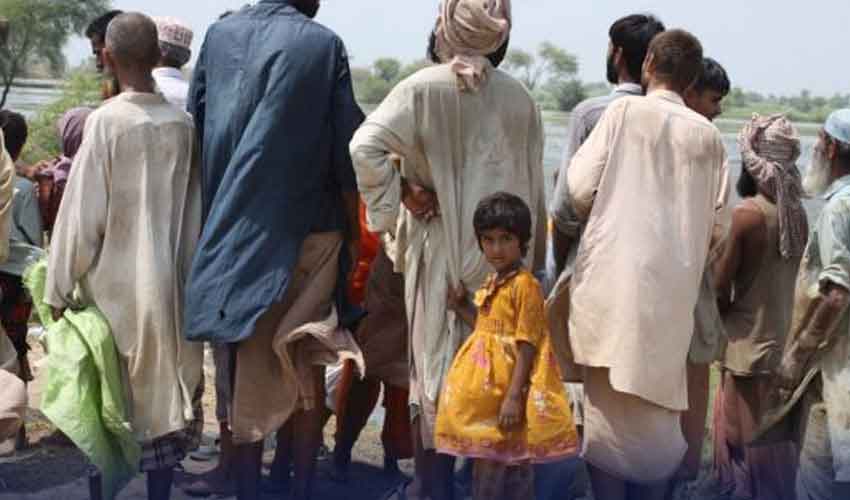
Pakistan’s poverty rate has climbed to 28.9% after seven years, reflecting a 7% increase over the period, Federal Minister for Planning Ahsan Iqbal revealed while releasing the latest poverty statistics.
Addressing a ceremony in Islamabad on Friday, the minister said the upward trend highlights the urgent need for disciplined economic reforms to reverse the decline.
The federal government released updated poverty figures after a gap of seven years. According to Ahsan Iqbal, poverty has increased by 7% during this period, pushing the national poverty rate to 28.9%.
He noted that poverty had declined between 2013 and 2018, but the trend has reversed over the past seven years.
Urban, rural poverty both surge
The data shows a significant rise in poverty in both urban and rural areas. Urban poverty has increased from 11% to 17.4%. In rural areas, poverty has risen from 28.2% to 36.2%.
Ahsan Iqbal said poverty has increased in all four provinces over the last seven years. In Punjab, the rate rose from 16.5% to 23.3%.
In Sindh, it increased from 24.5% to 32.6%. In Khyber Pakhtunkhwa, poverty went up from 28.7% to 35.3%. In Balochistan, which already had the highest rate, poverty climbed from 41.8% to 47%.
Economic inequality widens
The minister said economic inequality has also increased nationwide. According to the data, inequality has risen from 28.4% to 32.7%.
He emphasized that poverty and economic inequality are high in the provinces, despite provinces having three times more development funds than the federal government.
Ahsan Iqbal attributed the rise in poverty to policy inconsistency, the COVID-19 pandemic, and IMF programs. He said inflation, driven largely by the depreciation of the rupee, has “crushed people badly".
The minister added that while implementing the IMF program was necessary to prevent the country from defaulting, it also brought economic pressures.
“If we had not gone to the IMF, the country would have defaulted,” he said, stressing that macroeconomic stability was essential.
Development budgets, responsibilities
The planning minister pointed out that the federal development budget has shrunk significantly. He said provincial governments have a development budget of around Rs3,000 billion, compared to the federation’s Rs1,000 billion.
He added that the federal government has borne a burden of Rs722 billion under the Benazir Income Support Programme (BISP). According to him, eliminating poverty and economic inequality is primarily the responsibility of the provinces.
Disciplined economic agenda
Ahsan Iqbal said that under the “Uraan Pakistan” vision, the reform agenda must be followed with discipline.
“Without this, it is not possible to eliminate poverty,” he stressed.
He said economic stability has now been achieved and the focus must shift toward sustainable development.
“Without macroeconomic stability, poverty does not decrease,” he added, while also stating that there is now a need to move away from dependence on the IMF.
Exports, overseas remittances
Highlighting economic potential, the minister said nine million overseas Pakistanis are sending $40 billion in foreign exchange annually. Meanwhile, the remaining 240 million Pakistanis are exporting goods worth $40 billion each year.
He said Pakistan’s exports should reach $400 billion to truly transform the economy and reduce poverty.


.jpg)