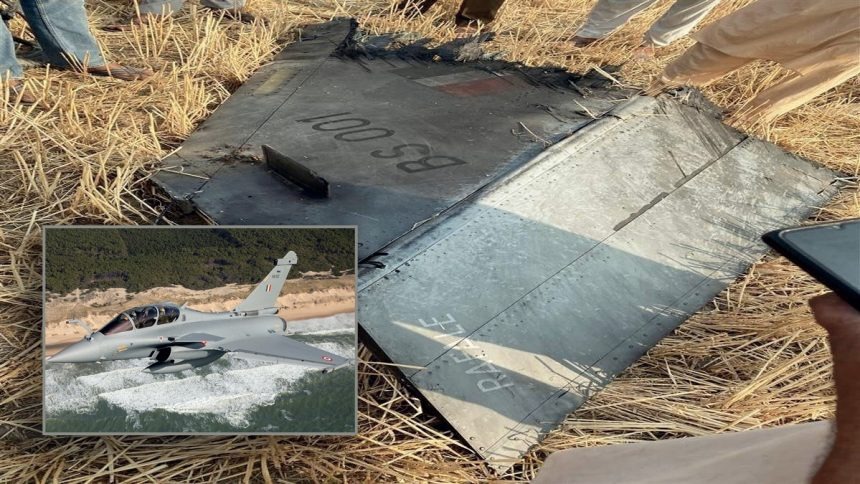
Adviser to the country’s National Command Authority (NCA), retired Lieutenant General Khalid Kidwai claimed that the Pakistan Air Force shot down eight Indian Air Force assets—including four Rafale fighter jets—during the May 2025 hostilities.
Speaking at an event organised by the Islamabad Policy Research Institute (IPRI), Lt Gen Kidwai confirmed that the Pakistan Air Force (PAF) successfully downed seven Indian fighter jets and one drone in an intense one-hour air battle.
He revealed that among the downed aircraft were:
-
Four French-made Rafale fighters (tail numbers: BS001, BS021, BS022, BS027)
-
One Mirage 2000
-
One MiG-29
-
One Su-30
-
One Heron UAV
“This was a technology-driven battle that changed the strategic balance of South Asia for a long time to come,” Kidwai remarked.
According to Kidwai, the dogfight forced the Indian Air Force (IAF) to retreat after losing seven front-line jets, despite having delivered their payloads from within Indian airspace.
India has not released official figures on its losses, but Kidwai stressed that Pakistan’s tally reflects “a clear air superiority established by the PAF.”
Indian response and global reactions
While India has sought to downplay the incident, IAF’s Director General of Air Operations, Air Marshal Awadesh Kumar Bharti, acknowledged in May that “losses are part of combat.”
Defense analysts note that India has maintained a “disjointed and contradictory cover-up,” while international security observers say the numbers reported by Pakistan are consistent with open-source intelligence (OSINT).
Role of Chinese missiles
Pakistani officials disclosed that the IAF jets were shot down with Chinese-made PL-15E long-range missiles, launched from J-10C fighters.
They added that Indian intelligence had underestimated the missile’s range at 150 kilometers, when it actually reaches 200 kilometers, giving PAF pilots a decisive edge.
The operation was further backed by an advanced surveillance network of ground, air, and space-based sensors, linked through Pakistan’s locally developed Data Link 17.