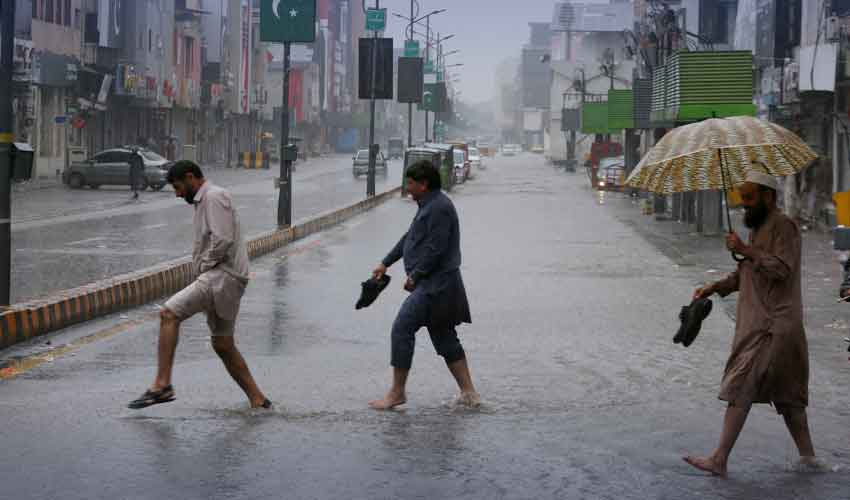
The National Disaster Management Authority (NDMA) has issued a high-alert weather advisory on Thursday, warning citizens across Pakistan to brace for thunderstorms, strong winds, and hailstorms, with the potential for damage to crops, vehicles, and solar panels.
According to the NDMA, a new weather system is sweeping across the country, bringing with it the likelihood of heavy rains and hailstorms in various regions. The authority has urged the public to take precautionary measures and stay updated with local forecasts.
Severe weather expected across key regions
The advisory predicts heavy rain, strong winds, and hail in Islamabad and Rawalpindi by 11pm on Thursday night, with similar conditions expected in parts of Khyber Pakhtunkhwa, north Punjab, and south Punjab.
In Khyber Pakhtunkhwa, districts such as Peshawar, Charsadda, Swabi, and Mardan are likely to experience intense storms accompanied by hail and wind gusts.
Meanwhile, Rahim Yar Khan and Sadiqabad in south Punjab are also predicted to receive possible heavy rain and thunderstorms.
The advisory warns that areas of Azad Jammu and Kashmir, including Muzaffarabad and Neelum Valley, will face thunderstorms and heavy downpours. In the mountainous regions of Gilgit-Baltistan and Azad Kashmir, landslides are possible due to saturated soils and persistent rainfall.
Potential for damage to property and crops
The NDMA cautioned that the severe weather conditions could damage standing crops, vehicles, and solar energy systems. Farmers and rural communities have been advised to secure their fields and equipment, while urban residents are urged to avoid unnecessary travel and stay indoors during peak storm activity.
Also Read: Monsoon 2025: Met Office warns of heavy rains, flood risk
Meanwhile, the director general of the Met Department, Mehr Sahibzad Khan, issued a high-alert advisory on Thursday, warning of an intensified monsoon season this year with above-average rainfall expected across several parts of Pakistan, potentially triggering floods and landslides.
Speaking at a press conference in Islamabad, Khan said that the department was maintaining constant coordination with the National Disaster Management Authority (NDMA) and Provincial Disaster Management Authorities (PDMA) to ensure preparedness for possible extreme weather events.
"Monsoon in Pakistan typically arrives in July-August and continues until mid-October. Based on both local and international indicators, we are forecasting this year's pattern a month in advance to enable timely preparedness,” said Khan.
Above-normal rainfall predicted
The central and southern parts of the country are likely to receive 20% more rainfall than usual, while northeastern Punjab and Kashmir will also experience heavier downpours, which could lead to urban flooding and riverine floods.
In contrast, slightly below-normal rainfall is expected in northern KP and Gilgit-Baltistan, although rising temperatures in these areas could trigger glacial lake outburst floods (GLOFs).
“There is a risk of floods and landslides due to increased rainfall and temperature changes,” Khan cautioned. He urged all stakeholders to stay alert and implement early preparedness measures, especially in low-lying regions of Sindh and upper Khyber Pakhtunkhwa.







.gif)

.jpg)