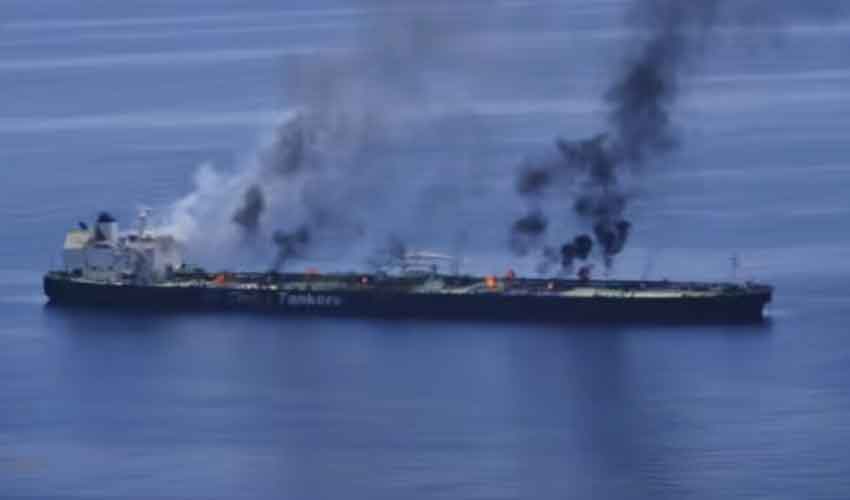
A Saudi-flagged crude oil tanker and a Qatari LNG tanker were damaged near the Strait of Hormuz, maritime security sources said Tuesday. The incidents come amid reports that Iran’s Revolutionary Guards fired missiles at commercial ships in the key waterway.
The Qatari liquefied natural gas tanker Al Rekayyat was struck near the Strait of Hormuz close to the coast of Oman, according to maritime security sources.
The vessel was loaded with LNG and sent distress signals after being hit on its port side.
In a recorded radio call reviewed by Reuters, the captain said: “Mayday, mayday, mayday. This is vessel Al Rekayyat. We are being hit by drone on port side, top of engine room.”
He added that the engine room was on fire and filled with smoke, making it difficult to assess the full damage.
Crew safe as evacuation begins
Sources said the crew of Al Rekayyat were safe and were being evacuated after the attack.
One source said the vessel’s position matched an advisory issued by Britain’s United Kingdom Maritime Trade Operations agency.
UKMTO said a tanker travelling southbound about 8 nautical miles, or 15 kilometres, east of Oman’s Limah was struck on its port side by an unknown projectile, causing a fire.
Saudi supertanker also damaged
A Saudi-flagged crude oil tanker was also damaged near the Strait of Hormuz close to Oman’s coast, maritime security sources said.
The tanker is believed to be the supertanker Wedyan, though the cause of the blast was not immediately known.
Ship-tracking data from MarineTraffic showed Wedyan’s last position inside the Gulf on July 3. The vessel is owned and managed by Saudi shipping firm Bahri.
Al Rekayyat is owned and managed by Nakilat, also known as Qatar Gas Transport Company Ltd, which operates one of the world’s largest LNG shipping fleets.
LSEG shipping data showed the vessel last transmitted its location on June 18, suggesting it had been travelling with its transponders switched off.
Bahri, Nakilat, QatarEnergy, Qatar’s international media office, the Saudi government’s media office and US Central Command did not immediately respond to requests for comment.
First Qatari LNG ship hit in Iran war
The incident marks the first time a Qatari LNG ship has been struck since the Iran war began at the end of February. Qatar has served as a mediator in talks between Washington and Tehran.
During the conflict, Iranian missile attacks had earlier caused extensive damage to Qatar’s LNG facilities.
Axios reported earlier that Iran’s Revolutionary Guards fired at least two missiles at commercial ships transiting through the Strait of Hormuz on Monday night, citing two US officials.
According to the report, two commercial ships suffered significant damage, but no casualties were reported.
The latest incidents have added to fears over safe passage through the narrow waterway between Iran and Oman.
Shipping risks remain high
The Strait of Hormuz remains one of the world’s most important energy routes. Before the conflict, about one-fifth of global oil shipments passed through the waterway.
Despite safe-passage provisions included in an interim agreement between Washington and Tehran, risks to commercial shipping remain high.
One maritime source said ships now face difficult choices over which route to use, with Iranian-controlled waters and the US-Oman channel both carrying risks.
The war has been paused under an interim peace deal reached last month, designed to allow a 60-day window for negotiations on a permanent agreement.
However, indirect talks in Qatar ended last week without any public sign of progress toward lasting peace.
The latest tanker incidents have once again highlighted how fragile the ceasefire remains and how vulnerable global energy shipping is around the Strait of Hormuz.