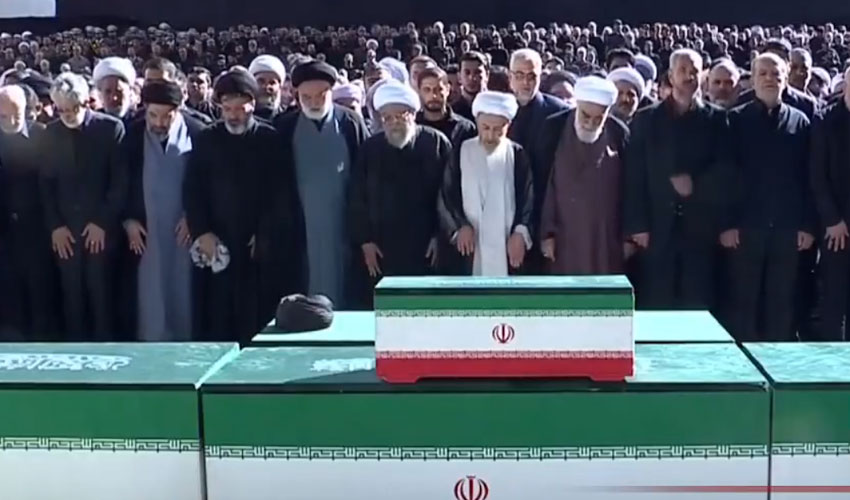
Funeral prayers for Iran’s late Supreme Leader Ayatollah Ali Khamenei were held in Tehran on Sunday, drawing massive crowds as the country entered the second day of nationwide mourning ceremonies.
The prayers were also offered for four members of Khamenei’s family who were killed alongside him, while senior Iranian leaders and officials joined mourners in paying their final respects.
Funeral prayers held at Imam Khomeini Grand Musalla
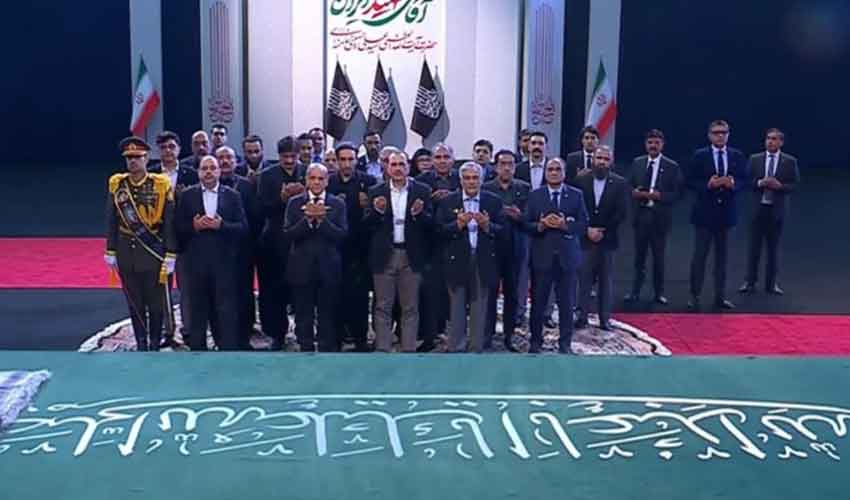
Funeral prayers for Ayatollah Ali Khamenei and four members of his family were held at the Imam Khomeini Grand Musalla in Tehran.
According to Iran’s Tasnim news agency, the prayers took place at the site where Khamenei’s body had been lying in state since Saturday for public mourning and official farewell ceremonies.
The funeral prayer begins for the bodies of the martyred members of the family of the martyred Leader of the Islamic Revolution. pic.twitter.com/bMhwtndyU3
— Tehran Times (@TehranTimes79) July 5, 2026
The funeral prayers were also offered for the martyred Supreme Leader’s daughter, daughter-in-law, son-in-law and great-grandson.
Tasnim reported that the main courtyard of the Musalla reached full capacity hours before the prayers began, highlighting the scale of public participation.
Senior Iranian leadership attends ceremony
Iranian President Masoud Pezeshkian attended the funeral prayers alongside Parliament Speaker Mohammad Baqer Qalibaf.
Foreign Minister Abbas Araqchi and several other senior government officials were also present at the ceremony.
The heads of the three branches of government stand in the front row for the funeral prayer over the sacred body of the martyred Leader of the Revolution and his family. pic.twitter.com/uq4YpS4wAH
— Tehran Times (@TehranTimes79) July 5, 2026
Authorities declared Sunday a public holiday across Iran, enabling citizens from different provinces to travel to Tehran and take part in the mourning events.
Millions gather across Tehran
Large crowds gathered outside the Imam Khomeini Prayer Center as mourners continued to arrive from across the country.
State media and local reports described a deeply emotional atmosphere in the capital, with mourners filling major roads and public spaces around the ceremony venue.
Thousands entered the Grand Musalla complex from the early hours of Saturday, while many others waited outside to pay their respects.
Week-long funeral programme underway
The funeral ceremonies are scheduled to continue over several days and across multiple cities.
Following Sunday’s prayers, funeral processions are planned in Tehran on Monday before moving to the holy city of Qom on Tuesday.
Khamenei’s body is expected to be transferred to Qom on July 7 as part of the official mourning programme.
After events in Iran, the body will be flown to the Iraqi holy cities of Najaf and Karbala for additional funeral rites on July 8.
The cross-border ceremonies reflect Khamenei’s significance for many within the Shia Muslim community and are expected to attract further participation from religious followers and dignitaries.
Burial scheduled in Mashhad
The final stage of the funeral programme will take place in Mashhad, where Ayatollah Ali Khamenei will be buried on July 9.
Authorities have described the farewell ceremonies as one of the largest public mourning events in recent Iranian history, with millions expected to participate throughout the week.
Security tightened around events
A heavy security presence has been deployed around funeral venues in Tehran.
Reports indicated that armoured vehicles, snipers and additional security personnel were stationed near key locations, while mourners underwent security checks before entering the Grand Musalla complex.
Men and women were accommodated in separate sections in line with Islamic customs observed during the ceremonies.
Background to the assassination
Ayatollah Ali Khamenei, who led Iran for nearly 37 years, was killed at the age of 86 in an airstrike at the start of the war involving Iran, the United States and Israel on February 28.
Large-scale commemorations began on Saturday, with red flags associated with martyrdom and remembrance visible throughout gathering sites in Tehran.
Religious chants and slogans echoed across the capital as mourners continued to honour the late Iranian leader.