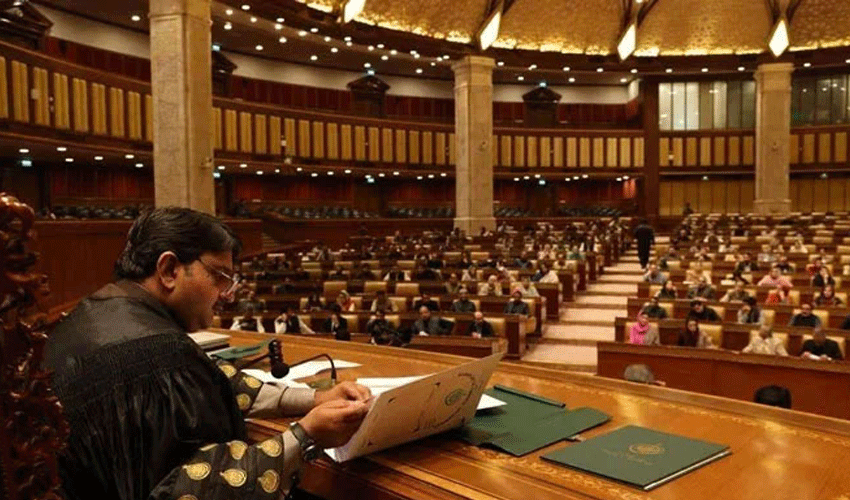
The Punjab government has stopped the Punjab Habitual Offender Bill 2026 after reservations were raised by Speaker Malik Muhammad Ahmed Khan, with Chief Minister Maryam Nawaz ordering the proposed law to be reconsidered.
The bill, presented in the Punjab Assembly by opposition member Rana Aftab Ahmed, will now be sent again to the Standing Committee of the Home Department for constitutional and legal scrutiny.
The proposed legislation regarding habitual criminals was presented in the Punjab Assembly by opposition member Rana Aftab Ahmed.
The bill had been approved by the Punjab Assembly’s Standing Committee on Interior a day earlier, but the government later stopped it after concerns emerged over its legal and constitutional implications.
According to sources, Chief Minister Maryam Nawaz ordered reconsideration of the bill due to the Speaker’s reservations.
Electronic monitoring proposed for habitual offenders
The bill proposed the use of electronic monitoring devices for the first time to monitor habitual criminals.
Under the draft law, people declared habitual offenders could be ordered to wear electronic monitoring devices, allowing authorities to continuously track their movement and activities.
The initial period of electronic surveillance would be three months, with the option to extend it if required. Compliance with the conditions of electronic monitoring devices and bail bonds would be mandatory.
District Intelligence Committee given key role
According to the text of the bill, the District Intelligence Committee would be empowered to declare a person a habitual offender after investigation. The magistrate concerned would issue a supervision order on the recommendation of the District Intelligence Committee.
The magistrate would also have the option to release habitual offenders on bail after submission of bonds.
Anti-social behaviour defined
The draft law included several actions under the category of anti-social behaviour. These included spreading false news on social media, publicizing hate speeches and inflammatory material, blackmailing, issuing threats, displaying weapons and harassing women.
The bill also covered indecent acts, gambling, selling alcohol and preparing fake documents.
Repeat offenders, people involved in organized crime and those linked to anti-social activities could also be declared habitual offenders under the proposed law.
Records, DNA and biometrics to be stored
The bill proposed that regular records of habitual offenders be compiled.
Fingerprints, DNA and biometric information would be stored in a government database, enabling law enforcement agencies to carry out complete profiling of habitual criminals.
The draft legislation proposed extraordinary powers for the District Intelligence Committee. The committee would have the authority to declare a person a habitual offender, freeze bank accounts and recommend blocking passports.
Names of habitual offenders could also be placed on the passport control list. Action against cyber and social media accounts would also be possible under the proposed law.
Composition of District Intelligence Committee
The District Intelligence Committee would be required to hold meetings every month. The divisional commissioner would serve as convener of the committee.
Police officers, representatives of the Special Branch, Counter Terrorism Department and federal intelligence agencies would also be part of the committee.
The decisions of the committee would be considered to have been made in good faith.
Punishment and appeal mechanism
The bill proposed imprisonment of up to three years for violating the law. An aggrieved person would have the right to appeal at the district, divisional and provincial levels.
The affected person could also file an appeal before a tribunal, while appeals against decisions would have to be submitted within 30 days.
Opposition raises rights concerns
Opposition Leader Moin Riaz Qureshi strongly criticized the bill in the House, calling it a violation of fundamental rights. He said the bill went against democratic traditions and would become “the last nail” in the coffin of freedom of expression.
Qureshi said the bill was being brought to suppress people, adding that the PML-N had earlier introduced the NAB law, which later contributed to its own disqualification.
Speaker explains reservations
Speaker Malik Ahmed Khan said he was not aware of the bill when it reached the Assembly after committee referral. He said someone else was presiding over the session on the day the bill was presented, and he was also not present when the committee report was taken up.
The speaker said the bill had come to the House, but the government had not placed it on the agenda, after which Mujtaba Shuja-ur-Rehman was asked to speak.
The speaker said Rana Aftab Ahmed had written him a letter regarding the bill.
Rana Aftab read out the letter in the House, demanding that approval of the bill be stopped and that it be sent to the relevant committee for constitutional and legal scrutiny.
The letter said the bill could pose a threat to citizens’ rights and freedoms. It also said the draft law must be constitutionally reviewed before being approved by the Assembly.
Bill termed threat to rights, transparency
According to the text of Rana Aftab’s letter, the bill raised questions about the transparency of legislation.
The letter said the bill conflicted with constitutional requirements related to fundamental rights and freedom of expression. It further argued that the bill significantly increased the powers of the administration while limiting the authority of the judiciary.
The letter demanded that the bill be fully debated and legal opinion be obtained before it is enacted.
Govt sends bill back for reconsideration
The Punjab government has now stopped the Punjab Habitual Offender Bill 2026 and referred it back to the Home Department’s Standing Committee for reconsideration.
The proposed law had been described as necessary for establishing the writ of the state, protecting public order and introducing a modern surveillance system to curb organized crime.
However, after objections over fundamental rights, freedom of expression and administrative powers, the bill will now undergo further review.