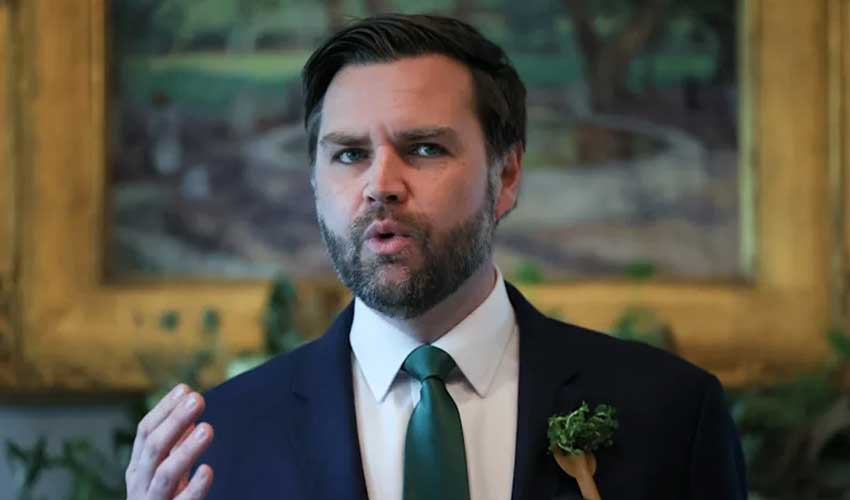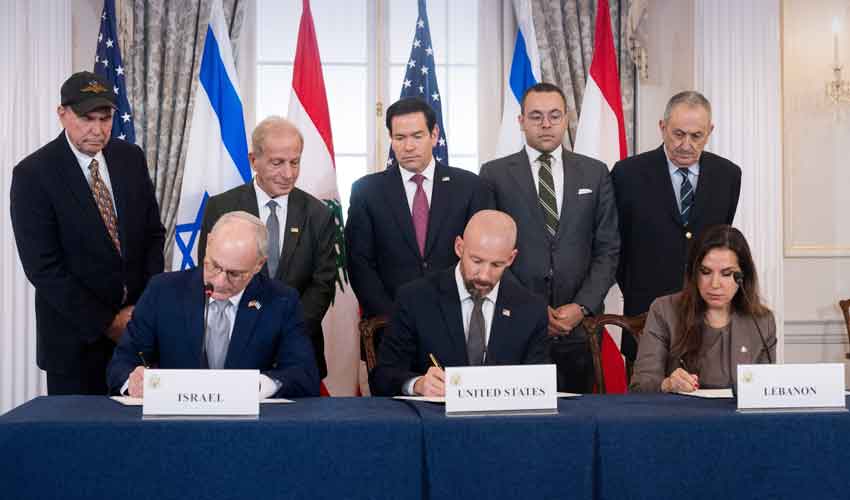
A signing ceremony for a framework agreement between Lebanon and Israel was held in Washington, in which the United States, Lebanon, and Israel took part.
US Secretary of State Marco Rubio said that Lebanon and Israel have reached a framework agreement, expressing hope that it may lead to positive progress towards peace in Lebanon.
He said the United States seeks to ensure that the people of Lebanon and Israel may live in a secure and peaceful future, adding that this is the core purpose of the agreement.
The agreement was formally signed by the United States, Israel, and Lebanon during the ceremony, while further details were not released immediately.
‘Much work remains’
According to Al Jazeera, US Secretary of State Marco Rubio said that although a framework agreement has been signed between Israel and Lebanon, much work remains.
He said, “It is the beginning of the beginning. There is a lot of work ahead. Today is the first step. The first step is sometimes the hardest one.”
The US-mediated framework aims to restore Lebanon's sovereignty, disarm Hezbollah, strengthen the Lebanese army and lay the groundwork for a lasting peace between Israel and Lebanon.
Speaking at the signing ceremony in Washington, Rubio said the agreement establishes a roadmap to restore Lebanon's sovereignty, dismantle Hezbollah's military infrastructure and create conditions for Israel's return to its borders once security threats are removed.
He said the US-mediated agreement is an important step toward achieving long-term peace in the region.
"Today is a good day," Rubio said. "We are happy to announce a framework agreement between the sovereign government of Lebanon and the government of Israel, with the mediation and support of the United States of America that begins to put in place a framework for lasting peace and security."
He added that both nations deserve peace, while acknowledging that significant work remains before the agreement can be fully implemented.
"Today we've taken the first step on what will be a difficult journey, without a doubt, but an important, essential and necessary one," Rubio said.
Ceasefire linked to Hezbollah withdrawal
According to the agreement, a ceasefire between Israel and Lebanon will take effect only after Hezbollah completely halts its military operations and withdraws all its fighters from the South Litani Sector in southern Lebanon.
The State Department said both governments agreed, under US guidance, to quickly establish pilot security zones where the Lebanese Armed Forces will exercise exclusive control over the territory, excluding all non-state armed groups.
US officials said these measures are intended to facilitate progress toward a comprehensive peace and security agreement.
However, Hezbollah was not a party to the agreement, and it remains unclear whether the Iran-backed group will comply with the proposed ceasefire or its disarmament provisions.
Officials noted that reducing hostilities between Israel and Lebanon is considered a key step toward securing a broader and more durable peace arrangement involving the United States and Iran, which supports Hezbollah.
Agreement seeks to restore Lebanon's sovereignty
Rubio said the framework creates a structured process to restore Lebanon's sovereignty while eliminating Hezbollah's military capabilities.
"This agreement establishes a clear and structured process to restore Lebanon's sovereignty, disarm Hezbollah and dismantle its terrorist infrastructure, and enable Israel to return to its borders once that threat to its citizens is removed," he said.
He added that the framework offers Lebanon a genuine opportunity to emerge from years of political and security crises while providing Israel with a verifiable path to removing the security threat along its northern border.
US-backed military coordination group
As part of the agreement, the United States will facilitate the creation of a new trilateral Military Coordination Group for Lebanon (MCG4L).
Rubio said the coordination mechanism will help both countries implement the framework agreement.
It was not immediately clear whether the new group will operate separately from the existing military deconfliction mechanism currently overseen by US Marine Corps Lt. Gen. Joseph Clearfield.
Humanitarian and military assistance
Rubio announced that Washington will immediately provide $100 million in humanitarian assistance for Lebanon in coordination with the United Nations.
He also said the US Department of Defense is prepared to provide more than $30 million to strengthen the Lebanese Armed Forces, helping improve their ability to establish state authority across Lebanese territory and support President Donald Trump's vision for an enduring peace.
The latest Trump administration budget proposal submitted to Congress allocates approximately $36 million for the Lebanese Armed Forces, significantly lower than previous annual allocations that typically ranged between $100 million and $200 million.
While the administration has pursued broader spending cuts, it remains unclear how the reduced funding aligns with its objective of strengthening Lebanon's military so it can effectively disarm Hezbollah.
Rubio reiterated that the agreement represents only the beginning of what is expected to be a lengthy and complex peace process.
He described the framework as an important milestone toward restoring stability, strengthening Lebanon's sovereignty, enhancing regional security and creating the conditions for a lasting peace between Israel and Lebanon.


.jpeg)