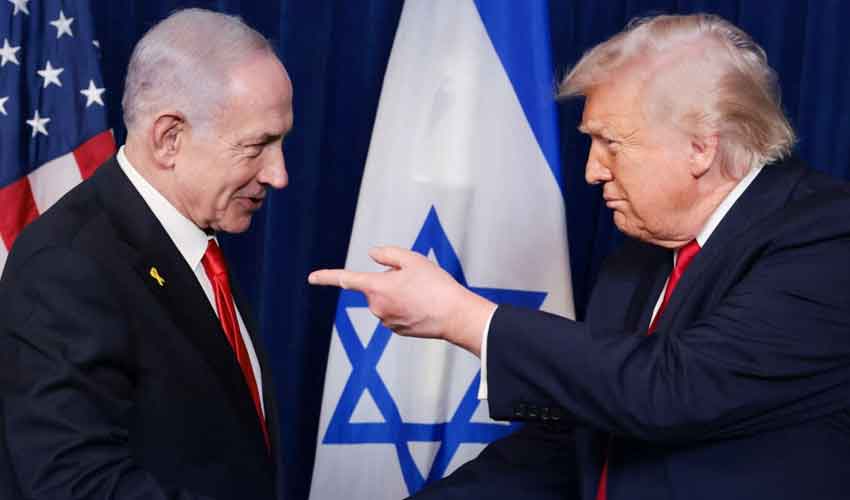
US President Donald Trump told Israeli Prime Minister Benjamin Netanyahu that it was time to end the war with Iran, as Washington moves closer to a possible agreement with Tehran, Axios reported on Saturday.
According to a senior US official cited by Axios, Trump called Netanyahu on Thursday evening and described the potential US-Iran agreement as “a great deal.”
“This is the deal. It’s a great deal, and it’s time to end this war,” Trump told Netanyahu, according to the US official.
Netanyahu reportedly expressed concern that any deal must address Iran’s nuclear program. However, he avoided a significant argument with the US president.
“Bibi probably understood that a deal was about to happen and that he could not stop it,” the official said.
Netanyahu caught off guard
Axios cited a source with direct knowledge of the call who said Netanyahu was caught off guard by the pending US-Iran agreement.
The report said the Israeli prime minister had not been directly involved in the talks and had been contacting his allies in Washington to gather information about the status of negotiations.
Trump’s post on Thursday claiming that a deal had been reached also surprised Netanyahu, according to a source familiar with the matter.
Israel avoids public criticism
Israeli officials are concerned about the contents of the possible agreement but have avoided publicly criticizing it, Axios reported.
A US official said Washington understands Israel’s skepticism, especially because of Hezbollah’s attacks on Israeli civilians.
However, the official said the US expects all sides to participate in the peace process if a broader agreement is reached.
The senior US official said Washington is confident that Israel will eventually “get on board” with the agreement. The official added that once Israel reviews the full terms of the deal, it will understand that Iran must first deliver on its commitments before receiving any benefits.
“We feel like when they see the full terms of the deal, and when they appreciate that fundamentally, that there has to be delivery from the Iranians before we deliver any of the benefits, that they’re comfortable with that,” the official said.
Trump reportedly stops major Israeli strikes
According to Axios, as exchanges with Iran intensified earlier in the week, Netanyahu had planned to launch massive strikes against Iranian energy and infrastructure facilities.
Trump reportedly intervened at the last moment and stopped the Israeli plan.
Since then, Netanyahu has found himself largely outside the main negotiating process, according to a US source with direct knowledge of the matter.
Israel concerned over Iran, Hezbollah
Israeli Defense Minister Israel Katz said on Friday that the pending deal was based on Trump’s “assessment of American interests.”
Katz said Israel expects Trump to uphold shared principles regarding Iran’s nuclear program, missiles and “terrorist proxies.”
He also said Israel reserves the right to act independently to prevent Iran from acquiring a nuclear weapon and would prepare accordingly.
Israeli officials are also concerned that the agreement could limit Israel Defense Forces operations against Hezbollah in Lebanon.
According to the report, Israel fears that if the ceasefire applies to Lebanon, the Trump administration may demand consultations before Israeli strikes and restrict Israel’s freedom of operation.
A senior US official said further Iranian support for Hezbollah would violate the agreement, as would any Hezbollah fire on Israel.
Israeli officials seek clarifications
On Friday morning, after Iranian state media claimed the agreement would provide Iran with billions of dollars immediately, Israeli officials asked the White House for clarification.
US officials reassured Israel that Iranian reports had mischaracterized the agreement.
The US side stressed that economic benefits would only flow to Tehran if Iran meets its obligations under the deal.
Pressure grows on Netanyahu
Axios noted that when Netanyahu went to war alongside Trump, this was not how he had envisioned the conflict ending.
From the beginning, Netanyahu had suggested that the war could push toward regime change in Tehran.
Now, four months before an election, his political rivals are accusing him of turning Israel into a “vassal state” by accepting Trump’s terms for peace.
Deal close but not finalised
Officials in both Washington and Tehran say an agreement is close but has not yet been finalized. Some in Washington believe Netanyahu could still play a disruptive role even if the deal takes hold.
For Netanyahu, accepting a deal to end the war without achieving his stated objectives would be a major strategic and political setback.
Lebanon remains key risk
Events in Lebanon could become one of the main factors that destabilize the deal.
Israeli forces still occupy large parts of southern Lebanon and continue to exchange cross-border strikes with Hezbollah.
The senior US official said that if Hezbollah fires rockets at Israel or Iran continues arming the group, it would run contrary to the agreement.



.jpg)